Wednesday, October 28, 2026
Science
No Result
View All Result
  • Login
  • HOME
  • SCIENCE NEWS
  • CONTACT US
  • HOME
  • SCIENCE NEWS
  • CONTACT US
No Result
View All Result
Scienmag
No Result
View All Result
Home Science News Cancer

Cell stress sensors ATF4 and ATF6 steer how lung cancer cells cope with glucose starvation

October 28, 2026
in Cancer, Medicine
Nathaniel Bowman
By Nathaniel Bowman Scienmag Editorial Profile - Precision Oncology
Reading Time: 3 mins read
0
Cell stress sensors ATF4 and ATF6 steer how lung cancer cells cope with glucose starvation

Cell stress sensors ATF4 and ATF6 steer how lung cancer cells cope with glucose starvation

65
SHARES
587
VIEWS
Share on FacebookShare on Twitter
ADVERTISEMENT

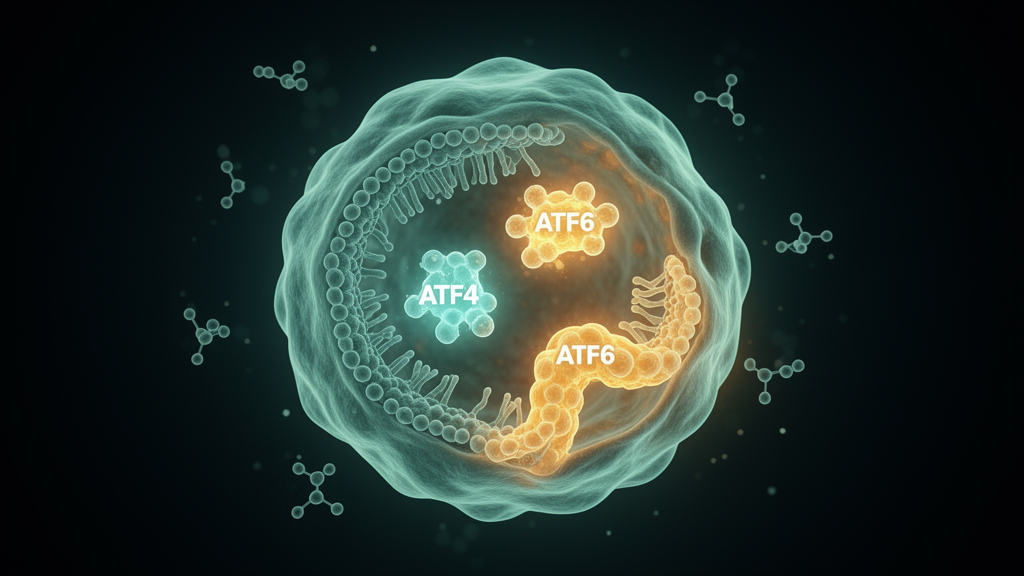
Lung cancer cells facing a shortage of glucose do not simply shut down. According to a new open-access study published in Cancer & Metabolism on 12 October 2026, two stress-activated transcription factors, ATF4 and ATF6, coordinate the transcriptional and metabolic changes that non-small cell lung carcinoma (NSCLC) cells deploy when their sugar supply is cut off.

Tumours often outgrow their local blood vessels, leaving pockets of tissue starved of oxygen and nutrients. The researchers, led by Mabel Cruz-Rodríguez and senior author Cristina Muñoz-Pinedo, set out to map how cells respond transcriptionally to one of those shortages: a lack of glucose.

To do this, the team used RNA sequencing of A549 lung cancer cells kept without glucose, identifying changes in individual genes and in Reactome pathways through gene-set-enrichment analysis. Bioinformatic inference then pointed to ATF4 and ATF6 as the most relevant transcription factors, which the group went on to test by silencing them with siRNA in several NSCLC cell lines.

The sequencing revealed a striking pattern. Multiple pathways related to DNA replication and the cell cycle were downregulated when glucose was withdrawn, while the single most strongly upregulated transcriptional pathway was the Unfolded Protein Response, or UPR, a stress programme previously shown to help cells adapt to proteotoxic and endoplasmic reticulum stress.

Glucose shortage robustly activated all three branches of the UPR across several NSCLC cell lines, the authors report. The evidence included accumulation of ATF4, splicing of XBP1 mRNA, and cleavage of ATF6. In a network analysis, ATF6 and ATF4 emerged as the transcription factors with the highest scores.

The influence of these two factors extended deep into metabolism. Silencing ATF4 or ATF6 with siRNA regulated multiple metabolic genes and pathways, including amino acid synthesis and transport, glycosylation and lipid synthesis. ATF4 silencing also affected the transcriptional induction of mitochondrial OXPHOS-associated pathways. Direct metabolite measurements showed that ATF4 regulates amino acid and citrate levels during glucose deprivation.

Perhaps the most unexpected finding concerns cell fate. Rather than promoting survival, ATF4 contributed to cell death in glucose-starved cells, with only a limited contribution from its target DR5/TRAILR2. Silencing CHOP, DR4 or NOXA did not affect cell death in glucose-starved A549 cells, and silencing or inhibiting other UPR factors, including ATF6 and IRE1/XBP1s, individually or in combination, likewise did not impact survival under glucose deprivation.

The study also uncovered a role for the stress pathway in controlling mTORC1, a central growth-regulating signalling complex. The absence of ATF4, or of its target sestrin 2, prevented the inactivation of mTORC1 that normally occurs when glucose is withdrawn. In contrast, reducing ATF6 enhanced the activation of XBP1 and ATF4 but did not regulate mTORC1 inactivation, indicating that the two transcription factors act through partly separate mechanisms.

The authors conclude that the Unfolded Protein Response is activated upon glucose deprivation and that some of its transcription factors control both the transcriptional and the metabolic responses to glucose shortage. Because the work was carried out in lung cancer cell lines, the findings describe mechanisms observed in cultured cells rather than outcomes in patients. The article was released early as a peer-reviewed, citable accepted manuscript, and the final version of record will replace it after further edits.

Subject of Research: Transcriptional and metabolic responses to glucose deprivation in non-small cell lung carcinoma cells

Article Title: ATF4 and ATF6 orchestrate transcriptional responses to glucose deprivation in NSCLC

Article References: Cruz-Rodríguez, M., Collado-Rodríguez, L., Favaro, F., Hijazo-Pechero, S., Püschel, F., Both, D., Palau-Gallinat, D., Plans-Marin, S., Jiménez-Hernández, F., Tang, M., Moreno-Caceres, J., Chevet, E., Nadal, E., & Muñoz-Pinedo, C. (2026). ATF4 and ATF6 orchestrate transcriptional responses to glucose deprivation in NSCLC. Cancer & Metabolism. https://doi.org/10.1186/s40170-026-00461-2

Image Credits: AI Generated

DOI: 10.1186/s40170-026-00461-2

Keywords: ATF4, ATF6, glucose deprivation, unfolded protein response, NSCLC, mTORC1, metabolism, XBP1, cell death, RNA sequencing, lung cancer, orchestrate

Cite Scienmag News

Nathaniel Bowman. (October 28, 2026). Cell stress sensors ATF4 and ATF6 steer how lung cancer cells cope with glucose starvation. Scienmag. https://scienmag.com/cell-stress-sensors-atf4-and-atf6-steer-how-lung-cancer-cells-cope-with-glucose-starvation/

Nathaniel Bowman. "Cell stress sensors ATF4 and ATF6 steer how lung cancer cells cope with glucose starvation." Scienmag, 28 October 2026, https://scienmag.com/cell-stress-sensors-atf4-and-atf6-steer-how-lung-cancer-cells-cope-with-glucose-starvation/. Accessed 28 October 2026.

Nathaniel Bowman. "Cell stress sensors ATF4 and ATF6 steer how lung cancer cells cope with glucose starvation." Scienmag. October 28, 2026. https://scienmag.com/cell-stress-sensors-atf4-and-atf6-steer-how-lung-cancer-cells-cope-with-glucose-starvation/

Tags: ATF4ATF4 and ATF6 in cancer stress responseATF6cell deathgene-set enrichment analysis in lung cancer stress pathwaysglucose deprivationlung cancerlung cancer cell glucose deprivation responsemetabolic and transcriptional changes in lung cancermetabolismmTORC1non-small cell lung carcinoma metabolic adaptationNSCLCorchestrateRNA sequencingRNA sequencing of lung cancer cells during glucose starvationsilencing ATF4 and ATF6 in lung cancer researchstress-activated transcription factors intranscriptional regulation in cancer under nutrient stresstumor microenvironment nutrient deprivation effectsunfolded protein responseunfolded protein response in cancer cell survivalXBP1
Share26Tweet16
Previous Post

Same Breed Label, Different Genomes: Simulations Reveal Hidden Offspring Risk in Composite Cattle

Next Post

Fluorescence derivatization enables sensitive delafloxacin measurement in drugs and plasma

Related Posts

Cardiovascular disease remains a major burden for people with type 1 diabetes
Medicine

Cardiovascular disease remains a major burden for people with type 1 diabetes

October 28, 2026
From small 1997 initiative to one of Europe’s largest breast imaging societies
Medicine

From small 1997 initiative to one of Europe’s largest breast imaging societies

October 28, 2026
Spiral Phase Masks Turn a Simple Camera into a Five-Dimensional Optical Encoder, Study Shows
Technology and Engineering

Spiral Phase Masks Turn a Simple Camera into a Five-Dimensional Optical Encoder, Study Shows

October 28, 2026
Old Age in Exile: Health, Identity and Strained Family Care Among Elderly Afghan Refugees in Pakistan
Medicine

Old Age in Exile: Health, Identity and Strained Family Care Among Elderly Afghan Refugees in Pakistan

October 28, 2026
Nanoparticle-delivered Pt(IV) prodrug shows boosted killing of cisplatin-tolerant oral cancer cells in 3D models
Cancer

Nanoparticle-delivered Pt(IV) prodrug shows boosted killing of cisplatin-tolerant oral cancer cells in 3D models

October 28, 2026
Rare Ring Chromosome 7 Case Links Severe Hypertriglyceridemia to Genetic Syndrome
Pediatry

Rare Ring Chromosome 7 Case Links Severe Hypertriglyceridemia to Genetic Syndrome

October 28, 2026
Next Post
Fluorescence derivatization enables sensitive delafloxacin measurement in drugs and plasma

Fluorescence derivatization enables sensitive delafloxacin measurement in drugs and plasma

  • Mothers who receive childcare support from maternal grandparents show more optimized

    Mothers who receive childcare support from maternal grandparents show more parental warmth, finds NTU Singapore study

    27656 shares
    Share 11059 Tweet 6912
  • University of Seville Breaks 120-Year-Old Mystery, Revises a Key Einstein Concept

    1061 shares
    Share 424 Tweet 265
  • Bee body mass, pathogens and local climate influence heat tolerance

    682 shares
    Share 273 Tweet 171
  • Researchers record first-ever images and data of a shark experiencing a boat strike

    546 shares
    Share 218 Tweet 137
  • Groundbreaking Clinical Trial Reveals Lubiprostone Enhances Kidney Function

    531 shares
    Share 212 Tweet 133
Science

Embark on a thrilling journey of discovery with Scienmag.com—your ultimate source for cutting-edge breakthroughs. Immerse yourself in a world where curiosity knows no limits and tomorrow’s possibilities become today’s reality!

RECENT NEWS

  • Cardiovascular disease remains a major burden for people with type 1 diabetes
  • Gas outburst risk tamed in China’s Shuidaqiao hydraulic tunnel
  • Excitation Wavelength Steers Green and Red Upconversion Light in Tetra-Doped Y2O3 Phosphors
  • Leather Waste Turned Into a Sunlight-Driven Catalyst That Breaks Down Drug Pollutants

Categories

  • Agriculture
  • Anthropology
  • Archaeology
  • Athmospheric
  • Biology
  • Biotechnology
  • Blog
  • Bussines
  • Cancer
  • Chemistry
  • Climate
  • Earth Science
  • Editorial Policy
  • Marine
  • Mathematics
  • Medicine
  • Pediatry
  • Policy
  • Psychology & Psychiatry
  • Science Education
  • Science News
  • Social Science
  • Space
  • Technology and Engineering

Subscribe to Blog via Email

Enter your email address to subscribe to this blog and receive notifications of new posts by email.

Join 5,151 other subscribers

© 2025 Scienmag - Science Magazine

Welcome Back!

Login to your account below

Forgotten Password?

Retrieve your password

Please enter your username or email address to reset your password.

Log In
No Result
View All Result
  • HOME
  • SCIENCE NEWS
  • CONTACT US

© 2025 Scienmag - Science Magazine

Discover more from Science

Subscribe now to keep reading and get access to the full archive.

Continue reading