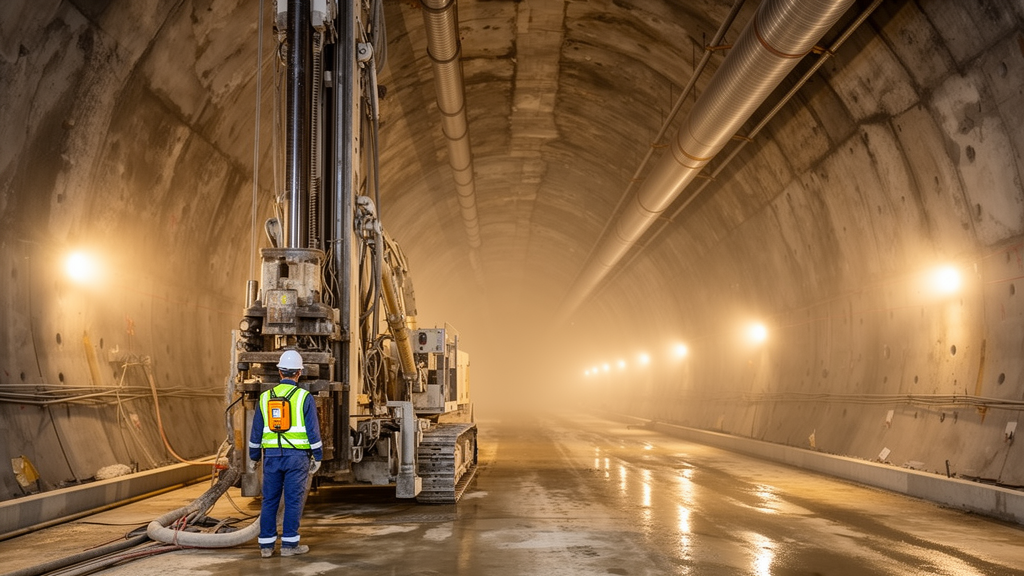
Engineers driving a 20-kilometre water conveyance tunnel through the coal-bearing hills of Guizhou Province, China, have documented in detail how they assessed and controlled one of underground construction’s most violent hazards: the coal-and-gas outburst.
Coal-and-gas outbursts are dynamic disasters in which large quantities of gas and coal dust are ejected suddenly from a working face, often causing casualties and economic losses. The first recorded outburst occurred at Isaac Colliery in the Rouaire Coalfield, France, in 1834, and the phenomenon has been studied extensively since, particularly in coal mining. The authors note that while outburst prevention in mines is comparatively mature, gas disaster prevention in hydropower tunnels has seen limited breakthroughs, and gas accidents in tunnel excavation differ from mine gas disasters in mechanism, development and characteristics. Because research on tunnel-specific mechanisms, control technologies and standards is extremely limited, current practice largely borrows from coal industry codes.
The Shuidaqiao Tunnel’s high-gas section extends from the inlet to chainage K1 + 410, with the outburst-prone section lying between K1 + 410 and K1 + 600. Strata at the heading face belong to the Upper Permian Longtan Formation, consisting of interbedded mudstone, sandstone and coal seams, with surrounding rock classified as Class V. The coal-bearing strata in the tunnel area range from about 201.02 to 233.17 metres thick, averaging 212.13 metres, and contain 12 coal seams numbered from top to bottom. Four of these, including the No. 6 Middle seam, are mineable. The No. 6 Middle Coal Seam varies from 0.69 to 6.13 metres in thickness and comprises high-quality anthracite that ranges from easily self-igniting to not easily self-igniting and presents no coal dust explosion hazard.
In September 2017, a professional organisation evaluated the seam and concluded that the observed gas dynamic phenomenon qualified as a coal-and-gas outburst and that the No. 6 Middle Coal Seam was prone to outbursts, classifying the tunnel as an outburst tunnel. To quantify the degree of risk, the researchers measured key parameters through in-situ and laboratory experiments and compared them with critical values in China’s Identification Regulation for Coal and Gas Outburst Mines (AQ1024-2006). Direct pressure measurements in three test holes using an M-II type instrument gave a representative gas pressure of 0.84 megapascals for the seam.
Gas content measurements told a similar story. A two-hour on-site desorption test conducted according to the MT/T77-94 standard, followed by laboratory analysis of residual gas, yielded gas contents ranging from 15.50 to 25.83 millilitres per gram, averaging 21.45 millilitres per gram across the area, indicating a high-gas coal seam. Direct measurement with a DGC device on samples from two drill holes gave an original gas content of 14.778 cubic metres per tonne. The gas content gradient showed an increase of 10.04 millilitres per gram for every 100 metres of additional burial depth on a dry ash-free basis. The seam’s normal gas composition includes more than 80 percent methane and less than 20 percent carbon dioxide, placing it in the methane zone.
Physical characterisation of the coal reinforced the hazard picture. Samples displayed a semi-bright and semi-dark luster with irregular, discontinuous joints and a friable texture that broke easily into fragments grindable into powder, leading to a Type IV crushed-coal classification. The consistency coefficient, measured with the standard drop-hammer method and adjusted for the soft coal’s small particle size, came to 0.278 when the minimum value across measurement points was taken as the regulation requires. The initial speed of methane emission, measured with a WT-1 instrument and taken as the maximum across points, reached 41.0 millimetres of mercury. Premonitory signs during probe drilling, including drill sticking, rod jamming and spouting from boreholes, were also observed.
Both assessment approaches pointed the same way. Under single-indicator analysis, the damage type, gas pressure, consistency coefficient and initial gas emission velocity all reached or exceeded critical values in the regulation, and the measured indicators fell within the dangerous ranges of China’s Regional Prediction Methods for Coal and Gas Outburst Danger (GB/T 25216-2024) and the Regulations on Prevention and Control of Coal and Gas Outburst (2019). The comprehensive D and K combined-index method, in which exceeding either index marks an area as outburst-prone, gave D = 0.272 and K = 147.48 for the seam at an average depth of 212.13 metres, both above their critical thresholds. The authors caution that single-index predictions often fail to fully reflect outburst risk, which is why multi-indicator judgment is favoured.
The precautionary plan that followed combined five elements: advanced geological prediction, a grouting cut-off wall, gas pre-drainage, grouting sealing and effectiveness verification, implemented in 25-metre segments with 5-metre overlaps between adjacent segments. Advanced horizontal drilling, 94 millimetres in diameter and 93.7 metres deep, mapped the strata ahead of the face; gas emanating from the drill rods reached concentrations above 40 percent, with a maximum of 56 percent, accompanied by hole spouting and frequent small coal bursts. A full-section cut-off wall of C20 concrete, 1.5 metres thick, was anchored to the initial support with 3-metre bolts at 0.5-metre spacing. Each excavation cycle began with outburst risk prediction using the drill cuttings method, measuring the gas desorption index K1 and drill cuttings quantity S in three 42-millimetre, 30-metre-deep holes; excavation could proceed only when K1 stayed below 0.5 millilitres per gram per minute to the half power for dry coal or 0.4 for wet coal, S stayed below 6 kilograms per metre, and no other anomalies appeared.
Gas pre-drainage continued until concentration fell below 10 percent and pressure below 0.2 megapascals, after which the coal seam ahead was consolidated by compaction grouting with ordinary Portland cement slurry of grade 42.5 or higher at a water-cement ratio of 0.6, in 5-metre segments with pressures rising from 0.3 to 1.5 megapascals. Grouting was deemed complete when injection fell to no more than 1 litre per minute and continued for another 30 minutes. Inspection holes then verified effectiveness through the same K1 and S criteria, with the cycle repeating until the face was confirmed free of outburst risk. On site, the team installed 15 gas probes, an over-limit alarm system triggering automatically at 0.5 percent concentration and power cut-off at 0.75 percent, and two ventilators totalling 370 kilowatts running continuously for 24-hour ventilation.
The outcome, the authors report, was that the highest gas concentration measured at the heading face was 0.46 percent, below the 0.5 percent threshold that Guizhou Province classifies as a general gas over-limit, and no further gas over-limit or outburst phenomena occurred until tunnel breakthrough. They present this as evidence that the one-stop measure is scientific and feasible for this case, and the integrated method was recognised as a provincial-level construction method in Guizhou for 2020-2021. The team also weighs the specific advantages of hydraulic tunnel environments, including easier equipment transport, better personnel coordination, more stable load-bearing structures and larger operational areas, against challenges such as limited specialised equipment, constrained schedules, elevated waterproofing requirements and insufficient technical expertise. They emphasise that the parameters were tailored to the Shuidaqiao Tunnel’s conditions, that coal industry standards still had to be relied upon given the scarcity of tunnel-specific rules, and that the limitations and generalisability of the measures require further validation through additional engineering cases before broader adoption.
Subject of Research: Risk analysis and prevention of coal-and-gas outbursts during construction of a hydraulic tunnel crossing a coal seam in Guizhou, China
Article Title: Research on risk analysis and precautionary measures of coal-and-gas outbursts in hydraulic tunnels
Article References: Dong, H., Zhang, Z., Zhang, Z., Yang, H., Jing, W., Huang, Z., & Song, Z. (2026). Research on risk analysis and precautionary measures of coal-and-gas outbursts in hydraulic tunnels. Geohazards & Remediation, 1(1), Article 8. https://doi.org/10.1007/s44517-026-00008-8
Image Credits: AI Generated
DOI: 10.1007/s44517-026-00008-8
Keywords: coal-and-gas outburst, hydraulic tunnel, Shuidaqiao Tunnel, Guizhou, gas pre-drainage, grouting cut-off wall, gas pressure, outburst risk prediction, D and K indices, tunnel construction safety, methane emission, advanced geological prediction
Cite Scienmag News
Violet Maxwell. (October 28, 2026). Gas outburst risk tamed in China’s Shuidaqiao hydraulic tunnel. Scienmag. https://scienmag.com/gas-outburst-risk-tamed-in-chinas-shuidaqiao-hydraulic-tunnel/
Violet Maxwell. "Gas outburst risk tamed in China’s Shuidaqiao hydraulic tunnel." Scienmag, 28 October 2026, https://scienmag.com/gas-outburst-risk-tamed-in-chinas-shuidaqiao-hydraulic-tunnel/. Accessed 28 October 2026.
Violet Maxwell. "Gas outburst risk tamed in China’s Shuidaqiao hydraulic tunnel." Scienmag. October 28, 2026. https://scienmag.com/gas-outburst-risk-tamed-in-chinas-shuidaqiao-hydraulic-tunnel/