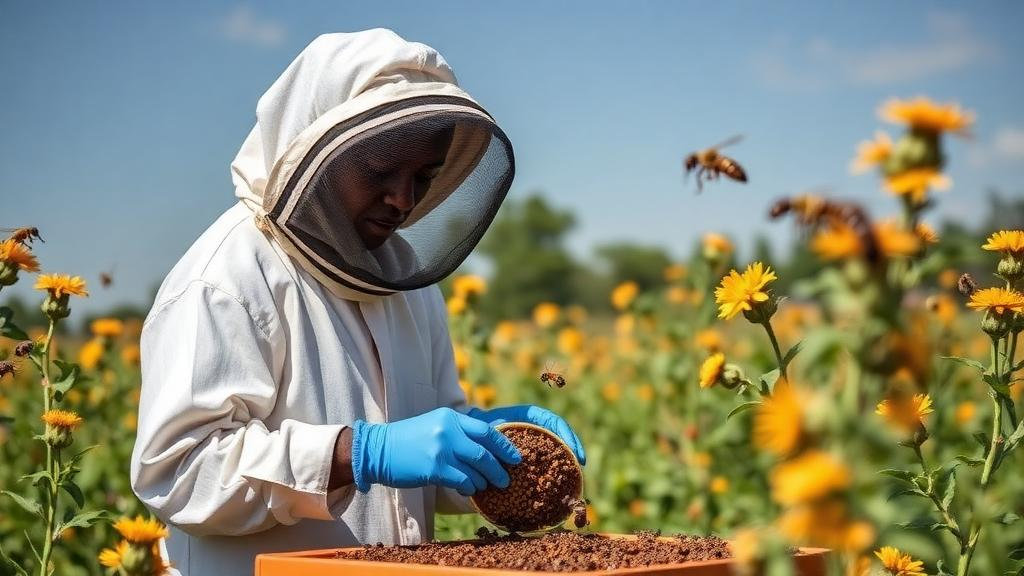
Beekeepers in Meru District, northern Tanzania, know their flowers remarkably well. A new survey of 240 beekeepers across the district’s upper, middle and lower ecological zones found that 97.9 percent could identify the plants their bees rely on for nectar and pollen, collectively naming 24 distinct bee flora species. Yet the same study, published in Discover Environment, reveals a striking gap between what these beekeepers know and what they do: despite strong local ecological knowledge, beekeeping in the district remains largely traditional, with limited adoption of modern processing, quality control and market-oriented practices that could lift both honey quality and rural incomes.
The respondents were overwhelmingly male, at 87.9 percent, and skewed older: nearly half, 49.6 percent, were aged 46 to 59, and a further 22.5 percent were 60 or above. Primary education was the most common schooling level, reported by 69.5 percent. Traditional hives dominated production, used by 62.5 percent of beekeepers, while only 32.5 percent had received any beekeeping training and just 18.8 percent belonged to a beekeeping association such as the Mali Hai club or Meru Natural Honey. This demographic profile, the authors note, mirrors patterns elsewhere in Tanzania and Africa, where beekeeping is traditionally a male activity shaped by cultural norms, labor demands and land ownership structures.
Knowledge of bee flora was both widespread and consistent. Less commonly recognized were Callistemon citrinus, Lippia species, Syzygium cumini and tamarind. The authors argue this shared knowledge base is a valuable entry point for promoting bee-flora conservation and improving apiary management in the district.
Perceptions of honey quality were strongly tied to floral diversity. A large majority, 81.2 percent, believed that the diversity of bee flora influences honey quality, and an even higher proportion, 97.1 percent, considered honey from multiple floral sources better than honey from a single nectar source. Some 87.1 percent viewed conserving bee flora as important for beekeeping success. When asked how they actually recognize good honey, however, beekeepers leaned on the senses: taste was the most cited indicator at 72.5 percent, followed by color at 57.9 percent, while viscosity was mentioned by only 19.6 percent. The authors caution that sensory evaluation alone cannot reliably detect adulteration, overheating, high moisture content or poor storage, all of which matter for formal markets and certification systems.
Management practices told a more cautious story. Only 2.9 percent of respondents practiced migratory beekeeping, and just 17.1 percent cultivated bee flora, even though most valued its conservation. Apiary-site selection was guided mainly by bee flora availability, cited by 75 percent of beekeepers, and secondarily by water availability at 36.2 percent, indicating ecological awareness but also a narrower set of criteria than recommended best practice, which would add shelter from wind, accessibility, security, distance from pesticide-treated farms and disturbance levels. Interestingly, bee-flora cultivation was strongly associated with education and age, with lower adoption among older and less educated respondents, but not with gender.
Post-harvest handling emerged as a key vulnerability. Adulteration was the threat most frequently identified, named by 64.6 percent of respondents, while equipment cleanliness, harvest maturity and storage conditions were each mentioned by only about one in ten. At the same time, 85.4 percent of beekeepers reported using previously used storage containers, and among those who process honey, 87.5 percent relied on traditional or local methods rather than modern ones. The researchers flag these practices as potential post-harvest quality risks, since reused containers and informal processing can increase contamination, moisture absorption and fermentation, undermining consumer confidence and access to higher-value markets. The most commonly reported contamination-prevention measure was the use of sterile or clean equipment during harvesting, at 74.2 percent, followed by storage in a dry place away from sunlight.
Training stood out as the factor most clearly linked to better practice. Beekeepers who had received training were significantly more likely to label and process their honey, with processing methods showing a strong statistical association with training status. Key informants reinforced this picture, describing uneven awareness of formal quality standards: some spoke confidently of moisture limits, noting that honey should not exceed 20 percent water content, while others simply reported having no knowledge of formal standards. Value addition and branding were also inconsistent, with some actors using packaging, labelling, social networks and websites while others reported no value addition or marketing strategy at all. Some informants described government programs that had supplied training, beehives and honey-processing machines, while others sold honey locally with no institutional support whatsoever.
Challenges were dominated by biology and equipment. Honeybee pests were the most frequently reported problem at 48.1 percent, followed by lack of modern beekeeping equipment at 14.6 percent, disturbances from people or animals at 14.1 percent, inadequate training at 11.9 percent and theft of hives or honey at 9.7 percent. Drought and pesticide application were reported less often, and a notable 22.9 percent of respondents said they faced no challenges at all. Key informants added market-side constraints, including weak networks, low production linked to colony losses, poor packaging facilities and seasonal price swings, with one informant reporting that a litre of honey could fetch anywhere from 13,000 to 17,000 Tanzanian shillings depending on the season and production rate.
The broader context gives these findings weight. Tanzania’s natural forests and diverse vegetation support an estimated potential honey production exceeding 130,000 tons annually, yet less than 30 percent of that potential is realized, largely because of reliance on traditional practices, limited technical knowledge and inadequate bee-flora management. The authors conclude that strengthening training, quality control, bee-flora conservation and market linkages could improve honey quality management and market competitiveness in Meru District. Their recommendations include extension programs that reach older and less educated beekeepers, practical instruction in quality standards, hygienic storage, moisture control, labelling and branding, improved access to processing equipment, and stronger market information systems so beekeepers can respond to seasonal price variation.
Subject of Research: Local ecological knowledge, beekeeping practices and market factors related to perceived honey quality in Meru District, Tanzania
Article Title: Local ecological knowledge, beekeeping practices and market factors related to perceived honey quality and sustainable beekeeping in Meru District, Tanzania
Article References: Mulokozi, V. S., Moyo, F., Kessy, S., & Hezron, E. (2026). Local ecological knowledge, beekeeping practices and market factors related to perceived honey quality and sustainable beekeeping in Meru District, Tanzania. Discover Environment, 4(1), Article 597. https://doi.org/10.1007/s44274-026-01142-z
Image Credits: AI Generated
DOI: 10.1007/s44274-026-01142-z
Keywords: beekeeping, honey quality, Tanzania, local ecological knowledge, bee flora, Meru District, traditional hives, adulteration, post-harvest handling, market barriers, floral diversity, beekeeper training
Cite Scienmag News
Violet Maxwell. (October 28, 2026). Tanzanian Beekeepers Hold Deep Knowledge of Bee Flora but Traditional Practices Limit Honey Quality. Scienmag. https://scienmag.com/tanzanian-beekeepers-hold-deep-knowledge-of-bee-flora-but-traditional-practices-limit-honey-quality/
Violet Maxwell. "Tanzanian Beekeepers Hold Deep Knowledge of Bee Flora but Traditional Practices Limit Honey Quality." Scienmag, 28 October 2026, https://scienmag.com/tanzanian-beekeepers-hold-deep-knowledge-of-bee-flora-but-traditional-practices-limit-honey-quality/. Accessed 28 October 2026.
Violet Maxwell. "Tanzanian Beekeepers Hold Deep Knowledge of Bee Flora but Traditional Practices Limit Honey Quality." Scienmag. October 28, 2026. https://scienmag.com/tanzanian-beekeepers-hold-deep-knowledge-of-bee-flora-but-traditional-practices-limit-honey-quality/