Thursday, October 29, 2026
Science
No Result
View All Result
  • Login
  • HOME
  • SCIENCE NEWS
  • CONTACT US
  • HOME
  • SCIENCE NEWS
  • CONTACT US
No Result
View All Result
Scienmag
No Result
View All Result
Home Science News Earth Science

Deep neural network maps minerals in petrographic thin sections with high accuracy

October 28, 2026
in Earth Science, Technology and Engineering
Blake Davidson
By Blake Davidson Scienmag Editorial Profile - Data Science
Reading Time: 2 mins read
0
Deep neural network maps minerals in petrographic thin sections with high accuracy

Deep neural network maps minerals in petrographic thin sections with high accuracy

65
SHARES
587
VIEWS
Share on FacebookShare on Twitter
ADVERTISEMENT

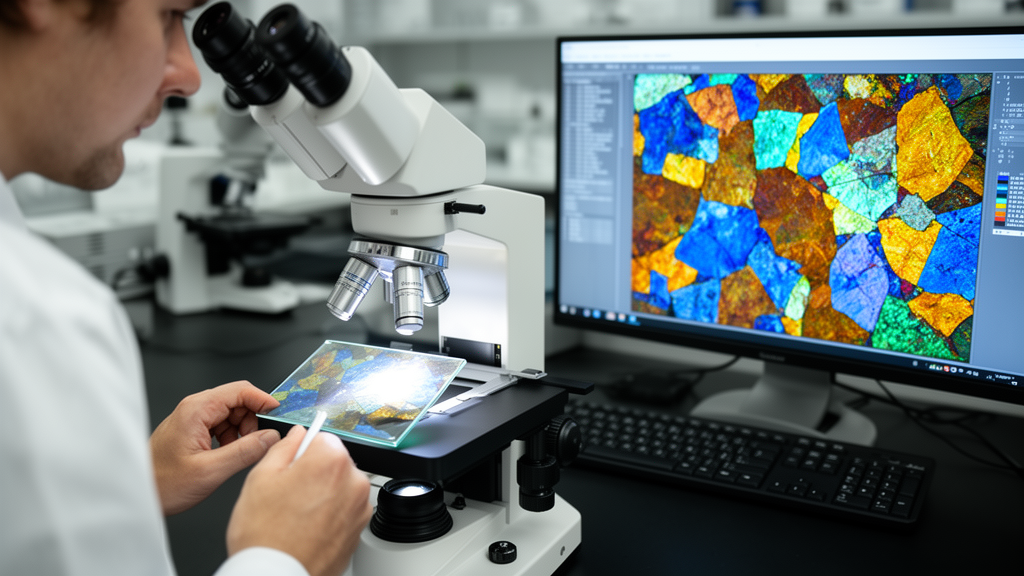
Identifying minerals in petrographic thin sections has long been a slow, manual task performed by geoscientists peering through optical microscopes. A new study published in Earth Science Informatics on 8 October 2026 reports a deep learning approach that automates this process, using a ResNeXt101-UNet architecture to perform semantic segmentation of minerals directly in thin section images. The work, led by Noureldin Laban, Safaa M. Hassan, Hind H. Zeyada and Mohamed R. Metwalli, with colleagues including Mabrouk Sami, Abdullah Alohali, Suhail S. Alhejji, Ioan V. Sanislav and Saif M. Abo Khashaba, targets eleven semantic classes: ten distinct mineral phases and one background class.

The ten mineral phases covered by the model are biotite, chlorite, K-feldspar, muscovite, olivine, plagioclase, quartz, serpentine, talc and titanite, a set chosen to represent diverse silicate and phyllosilicate minerals commonly found in basement rocks. The architecture combines ResNeXt101 as an encoder, which extracts feature representations from the images, with a U-Net decoder that provides the spatial precision needed to trace mineral boundaries.

The quantitative results come from evaluation over 4,440,900 annotated test pixels. The ResNeXt101-UNet reached macro-averaged precision, recall and F1-score of 0.842, 0.811 and 0.813 respectively, and weighted-averaged values of 0.874, 0.860 and 0.863. In benchmark comparisons, the model outperformed both a baseline U-Net and a ResNet-UNet across multiple segmentation metrics, with the largest advantages appearing in handling mineralogical heterogeneity and subtle textural variations within the thin sections.

Performance varied considerably across mineral classes. The model was most accurate for optically distinctive phases: olivine achieved an F1-score of 0.95, serpentine 0.91 and biotite 0.90. At the other end of the scale, the background class scored an F1 of just 0.44, and sparsely represented accessory minerals such as titanite (0.76) and chlorite (0.78) also lagged behind. The authors identify these weakly represented classes as the principal sources of error in the segmentation output, a pattern consistent with the difficulty of learning from fewer annotated examples of rare phases.

The study’s authors argue that these results highlight the potential of advanced deep learning frameworks to support and accelerate petrographic analysis with high accuracy and reliability. Because the model was evaluated on a large annotated test set spanning common rock-forming minerals as well as minor accessory phases, the reported scores offer a detailed picture of where automated mineral mapping currently succeeds and where it still struggles. The full article, published in Volume 19 of Earth Science Informatics as article number 226, is available from Springer, with access provided through institutional subscription or purchase.

Subject of Research: Deep learning-based semantic segmentation of minerals in petrographic thin sections for automated mineral mapping

Article Title: Semantic segmentation of petrographic thin sections using deep neural networks for automated mineral mapping

Article References: Laban, N., Hassan, S. M., Zeyada, H. H., Metwalli, M. R., Sami, M., Alohali, A., Alhejji, S. S., Sanislav, I. V., & Abo Khashaba, S. M. (2026). Semantic segmentation of petrographic thin sections using deep neural networks for automated mineral mapping. Earth Science Informatics, 19(12), Article 226. https://doi.org/10.1007/s12145-026-02269-6

Image Credits: AI Generated

DOI: 10.1007/s12145-026-02269-6

Keywords: semantic segmentation, petrographic thin sections, deep learning, ResNeXt101-UNet, mineral mapping, geosciences, optical microscopy, U-Net, basement rocks, image segmentation, Semantic, segmentation

Cite Scienmag News

Blake Davidson. (October 28, 2026). Deep neural network maps minerals in petrographic thin sections with high accuracy. Scienmag. https://scienmag.com/deep-neural-network-maps-minerals-in-petrographic-thin-sections-with-high-accuracy/

Blake Davidson. "Deep neural network maps minerals in petrographic thin sections with high accuracy." Scienmag, 28 October 2026, https://scienmag.com/deep-neural-network-maps-minerals-in-petrographic-thin-sections-with-high-accuracy/. Accessed 29 October 2026.

Blake Davidson. "Deep neural network maps minerals in petrographic thin sections with high accuracy." Scienmag. October 28, 2026. https://scienmag.com/deep-neural-network-maps-minerals-in-petrographic-thin-sections-with-high-accuracy/

Tags: AI-driven petrography toolsautomated mineral classification in microscopybasement rockscomputational mineralogy using deep learningdeep learningDeep learning mineral identification in petrographic thin sectionsgeoscienceshigh-accuracy deep neural networks for petrologyimage analysis of basement rocksimage segmentationmachine learning in geoscience imagingmineral boundary tracing using deep neural networksmineral mappingmineral phase detection in thin section imagesoptical microscopypetrographic thin sectionsquantitative evaluation of mineral segmentation modelsResNeXt101-UNetResNeXt101-UNet architecture for mineral mappingsegmentationSemanticsemantic segmentationsemantic segmentation of geological imagesU-Net
Share26Tweet16
Previous Post

Animal markets linked to higher viral diversity and virus–host connectivity

Next Post

Popular endurance models fail to predict runners’ interval performance, study finds

Related Posts

Successive soybean plantings reshape soil microbiomes to suppress cyst nematode
Biology

Successive soybean plantings reshape soil microbiomes to suppress cyst nematode

October 29, 2026
New AI Model Learns a Generative Map of EEG Microstates While Preserving Their Spatial Shape
Medicine

New AI Model Learns a Generative Map of EEG Microstates While Preserving Their Spatial Shape

October 29, 2026
Ozone, catalysts and hydrogen peroxide: what really drives dye wastewater treatment
Chemistry

Ozone, catalysts and hydrogen peroxide: what really drives dye wastewater treatment

October 29, 2026
Laser-Made Gold Nanoparticles Kill Cancer Cells in the Lab, With the Right Liquid Making All the Difference
Technology and Engineering

Laser-Made Gold Nanoparticles Kill Cancer Cells in the Lab, With the Right Liquid Making All the Difference

October 29, 2026
Improved Particle Swarm Optimization and Stacking Learning Target Power Grid Load Outliers
Technology and Engineering

Improved Particle Swarm Optimization and Stacking Learning Target Power Grid Load Outliers

October 29, 2026
Support Hubs Help New Researchers Break Through Bottlenecks at Big Science Facilities
Technology and Engineering

Support Hubs Help New Researchers Break Through Bottlenecks at Big Science Facilities

October 29, 2026
Next Post
Popular endurance models fail to predict runners’ interval performance, study finds

Popular endurance models fail to predict runners' interval performance, study finds

  • Mothers who receive childcare support from maternal grandparents show more optimized

    Mothers who receive childcare support from maternal grandparents show more parental warmth, finds NTU Singapore study

    27656 shares
    Share 11059 Tweet 6912
  • University of Seville Breaks 120-Year-Old Mystery, Revises a Key Einstein Concept

    1061 shares
    Share 424 Tweet 265
  • Bee body mass, pathogens and local climate influence heat tolerance

    682 shares
    Share 273 Tweet 171
  • Researchers record first-ever images and data of a shark experiencing a boat strike

    546 shares
    Share 218 Tweet 137
  • Groundbreaking Clinical Trial Reveals Lubiprostone Enhances Kidney Function

    531 shares
    Share 212 Tweet 133
Science

Embark on a thrilling journey of discovery with Scienmag.com—your ultimate source for cutting-edge breakthroughs. Immerse yourself in a world where curiosity knows no limits and tomorrow’s possibilities become today’s reality!

RECENT NEWS

  • Silenced Gene PRSS33 Reactivates Antitumor Immunity in Myelodysplastic Syndromes
  • REM Sleep Deprivation in Rats Tied to Manic- and OCD-Like Behaviors and Hippocampal Gene Changes
  • Research report: Nursing as a systems profession in One Health: opportunities across the Quadripartite action tracks
  • Successive soybean plantings reshape soil microbiomes to suppress cyst nematode

Categories

  • Agriculture
  • Anthropology
  • Archaeology
  • Athmospheric
  • Biology
  • Biotechnology
  • Blog
  • Bussines
  • Cancer
  • Chemistry
  • Climate
  • Earth Science
  • Editorial Policy
  • Marine
  • Mathematics
  • Medicine
  • Pediatry
  • Policy
  • Psychology & Psychiatry
  • Science Education
  • Science News
  • Social Science
  • Space
  • Technology and Engineering

Subscribe to Blog via Email

Enter your email address to subscribe to this blog and receive notifications of new posts by email.

Join 5,151 other subscribers

© 2025 Scienmag - Science Magazine

Welcome Back!

Login to your account below

Forgotten Password?

Retrieve your password

Please enter your username or email address to reset your password.

Log In
No Result
View All Result
  • HOME
  • SCIENCE NEWS
  • CONTACT US

© 2025 Scienmag - Science Magazine

Discover more from Science

Subscribe now to keep reading and get access to the full archive.

Continue reading