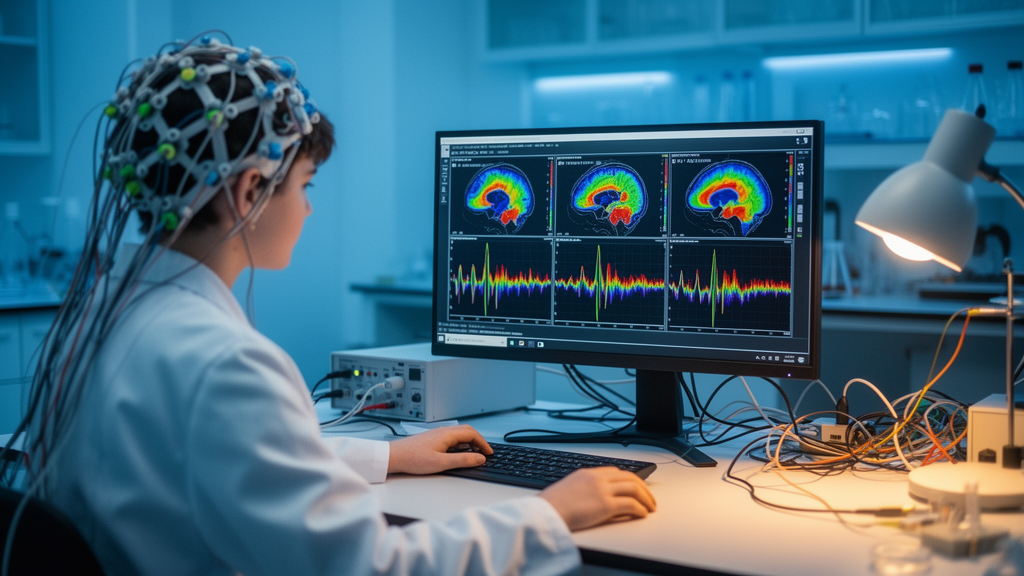
Researchers have designed a deep learning model that clusters brief, recurring patterns of electrical brain activity — EEG microstates — while keeping the spatial information of the scalp topographies intact. The model, called Conv-VaDE, combines a convolutional variational autoencoder with a Gaussian mixture model and was tested on resting-state EEG recordings from 203 healthy adults with their eyes closed, drawn from the LEMON dataset. The work, published in Brain Informatics, was carried out by Saheed Faremi and Luca Longo.
EEG microstate analysis is built on the idea that continuous brain activity can be segmented into short-lived, quasi-stable topographic configurations. The number of these configurations, how long they last, and how they transition into one another are known to index cognitive state and neuropsychiatric conditions. The standard algorithm in this field, modified k-means (ModKMeans), operates directly in electrode space. It performs hard partitioning, meaning each data point is assigned to exactly one cluster, and it offers no learned representation, no generative decoder, and no probabilistic soft assignment of ambiguous states.
Conv-VaDE addresses these limitations by placing a Gaussian mixture model prior on the latent space of a convolutional variational autoencoder, and jointly training the encoder, the decoder, and the mixture model together. Because the architecture is convolutional, it works on the topographic maps themselves rather than on flattened electrode vectors, which the authors describe as a topographic-map adaptation of the Variational Deep Embedding (VaDE) framework.
A central technical challenge in clustering EEG topographies is polarity invariance: a topography and its sign-inverted counterpart index the same underlying neural configuration, even though they look different as raw maps. The model preserves this property through three coordinated mechanisms. First, the training set is augmented with sign-flipped versions of the maps. Second, the reconstruction loss is made polarity-invariant, so the model is not penalised for the sign of a map. Third, an encoder regulariser acts on the latent embedding to encourage that a map and its inverse land in the same region of latent space.
The evaluation used a multi-quadrant framework in which each method was assessed in its native frame, with cross-method comparisons carried out through rank-based Wilcoxon signed-rank tests. On the learned latent manifold, Conv-VaDE achieved a silhouette score of 0.232 at K = 3 clusters, with a very narrow cross-subject interquartile range of roughly 0.02 across the 203 participants — a figure the authors interpret as indicating highly reproducible latent geometry across individuals.
Beyond the clustering metrics, the model offers capabilities the standard pipeline does not provide. The generative decoder can reconstruct the Gaussian mixture cluster centres as inspectable scalp topographies, so researchers can look directly at what each cluster represents. Probabilistic soft assignment allows transitional states — moments when the brain is shifting between configurations — to be assigned partial membership across clusters rather than forced into a single category. And because the model is generative, it supports downstream representation analysis of the learned manifold.
How many microstates should the data be split into? A rank-based meta-criterion combining silhouette, Calinski–Harabasz, and Davies–Bouldin indices yielded a modal K of 4 for Conv-VaDE (chosen in 39.4 percent of cases) and a modal K of 3 for ModKMeans (29.6 percent). The researchers adopted K = 4 to align with the canonical Lehmann A/B/C/D literature, the long-standing four-class taxonomy of EEG microstates.
The comparison between the two methods is not a simple victory for the new model. Within the classical cluster-validity register, ModKMeans attained a higher silhouette score and 4 to 5 percentage points higher Global Explained Variance at every value of K, differences that were statistically significant under Wilcoxon signed-rank tests with Benjamini–Hochberg correction (p < 10⁻³⁰). The authors are explicit that the two methods occupy distinct positions in the methodological design space, and that the cross-method comparison characterises the trade-off between direct electrode-space optimisation and learned generative representation rather than adjudicating method superiority.
In practical terms, the trade-off comes down to what a researcher needs. If the goal is to maximise the fraction of EEG variance explained by a fixed set of microstate prototypes in electrode space, the established ModKMeans pipeline remains stronger on those classical metrics. If the goal is to obtain a reproducible, generative latent manifold in which cluster structure is learned, soft assignments are available for transitional states, and cluster centres can be decoded back into interpretable scalp maps, Conv-VaDE provides a focused set of capabilities that the standard pipeline does not offer.
The study is an early-access publication, shared ahead of the final version of record, and its findings are limited to healthy adults in a resting, eyes-closed condition from a single dataset. The authors frame the contribution as a methodological one: a way of learning the manifold of EEG microstate topographies that preserves their spatial structure, respects polarity symmetry, and opens the door to generative analysis of brain dynamics — while leaving open the question of how such learned representations will perform against classical methods in applied and clinical settings.
Subject of Research: A deep learning model combining convolutional variational autoencoders and Gaussian mixture models for clustering EEG microstate topographic maps.
Article Title: Integrating convolutional variational autoencoders and the Gaussian mixture model for efficient manifold learning and clustering of spatially preserved EEG topographic maps
Article References: Faremi, S., & Longo, L. (2026). Integrating convolutional variational autoencoders and the Gaussian mixture model for efficient manifold learning and clustering of spatially preserved EEG topographic maps. Brain Informatics. https://doi.org/10.1186/s40708-026-00327-9
Image Credits: AI Generated
DOI: 10.1186/s40708-026-00327-9
Keywords: EEG, microstates, variational autoencoder, Gaussian mixture model, clustering, manifold learning, topographic maps, neuroscience, machine learning, resting-state EEG, LEMON dataset, Brain Informatics
Cite Scienmag News
Cassandra Pierce. (October 29, 2026). New AI Model Learns a Generative Map of EEG Microstates While Preserving Their Spatial Shape. Scienmag. https://scienmag.com/new-ai-model-learns-a-generative-map-of-eeg-microstates-while-preserving-their-spatial-shape/
Cassandra Pierce. "New AI Model Learns a Generative Map of EEG Microstates While Preserving Their Spatial Shape." Scienmag, 29 October 2026, https://scienmag.com/new-ai-model-learns-a-generative-map-of-eeg-microstates-while-preserving-their-spatial-shape/. Accessed 29 October 2026.
Cassandra Pierce. "New AI Model Learns a Generative Map of EEG Microstates While Preserving Their Spatial Shape." Scienmag. October 29, 2026. https://scienmag.com/new-ai-model-learns-a-generative-map-of-eeg-microstates-while-preserving-their-spatial-shape/