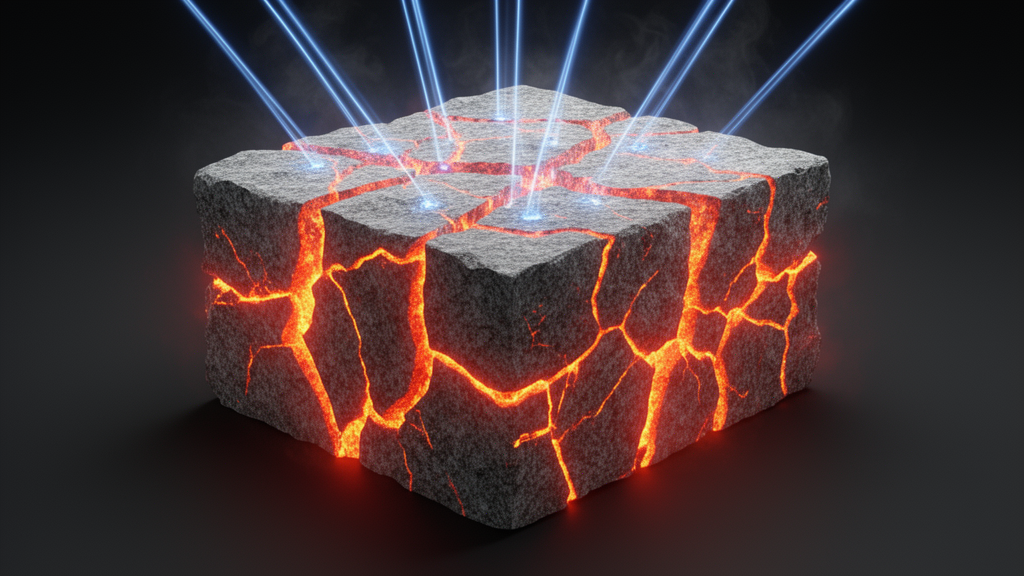
Thermal cracking in rocks has long been treated as an unavoidable byproduct of high-temperature engineering, something to be characterized after the fact or mitigated once damage has already appeared. A new perspective article published in GeoEnergy Communications argues that this passive mindset is precisely what limits some of the most promising technologies in deep rock excavation. The paper, authored by Fei Wang, proposes a formal framework for actively regulating and controlling thermally induced fractures, reframing cracking from a chaotic hazard into a manageable, designable engineering process.
The motivation comes from a class of thermal-assisted rock-breaking technologies that includes flame jets, laser heating, electric plasma, and microwave systems. Unlike conventional mechanical tools that fracture rock through impact or shear, these approaches apply heat energy at the rock surface or internally, producing rapid and localized temperature gradients. The resulting thermal expansion mismatch between constituent minerals generates intense stress concentrations that can exceed the rock’s local strength and trigger microcrack propagation. In microwave irradiation, selective heating of dielectric minerals further weakens rock structures, particularly when microwave-sensitive phases coexist with minerals that have high thermal expansion coefficients. By exploiting these mechanisms, heat-related methods can achieve faster penetration rates in hard, abrasive formations while greatly reducing tool wear.
Yet the same high-energy inputs introduce new and often overlooked risks. Extensive prior research has established that thermal cracking intensifies significantly at elevated temperatures, typically beyond thresholds around 300 degrees Celsius or even 400 degrees Celsius, driven primarily by mismatched or anisotropic thermal expansion among constituent minerals. This leads to nonlinear increases in porosity, permeability, and crack density. Rapid cooling, such as liquid nitrogen quenching, generates severe thermal shocks that substantially amplify crack development and degrade mechanical integrity. Mineralogical heterogeneity adds further complexity, with differences in grain orientation and expansion coefficients driving anisotropic cracking along grain boundaries and within individual crystals. Mineral phase transitions, particularly the alpha-beta quartz transformation around 573 degrees Celsius, amplify localized stress concentrations and accelerate microcrack interactions.
The cyclic exposure of rocks to extreme heat from energy beams and cooling from drilling fluids causes sharp spatial and temporal temperature fluctuations. Under such conditions, induced thermal gradients promote rapid microcrack generation and unstable deformation, which may escalate into spalling and eventual borehole collapse. Without intentional cracking management, the uncontrolled growth and interaction of thermally induced fractures can undermine borehole integrity, negating the very efficiency gains these high-energy technologies are designed to achieve. The paper identifies this absence of a guiding philosophy for active thermal cracking management as a critical conceptual gap that currently prevents the safe, reliable, and efficient application of novel thermal rock-breaking methods.
To fill that gap, the study introduces the Thermal Cracking Regulation and Control framework, abbreviated R&C. The framework distinguishes two complementary strategies. Regulation is the proactive strategy of intentionally steering crack initiation and propagation paths, with the central goal of spatially guided crack formation along a desired geometric trajectory. Control, by contrast, is the strategy of deliberately managing the intensity and extent of cracking within predefined boundaries, either suppressing it to ensure safety and integrity or intentionally increasing it, for example as a rock-weakening pre-treatment that creates a dense, localized network of microcracks to weaken a specific volume of rock for easier subsequent mechanical removal.
The two strategies address different aspects of the same process. Regulation is fundamentally a geometric task focused on steering a crack path, answering the question of where, whereas control is a magnitude task focused on managing crack intensity or extent, answering the question of how much. The paper illustrates their interplay with thermal-assisted drilling for enhanced geothermal systems: a regulation strategy would actively steer the thermal rock-breaking process to create a horizontal or deviated wellbore path designed to maximize contact with the reservoir rock, while a control strategy would simultaneously suppress chaotic, off-axis fracturing to keep wellbore walls stable and prevent unintended damage to the surrounding rock mass.
Translating the concept into practice requires a closed-loop system in which high-energy actuators, such as a laser or plasma jet, apply precise thermal loads while a network of sensors monitors the rock’s real-time response by tracking temperature fields, crack locations, and damage intensity. Data streams to a controller that continuously compares incoming information against predefined success criteria, and should a deviation from the desired fracture plan be detected, the controller commands the actuators to adjust their power or position. The author emphasizes that the system must be predictive rather than reactive, because crack propagation in brittle rock is exceptionally fast and the controller must strategically manage the thermal field ahead of the crack rather than chase a high-speed crack tip. A hierarchical control architecture, combining a low-level controller for rapid thermal setpoint maintenance with a higher-level supervisory controller for strategic decisions, is proposed as a likely practical implementation.
The framework’s physical basis rests on classical thermo-mechanical models. A bicrystal model describes intergranular stresses arising between two isotropic crystals bonded at a planar interface and subjected to uniform heating, yielding an analytical expression for the tensile stress produced by incompatible thermal expansions. A spherical-inclusion model analyzes a thermally mismatched spherical grain embedded within a matrix, predicting that tensile radial stresses dominate when the inclusion’s expansion coefficient exceeds that of the matrix, promoting outward radial cracks, while interface debonding and tangential cracks dominate in the opposite case. These solutions imply that deliberate local thermal engineering, such as selectively heating or insulating targeted inclusion-like zones, could produce predefined crack orientations and intensities by manipulating the intensity, spatial distribution, and rate of the applied thermal load.
To demonstrate feasibility beyond idealized theory, numerical simulations were conducted using FLAC3D. A bicrystal model under plane-strain conditions, heated uniformly from 0 to 10 degrees Celsius, validated the numerical approach against analytical solutions: with equal Young’s moduli the simulated tensile stress of 1.55 megapascals closely matched the analytical prediction of 1.56 megapascals, and with a modulus ratio of two the simulation yielded 0.93 megapascals against an analytical 1.04 megapascals. A subsequent conceptual model with a strain-softening law showed that when high thermal loads of 400 degrees Celsius maximum temperature at a heating rate of 100 degrees Celsius per minute were applied without strategic management, the resulting cracking network was chaotic and widespread. In contrast, limiting the maximum temperature to 150 degrees Celsius within a smaller range completely prevented unintended damage, while applying a high heating rate of 1000 degrees Celsius per minute focused on a narrow target area initiated and precisely guided a fracture. A combined application achieved both goals at once, guiding the crack path exactly as designed while suppressing unexpected fractures.
The author is explicit about the limitations. The FLAC3D model is a continuum simulation that does not capture grain-scale micro-mechanics or mineral heterogeneity, and the two-dimensional lab-scale demonstration does not capture field-scale complexities such as three-dimensional geological heterogeneity, pre-existing fractures, complex in-situ stress fields, or coupled thermo-hydro-mechanical-chemical processes. The simulations show only the initiation of a few fractures and do not address multi-crack interactions such as stress shielding and coalescence, nor time-dependent effects such as crack healing or sintering. The concept of a designable crack also does not imply perfect deterministic control, which the paper calls physically impossible in heterogeneous, stochastic materials like rock; the framework is instead framed as a tool for probabilistic management, making desired outcomes significantly more probable than uncontrolled ones. Key hurdles for real-world deployment include real-time quantification of success criteria in complex three-dimensional formations, the nonlinear relationship between raw sensor data such as acoustic emission event counts and physical crack state, latency and system stability, the cost of high-precision high-temperature sensors and actuators, and the need for extensive experimental validation, objective quantitative metrics such as fractal dimension and crack density, and detailed techno-economic analysis. If those challenges can be met, the framework could allow flame jet, laser, and plasma technologies to evolve from simply inducing fractures to actively sculpting them, with potential gains in precision, efficiency, and safety in deep geothermal drilling and hard rock excavation.
Subject of Research: A conceptual framework for the active regulation and control of thermal cracking in rocks during thermal-assisted rock breaking
Article Title: From passive chaos to active order: conceptualizing thermal cracking regulation and control in rocks
Article References: Wang, F. (2025). From passive chaos to active order: conceptualizing thermal cracking regulation and control in rocks. GeoEnergy Communications, 1(1), Article 10. https://doi.org/10.1007/s44421-025-00010-5
Image Credits: AI Generated
DOI: 10.1007/s44421-025-00010-5
Keywords: thermal cracking, rock mechanics, geothermal energy, thermal-assisted drilling, fracture control, flame jet, laser heating, microwave, FLAC3D simulation, thermo-mechanical modeling, borehole stability, enhanced geothermal systems
Cite Scienmag News
Denise Maddox. (October 29, 2026). Steering Chaos: New Framework Aims to Actively Regulate Thermal Cracking in Rocks. Scienmag. https://scienmag.com/steering-chaos-new-framework-aims-to-actively-regulate-thermal-cracking-in-rocks/
Denise Maddox. "Steering Chaos: New Framework Aims to Actively Regulate Thermal Cracking in Rocks." Scienmag, 29 October 2026, https://scienmag.com/steering-chaos-new-framework-aims-to-actively-regulate-thermal-cracking-in-rocks/. Accessed 31 October 2026.
Denise Maddox. "Steering Chaos: New Framework Aims to Actively Regulate Thermal Cracking in Rocks." Scienmag. October 29, 2026. https://scienmag.com/steering-chaos-new-framework-aims-to-actively-regulate-thermal-cracking-in-rocks/