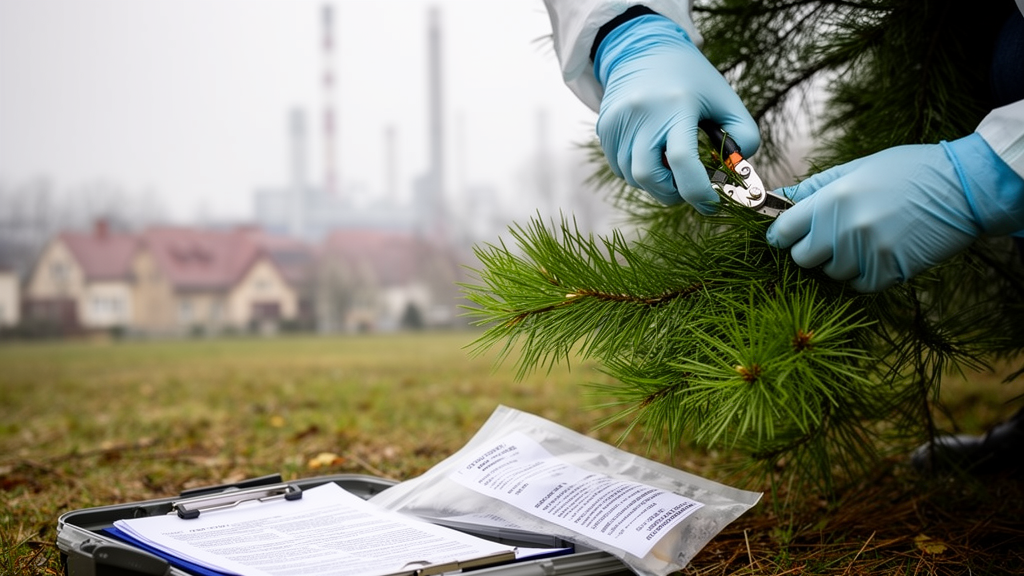
Two-year-old needles of the Scots pine (Pinus sylvestris L.) have been used to chart the spatial distribution of trace element pollution in Starachowice, a town in south-eastern Poland, in a study published in Scientific Reports. The research, led by Rafał Kozłowski and Marta Ludew, analysed the accumulation of ten trace elements in pine needles collected across the urban-industrial area.
The sampling design covered a representative network of sites spanning zones with differing levels of anthropogenic pressure, including areas exposed to industrial and transport emissions as well as reference zones in the town’s periphery. Element concentrations were measured with a high-resolution spectrometric technique suitable for the analysed metals, ICP-MS/TOF, and the resulting dataset was examined statistically, including principal component analysis (PCA).
The results revealed significant variation in element accumulation across the town. Deposition of metals was clearly elevated in areas with intensive industrial activity and heavy road traffic, and increased accumulation was also recorded in municipal and residential areas. By contrast, concentrations measured in the peripheral zones were close to the reference levels, a pattern the authors interpret as confirming the local character of the emission sources.
According to the study, the findings support the usefulness of Scots pine needles as a bioindicator of trace element deposition in urban and industrial environments. Biomonitoring with needles, particularly the two-year-old needles of Pinus sylvestris, is described as a recognised method for assessing the intensity of atmospheric deposition of trace elements in such settings.
The authors suggest that the results may form a basis for delimiting zones with varying levels of anthropogenic pressure and potential impacts on the environment, and note that the work is relevant to sustainable development Goal 11 on sustainable cities and communities. The study is an open-access article published on 27 October 2026 and is being shared as a peer-reviewed, accepted manuscript that remains subject to further editorial processing before the final version of record appears.
Subject of Research: Using Scots pine needles as bioindicators to map spatial variation in trace element deposition in an urban-industrial area of Poland
Article Title: Pine needles as an indicator of the spatial distribution of trace elements in an urban-industrial area
Article References: Kozłowski, R., & Ludew, M. (2026). Pine needles as an indicator of the spatial distribution of trace elements in an urban-industrial area. Scientific Reports. https://doi.org/10.1038/s41598-026-76883-1
Image Credits: AI Generated
DOI: 10.1038/s41598-026-76883-1
Keywords: biomonitoring, Scots pine, trace elements, heavy metals, air pollution, Starachowice, Poland, ICP-MS, PCA, urban-industrial emissions, atmospheric deposition, bioindicator
Cite Scienmag News
Russell Cooper. (October 30, 2026). Scots pine needles map trace element pollution in Polish industrial town. Scienmag. https://scienmag.com/scots-pine-needles-map-trace-element-pollution-in-polish-industrial-town/
Russell Cooper. "Scots pine needles map trace element pollution in Polish industrial town." Scienmag, 30 October 2026, https://scienmag.com/scots-pine-needles-map-trace-element-pollution-in-polish-industrial-town/. Accessed 2 November 2026.
Russell Cooper. "Scots pine needles map trace element pollution in Polish industrial town." Scienmag. October 30, 2026. https://scienmag.com/scots-pine-needles-map-trace-element-pollution-in-polish-industrial-town/