


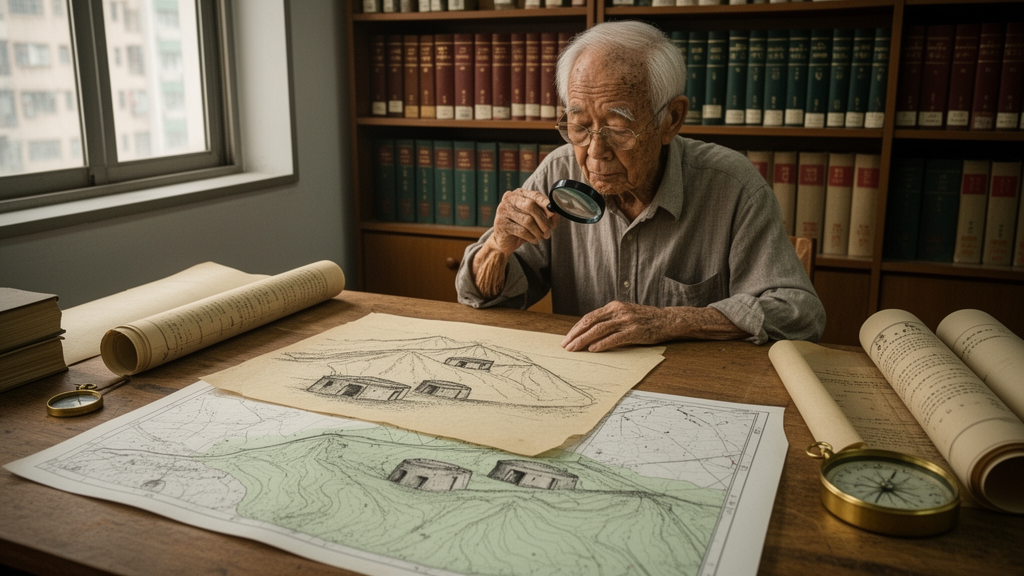
High on a 121-metre knoll above Starling Inlet in Hong Kong’s New Territories, 13 concrete pillboxes built during the Japanese occupation have been quietly accumulating a written and mapped life of their own. A new study in the journal Built Heritage examines that life in detail, tracing how amateur enthusiasts, academic surveyors and government cartographers each added layers of information to the structures’ story, and how those layers appear to have fed directly into official conservation action.
The research, led by Lawrence W. C. Lai of the University of Hong Kong, applies the concept of “object biography” to fixed field defence works. Object biography is a term of art in the museum profession relating to historical descriptions of exhibits, and it has been transferred, under the label “cultural biography of things”, to describe artefacts and fixtures on land as part of a changing material culture. Because the pillboxes cannot write about themselves, the study argues, people must write their biographies for them, and mapping has been the most prominent such biography produced for Hong Kong’s Japanese pillboxes.
The case centres on the pillboxes on Luk Keng Knoll, which the Hong Kong Government’s Antiquities and Monument Office administratively graded 2 for conservation purposes in December 2009. Officially, however, the structures were never surveyed after grading. The Antiquities Advisory Board’s own record states that no detailed survey had been made of the pillboxes, so that layout plans, concrete thickness, and the positions of entrances and firing ports were not known. That gap is precisely what a chain of private and institutional surveys has been working to close.
The first documented field survey came from Robin Weir, a retired flight engineer and World War II military relics enthusiast who studied observation posts and pillboxes across Hong Kong from 1994 to 2006. In March and April 1998, after a major hill fire cleared vegetation from the hillcrest, Weir conducted what the study describes as probably the first post-war field survey of the Luk Keng pillboxes. He produced a freehand sketch map showing the approximate positions of all 13 pillboxes and the alignments of their communication trenches, along with sketches and photos. Six of the structures could each accommodate only one standing soldier. The map was not publicised until 2025, when it appeared in the journal Surveying & Built Environment.
Because Weir had not previously reported his findings, the first known published map of the pillboxes, in Tim Ko’s 2001 book Relics in the Green, was based on Ko’s own independent field observations after another hill fire. Ko’s map showed the locations of the pillboxes, with twelve indicated as eleven dots and a star, the missing one likely being a small one-person pillbox designated PBY. Ko later accompanied Weir during the latter’s survey of Luk Keng. The study identifies Ko’s map as likely a reference for the production of a later institutional map, and as the spur for a professional land survey of Luk Keng by a University of Hong Kong team in 2010.
That 2010 survey produced a map published in 2011, on which the positions of eight pillboxes were surveyed by surveyor Ken S. T. Ching, with two other one-person pillboxes marked using aerial photo positioning. Seven large and six one-person pillboxes were measured and marked on a 1:1,000 survey map, together with the rough locations of four other one-person pillboxes. The team publicised the findings at a press conference on 8 December 2011 marking the 70th anniversary of the start of the Battle of Hong Kong. After another field survey in January 2019, during which the team photographed the exteriors and interiors of all 13 pillboxes, the map was updated and republished in 2021, and was featured in press and television reports following a second press conference on 3 March 2021, the 80th anniversary of a 1941 Japanese raid on the Communist East River Column base at Nam Chung below the hill.
Against this private and academic record, the researchers examined the official cartographic record. They inspected 31 editions of the 1:1,000 Survey and Mapping Office survey map No. 3-NE-22D, dated from December 1999 to the current version accessed in January 2026. From March 1999 to 2025 the map was updated 30 times. The rough locations of most pillboxes first appeared as large rectangular boxes marked with broken lines in the sixth revision, dated 11 March 2010. By the 26th revision, dated 7 January 2025, those boxes had shrunk, apparently omitting pillboxes Y and Z, and in the current revision PBY remains missing. The authors conclude that the boxes on government survey maps were likely identified and depicted as pillbox locations based on government aerial photo analysis, a process that might have taken Ko’s 2001 map into consideration, while the smaller boxes resulted from the professional land surveys published in 2011.
Aerial photography added a further layer. The researchers reviewed five relevant Survey and Mapping Office aerial photos taken between March 1999 and November 2024, in which some pillboxes were better exposed after hill fires, sometimes caused by cemetery sweepings. The photo dated 7 November 2024 shows, for the first time, a newly paved footpath running from a village graveyard south of the hill up to the site, evidence of the path construction that the Agriculture, Fisheries and Conservation Department undertook from 2024 to 2025. Two tourist viewing platforms have been built close to two large pillboxes, and tourist information boards may follow in a layout similar to those at Shan Tsui. The conservation project was still ongoing at the time of writing.
The culmination came in November 2025, when a complete plan for the site showing all pillboxes, based on professional land surveys, was produced by a land surveyor commissioned by the University of Hong Kong, an institution with more resources than the typical military enthusiast. This followed the Survey and Mapping Office’s revision and issue of a new 1:1,000 survey map in January 2025. The resulting map is described as the first known one to show the surveyed footprints and positions of all 13 inspected Japanese pillboxes and a cistern on Luk Keng Knoll. The study’s working hypothesis, that the Hong Kong Government’s mapping of heritage sites is an essential prelude to their actual conservation, was judged not refuted, because actual conservation efforts followed mapping protocols, and by January 2025 the footprints of all pillboxes except one had been mapped.
The findings carry a broader argument about how war relics acquire documented lives. Privately conducted surveys and documentation of war relics, the authors note, have little social impact unless the results are published and publicised, and the publication of maps in books and in Surveying & Built Environment, read by many Survey and Mapping Office land surveyors who are Hong Kong Institute of Surveyors members, should have influenced official cartography. Grading itself, as an identity declaration on an official list with technical descriptions, is part of drafting an object biography that leads to conservation using public funds. The researchers also flag open questions about the pillboxes’ physical production: according to an oral history account in Ko’s 2001 book, the structures were built by Luk Keng villagers pressed into service by the Japanese, and their exact construction dates, tactical purpose and possible prefabrication remain subjects for further research. With the government converting the site into an open museum under a framework that now includes the renamed Hong Kong Museum of the War of Resistance and Coastal Defence, the authors advise conserving such Japanese sites systematically, rather than in isolation, before connecting them, after careful feasibility study, within a framework of historical trails.
Subject of Research: An object biography case study of the Japanese pillboxes on Luk Keng Knoll, Hong Kong, tracing how private field surveys and official mapping contributed to heritage grading and conservation.
Article Title: Object biography of war relics: a case study on the Japanese pillboxes on Luk Keng Knoll
Article References: Lai, L. W. C. (2026). Object biography of war relics: a case study on the Japanese pillboxes on Luk Keng Knoll. Built Heritage, 10(1), Article 54. https://doi.org/10.1186/s43238-026-00285-5
Image Credits: AI Generated
DOI: 10.1186/s43238-026-00285-5
Keywords: Hong Kong, Japanese pillboxes, Luk Keng Knoll, object biography, heritage conservation, cartography, field survey, aerial photography, World War II relics, Survey and Mapping Office, open museum, built heritage
Cite Scienmag News
Denise Maddox. (October 30, 2026). Amateur maps and sketches helped put Hong Kong’s wartime pillboxes on official charts. Scienmag. https://scienmag.com/amateur-maps-and-sketches-helped-put-hong-kongs-wartime-pillboxes-on-official-charts/
Denise Maddox. "Amateur maps and sketches helped put Hong Kong’s wartime pillboxes on official charts." Scienmag, 30 October 2026, https://scienmag.com/amateur-maps-and-sketches-helped-put-hong-kongs-wartime-pillboxes-on-official-charts/. Accessed 4 November 2026.
Denise Maddox. "Amateur maps and sketches helped put Hong Kong’s wartime pillboxes on official charts." Scienmag. October 30, 2026. https://scienmag.com/amateur-maps-and-sketches-helped-put-hong-kongs-wartime-pillboxes-on-official-charts/




