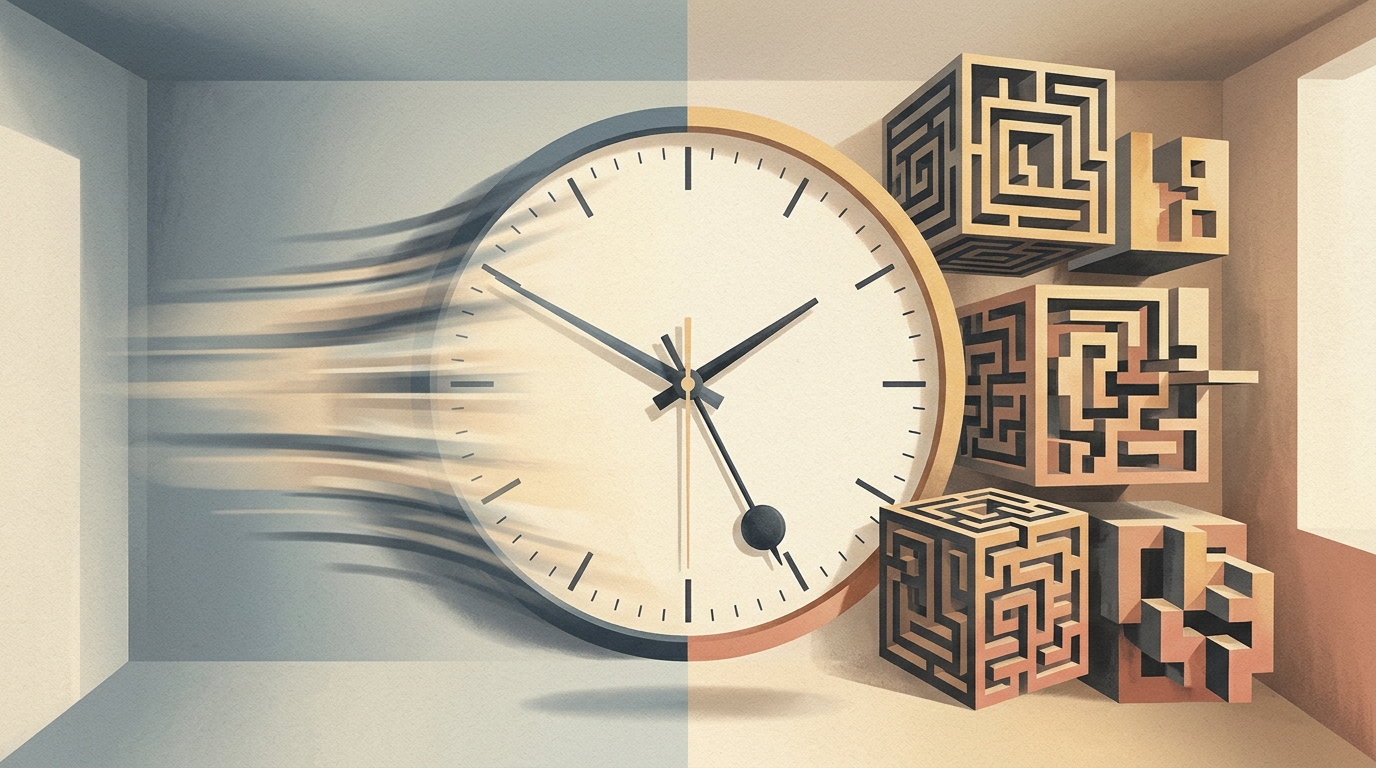
Time perception researchers have long relied on a simple question to study how people experience duration: how long did that task take? A new laboratory experiment with 841 participants now suggests that this familiar approach captures only part of the story. The study, published in the journal Attention, Perception, & Psychophysics, tested several complementary ways of measuring the experience of time and found a striking disconnect between how fast or slow time feels and how accurately people estimate its length.
The research team, led by Jesika A. Walker with Mohammed Aswad, Denis Cousineau and Guy Lacroix, designed an in-laboratory experiment in which participants performed a visual and memory search task. The investigators manipulated both the difficulty and the duration of the task, and they divided participants into two groups. Those in a prospective condition were told in advance that they would later estimate how long the task had lasted, while those in a retrospective condition received no such warning and only learned about the estimation requirement afterward.
Duration estimation, the method in which an estimate’s accuracy is compared with the task’s actual duration, is commonly used for brief tasks and underpins several theories in the field. The present experiment was designed to explore additional ways of capturing the experience of time under varying conditions, extending the standard toolkit beyond a single estimate.
One of the clearest findings concerned task difficulty. Despite the deliberate manipulation of how hard the search task was, difficulty did not affect any of the measures of time perception the researchers recorded.
The study also examined passage of time judgements, a separate question asking participants how quickly time seemed to pass, rather than how long an interval lasted. These judgements did not correlate with duration estimates in the experiment. According to the authors, this pattern suggests that the two measures may reflect different aspects of time perception.
Confidence added an intriguing layer to the picture. Participants provided confidence ratings alongside their judgements, and these ratings varied with estimation accuracy. In other words, people showed some insight into their own temporal distortions: when their estimates were off, they tended to know it, at least in the sense that their expressed confidence tracked how well they had actually done.
Affective states turned out to matter as well, but selectively. Engagement and boredom influenced how fast or slow time felt, shaping the subjective experience of time’s passing. Yet these same emotional states did not affect duration estimates.
Taken together, the findings reveal a disconnect between the subjective experience of time’s passing and the accuracy of time estimation, underscoring the complexity of temporal experience. The study was not preregistered, and the authors note that derived subject-level data supporting the findings are available online through the Open Science Framework, allowing other researchers to examine and extend the analysis.
Because the work was conducted in a laboratory with a brief search task, its scope is bounded by those conditions, and the authors frame it as an exploration of additional measurement approaches rather than a definitive account of temporal experience. The message for anyone who has watched a boring task crawl by: how time feels and how long it actually was are two different questions, and your answers to them may not agree.
Subject of Research: Prospective and retrospective judgements of time passage and duration estimation in a visual and memory search task
Article Title: How duration, difficulty, and boredom impact prospective and retrospective passage of time judgements and duration estimates
Article References: Walker, J. A., Aswad, M., Cousineau, D., & Lacroix, G. (2026). How duration, difficulty, and boredom impact prospective and retrospective passage of time judgements and duration estimates. Attention, Perception, & Psychophysics, 88(8), Article 219. https://doi.org/10.3758/s13414-026-03366-w
Image Credits: AI Generated
DOI: 10.3758/s13414-026-03366-w
Keywords: time perception, duration estimation, passage of time judgements, prospective timing, retrospective timing, boredom, engagement, task difficulty, confidence ratings, visual search, memory search, psychological time
Cite Scienmag News
Glenn Wilkins. (November 4, 2026). Boredom Speeds Time Up While Difficulty Leaves It Untouched in New Time Perception Study. Scienmag. https://scienmag.com/boredom-speeds-time-up-while-difficulty-leaves-it-untouched-in-new-time-perception-study/
Glenn Wilkins. "Boredom Speeds Time Up While Difficulty Leaves It Untouched in New Time Perception Study." Scienmag, 4 November 2026, https://scienmag.com/boredom-speeds-time-up-while-difficulty-leaves-it-untouched-in-new-time-perception-study/. Accessed 8 November 2026.
Glenn Wilkins. "Boredom Speeds Time Up While Difficulty Leaves It Untouched in New Time Perception Study." Scienmag. November 4, 2026. https://scienmag.com/boredom-speeds-time-up-while-difficulty-leaves-it-untouched-in-new-time-perception-study/