Selenium is a micronutrient that sits on a knife edge: too little impairs immune function and thyroid hormone metabolism, while too much causes selenosis, with symptoms ranging from gastrointestinal distress to hair loss and neurological disturbance. For farming communities whose diets depend on locally grown crops, the amount of selenium that soils actually release to plants matters enormously. A new study from the steep slopes of the Oroba Valley in Nandi County, Kenya, now shows that the way land is tilled, terraced and left to erode can measurably shift the pool of selenium available for crop uptake over just two years, even though that shift does not translate straightforwardly into more selenium in the food itself.
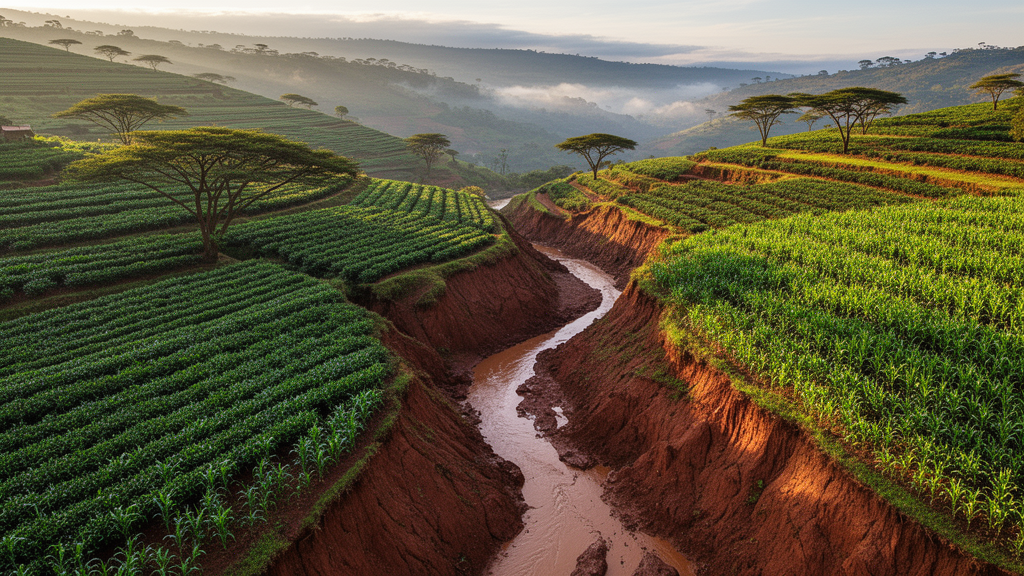
Researchers from the University of Eldoret, the British Geological Survey and partner institutions sampled three agricultural plots along the valley slopes between 2021 and 2023. The plots differ sharply in their histories. Plots 1 and 2 have been cultivated continuously since the 1940s, representing more than eight decades of intensive land use, while Plot 3 was converted from shrubland to farmland in 2023 and is only partially tilled with handheld hoes. Plot 1 relies on traditional and increasingly intensive conventional methods, whereas Plot 2 uses conventional tillage with oxen combined with terracing to control erosion. The valley sits in Kenya’s upper highland agroecological zone, receives between 500 and 1200 millimetres of rain a year, and has previously been classified as high-risk for erosion because of agricultural land disturbance.
The team used a stratified sampling design that followed the topography. Each plot was divided into five or six elevation-based sections running from roughly 1900 metres at the top to about 1300 metres at the bottom, with three random sampling points per section. At each point, topsoil was collected from the upper 20 centimetres as composite samples, yielding 15 composite samples from each of Plots 1 and 2 and 18 from Plot 3. Plant tissue sampling took place at the same georeferenced locations: 2 by 2 metre sub-plots were planted with maize, beans and pumpkin, received no fertiliser or irrigation within the experimental plots, and were harvested four months after planting before being freeze-dried, ground and shipped to the British Geological Survey for analysis of 57 elements by ICP-MS.
To distinguish total selenium from the fraction plants can actually access, the researchers digested soil with a mixed acid solution of hydrofluoric acid, nitric acid and hydrogen peroxide for total concentrations, and used a 1 molar ammonium chloride extraction for the bioavailable fraction. Soil redistribution was tracked with a less conventional tool: fallout plutonium. The radionuclides 239+240Pu, deposited globally during the atmospheric weapons testing era around 1963, act as long-term tracers of soil movement. By comparing measured plutonium inventories at each sampling point with a reference profile, and running the differences through the MODERN model (Modelling Deposition and Erosion Rates with Radio-Nuclides), the team estimated where soil was being lost and where it was accumulating, then interpolated the patterns with ordinary kriging in ArcGIS. Analytical accuracy was checked against certified reference materials including spinach leaves, tomato leaves, basalt rock and two soil standards, with average recoveries between roughly 93 and 98 percent.
The headline temporal result concerns Plots 1 and 3, which moved in opposite directions. Bioavailable selenium in Plot 3 rose significantly from 6.74 micrograms per kilogram in 2021 to 10.03 micrograms per kilogram in 2023, a 42 percent increase. Plot 1, by contrast, declined significantly from 14.72 to 9.56 micrograms per kilogram over the same period, a drop of about 35 percent that coincided with a shift from net deposition to net erosion at a rate of 0.58 tonnes per hectare per year. Plot 2, which had shown net soil loss of 1.66 tonnes per hectare per year in 2021 and continued losing soil at 0.51 tonnes per hectare per year in 2023, maintained low bioavailable selenium concentrations of around 7.8 to 7.9 micrograms per kilogram with the lowest bioavailable-to-total selenium proportion, roughly 1.9 to 2 percent.
The cumulative erosion figures put these changes in context. Over the two years, Plot 1 lost the most soil at 13.68 plus or minus 3.9 tonnes per hectare per year, followed by Plot 2 at 6.09 plus or minus 3.2, while Plot 3 recorded only 0.32 plus or minus 3.6. In 2021, both Plot 1 and Plot 3 had actually shown net deposition, at 0.30 and 0.72 tonnes per hectare per year respectively, conditions that appeared to support selenium retention. Plot 3’s later rise in bioavailable selenium despite a shift to net erosion of 0.43 tonnes per hectare per year, driven by farmer encroachment and soil disturbance, was the counterintuitive exception. The authors suggest this may reflect enhanced selenium mineralisation, root turnover, or redistribution of selenium from previously enriched depositional zones, temporarily boosting availability, and note that microbial activity and organic matter decomposition following soil disturbance can convert geochemically stable selenium into more plant-accessible forms such as selenate and selenite.
Structural equation modelling clarified which soil properties govern the bioavailable pool. Soil pH had a significant negative effect on bioavailable selenium, with a standardised path coefficient of minus 0.41, while total selenium and organic matter had significant positive effects of 0.30 and 0.29 respectively. Together these three factors explained 28 percent of the variation in bioavailable selenium. The negative pH relationship is consistent with soil chemistry: under acidic conditions, selenite binds strongly to iron and aluminium oxides and organic matter, reducing mobility, whereas in neutral to alkaline soils selenate remains soluble and readily taken up.
The sobering part of the study lies one step up the soil-plant continuum. Although soil properties reliably predicted the bioavailable selenium pool, that pool explained only 2 percent of the variation in selenium accumulation in maize, and essentially none of the variation in beans and pumpkin. Transfer factors, the ratio of crop to soil selenium concentrations, ranged from 4 to 24 and were consistently highest for maize, with Plot 1 maize rising from 11.7 in 2021 to 24.4 in 2023. Yet the crop-specific responses were spatially patchy: maize, beans and pumpkin each showed significant selenium increases only in Plot 1, with no significant changes in Plots 2 or 3. Maize accumulated significantly more selenium in Plot 1, at 187 micrograms per kilogram, than in Plot 3, at 87 micrograms per kilogram, while beans and pumpkin showed no significant differences across plots. High within-plot variability, particularly for beans and maize, points to micro-scale erosion patterns, patchy organic matter and differing soil amendments as complicating factors.
The authors are careful about what these low crop concentrations do and do not mean. Several crops fell below reference ranges considered in the study, roughly 20 to 50 micrograms per kilogram for maize, 30 to 100 for beans and 10 to 30 for pumpkin, which the researchers describe as a potential concern for selenium adequacy rather than evidence of dietary selenium deficiency. Establishing actual nutritional risk, they stress, would require assessment of dietary intake and human biomarkers, which this study did not undertake. Selenium deficiency is estimated to affect more than a quarter of Africa’s population, giving the regional stakes real weight, but the study’s own data caution against simple fixes: improving soil selenium availability through management may support the soil selenium pool without proportionally raising crop concentrations, because physiological and species-specific traits also govern uptake.
The practical takeaways are correspondingly nuanced. The findings suggest that erosion control and appropriate land management can help maintain soil selenium bioavailability, with reduced tillage, protective cover and organic amendments preserving the labile pools that erosion otherwise strips away along with fine, selenium-rich clay and organic particles. Where the goal is to raise crop selenium concentrations specifically, the authors point to targeted agronomic strategies: Se fertilisation, foliar application, crop diversification, and selection of varieties with greater selenium accumulation efficiency. For a landscape where eight decades of cultivation have thinned the soil on some slopes while newly cleared land briefly releases a flush of nutrients, the study offers a quantitative reminder that micronutrient security depends not just on how much selenium the soil holds, but on whether erosion, chemistry and crop physiology allow that selenium to reach the plate.
Subject of Research: Effects of soil erosion and land-use management on bioavailable selenium in soils and crops in a highland agricultural landscape in Nandi County, Kenya
Article Title: Soil erosion and land-use management influence bioavailable selenium in a highland agricultural landscape in Kenya
Article References: Isaboke, J., Humphrey, O. S., Osano, O., Njoroge, R., & Watts, M. J. (2026). Soil erosion and land-use management influence bioavailable selenium in a highland agricultural landscape in Kenya. Environmental Geochemistry and Health, 48(16), Article 660. https://doi.org/10.1007/s10653-026-03557-2
Image Credits: AI Generated
DOI: 10.1007/s10653-026-03557-2
Keywords: selenium, soil erosion, bioavailability, Kenya, agriculture, 239+240Pu tracer, structural equation modelling, soil pH, organic matter, maize, biofortification, Nandi County
Cite Scienmag News
Alan Morgan. (October 28, 2026). Erosion and land use reshape soil selenium availability in Kenyan highlands. Scienmag. https://scienmag.com/erosion-and-land-use-reshape-soil-selenium-availability-in-kenyan-highlands/
Alan Morgan. "Erosion and land use reshape soil selenium availability in Kenyan highlands." Scienmag, 28 October 2026, https://scienmag.com/erosion-and-land-use-reshape-soil-selenium-availability-in-kenyan-highlands/. Accessed 28 October 2026.
Alan Morgan. "Erosion and land use reshape soil selenium availability in Kenyan highlands." Scienmag. October 28, 2026. https://scienmag.com/erosion-and-land-use-reshape-soil-selenium-availability-in-kenyan-highlands/