


High in the rugged eastern Pyrenees, a remarkable archaeological site is reshaping our understanding of prehistoric human activity at high altitudes. Cave 338, perched at an imposing 2,235 meters above sea level in the Freser Valley, has yielded an extraordinary sequence of artefacts and hearths that suggest repeated and sustained human occupation over two millennia. This groundbreaking site offers a rare glimpse into the lives of ancient communities who ventured far beyond traditional lowland settlements, challenging longstanding assumptions about prehistoric mobility and resource exploitation.
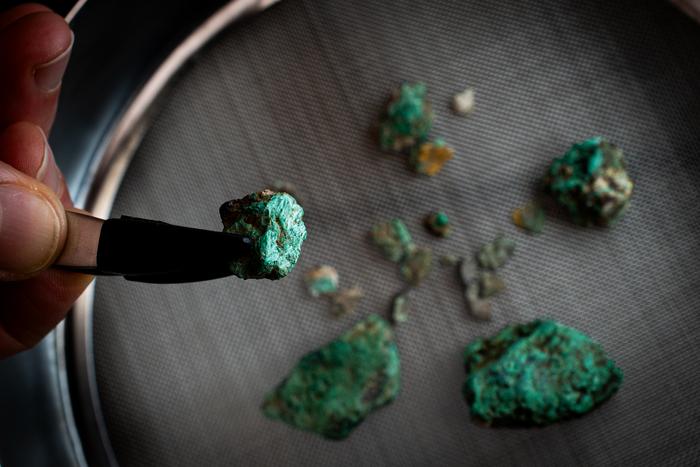
The excavation at Cave 338, led by Prof Carlos Tornero from the Catalan Institute of Human Paleoecology and Social Evolution (IPHES-CERCA), uncovered multiple stratified layers of occupation, each recording distinct periods of human presence. The uppermost layer reveals limited use with artefacts aligning with historical times, yet deeper strata tell an entirely different story. Among the most compelling discoveries are twenty-three hearths, situated within the middle layers, that contained an abundance of crushed and thermally altered green mineral fragments. Preliminary analysis suggests these fragments are malachite, a copper-rich mineral historically known for its role in early metalworking.
Malachite’s presence in these hearths implies that prehistoric peoples engaged in the early stages of copper processing, potentially marking Cave 338 as one of the highest altitude mining camps documented to date. This raises important questions about the sophistication of Bronze Age metallurgy and resource extraction strategies, especially in environments previously considered marginal. The deliberate thermal alteration of these mineral fragments, as indicated by their charred state localized to the hearths, underscores the intentional and systematic nature of these ancient metallurgical practices.
Detailed radiocarbon dating has anchored these layers in time, with hearths in the third excavation layer dating between approximately 5,500 and 4,000 years ago, and those in the second layer around 3,000 years old. The stratigraphy, showing distinct yet overlapping hearths, suggests that human groups returned throughout centuries or even millennia, utilizing the cave as a seasonal or intermittent base—an early form of high-altitude encampment rather than permanent settlement. This pattern supports a nuanced model of prehistoric land use involving repeated, organized expeditions to extract valuable mineral resources.
The site’s archaeological record extends beyond metallurgical evidence. The discovery of human remains, specifically a child’s finger bone and a baby tooth within the third layer, introduces the possibility of Cave 338 serving as a burial site in addition to a mining outpost. While no clear indicators of cause of death or familial relations exist yet, these findings emphasize the multi-functional significance of the site. Such evidence may illuminate social and ritual behaviors connected to high-altitude lifeways, expanding the cultural context of these prehistoric communities.
Additionally, ornamental artefacts found in the second layer further enrich the narrative. Two pendants—a shell and a brown bear tooth—have been recovered, with stylistic comparisons to contemporaneous sites in the broader Catalonian region. The shell pendant suggests connections or shared traditions among disparate prehistoric groups, while the rarity of bear tooth adornments potentially signifies a unique symbolic or environmental affiliation. Together, these artifacts attest to complex social networks and identity expressions woven into the lives of these high-altitude visitors.
The technological implications of the malachite fragments are especially significant. Malachite, a copper carbonate hydroxide mineral, serves as an important copper ore, historically subjected to roasting and smelting to extract usable metal. The evidence of combustion structures containing thermally modified malachite at this altitude points to advanced pyrotechnological techniques. It suggests that prehistoric miners not only collected ore deposits but had the technical knowledge and skills to process raw materials near extraction sites, potentially refining their metalworking craft even in challenging mountainous terrain.
The frequent re-use of hearths, coupled with their spatial arrangement, hints at social or organizational aspects of these mining expeditions. Occupation layers suggest repeat visits possibly coordinated by groups familiar with the terrain and the extraction process. This recurrent occupation could inform models of prehistoric seasonal movement, resource management, and territoriality in alpine environments, hinting at sophisticated logistical planning and longstanding knowledge transmission across generations.
Further excavations planned for upcoming field seasons aim to deepen stratigraphic coverage and refine chronological frameworks, promising to shed light on the full extent of human use of Cave 338. This ongoing research, conducted in collaboration with the University of Granada and the Autonomous University of Barcelona, also seeks to conclusively identify the green mineral fragments through comprehensive mineralogical and chemical analyses, confirming or adjusting the current preliminary malachite identification.
The implications of this research extend far beyond Pyrenean prehistory. By highlighting a long-term, high-altitude mining culture intertwined with metallurgical innovations, the findings challenge the traditional paradigm that ancient metallurgical developments were confined to more hospitable lowland environments. Instead, they reveal that prehistoric peoples possessed not only the technological expertise but also the resilience and social organization necessary to exploit challenging mountainous landscapes intensively.
Moreover, the evidence from Cave 338 invites broader reconsiderations of how prehistoric humans adapted to and integrated extreme environments into their subsistence strategies. The site’s artifacts and features argue for a model of dynamic, flexible mobility, where mountainous zones were not isolated peripheries but integral parts of ancient economic and social networks. This perspective enriches our understanding of prehistoric human adaptation, cultural complexity, and the deep history of human interaction with mountain ecosystems.
Finally, this discovery underscores the value of interdisciplinary archaeological approaches—combining meticulous excavation, radiometric dating, mineralogical analysis, and bioarchaeological assessment—to reconstruct nuanced past human behaviors. As the research unfolds, Cave 338 promises to contribute vital insights into early metallurgical practices, prehistoric migration patterns, and the cultural significance of high-altitude landscapes, capturing the imagination of scientists and the public alike.
Cite Scienmag News
Courtney Benton. (May 5, 2026). “Burned Stone, Child’s Bones, and Lost Jewelry Uncover Prehistoric Mining Camp High in the Pyrenees: ‘They Weren’t Burned by Accident’”. Scienmag. https://scienmag.com/burned-stone-childs-bones-and-lost-jewelry-uncover-prehistoric-mining-camp-high-in-the-pyrenees-they-werent-burned-by-accident/
Courtney Benton. "“Burned Stone, Child’s Bones, and Lost Jewelry Uncover Prehistoric Mining Camp High in the Pyrenees: ‘They Weren’t Burned by Accident’”." Scienmag, 5 May 2026, https://scienmag.com/burned-stone-childs-bones-and-lost-jewelry-uncover-prehistoric-mining-camp-high-in-the-pyrenees-they-werent-burned-by-accident/. Accessed 3 September 2026.
Courtney Benton. "“Burned Stone, Child’s Bones, and Lost Jewelry Uncover Prehistoric Mining Camp High in the Pyrenees: ‘They Weren’t Burned by Accident’”." Scienmag. May 5, 2026. https://scienmag.com/burned-stone-childs-bones-and-lost-jewelry-uncover-prehistoric-mining-camp-high-in-the-pyrenees-they-werent-burned-by-accident/


