


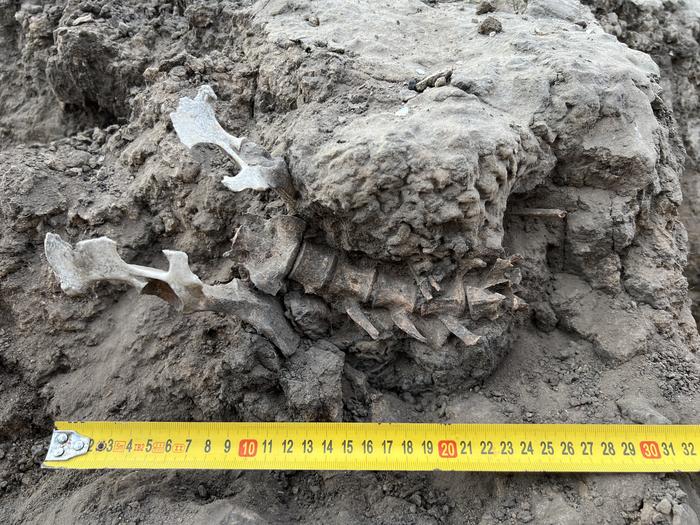
A groundbreaking archaeological discovery along the Baaka, also known as the Darling River in western New South Wales, Australia, has revealed a millennium-old ritual burial of a dingo, or garli as called in the Barkindji language. This finding provides unprecedented insight into the intimate and longstanding relationships between First Nations peoples and dingoes, illuminating complex social and cultural dynamics previously underestimated in this region.
The dingo’s skeletal remains were found deliberately interred within a purpose-built riverside midden, a type of ancient refuse heap. Radiocarbon analysis has dated the burial to between 963 and 916 years ago, marking it as an extraordinary example of early Indigenous ritual practice surrounding animals. Even more remarkable is evidence that the midden continued to be actively maintained and supplemented with river mussel shells for centuries after the dingo’s death. This ongoing “feeding” ritual suggests the animal was venerated as an ancestral figure, demonstrating a profound spiritual connection extending well beyond mere coexistence.
The project, spearheaded by Dr. Amy Way, a leading archaeologist affiliated with the Australian Museum and the University of Sydney, highlights the depth of knowledge held by the Barkindji custodians. According to Dr. Way, Barkindji people have long understood this cultural practice, but the archaeological validation deepens the appreciation of the meticulous care versus animals like garli that were integrated into everyday life and ceremonial traditions.
The dingo’s discovery at Kinchega National Park, near the Menindee Lakes approximately 100 kilometers southeast of Broken Hill, followed a road cutting excavation. As erosion exposed the skeleton, Barkindji Elder Uncle Badger Bates, together with archaeologist Dan Witter from the National Parks and Wildlife Service, identified the site. Subsequent excavations were conducted under the guidance and with the cultural permissions of the Menindee Aboriginal Elders Council, emphasizing the importance of respecting Indigenous cultural protocols in heritage research.
Detailed osteological analysis reveals that the buried dingo was a male who lived an unusually long life for its species, estimated between four and seven years. This longevity is particularly significant, as it contrasts with typical dingoes in the wild that seldom survive beyond three years. The remains show evidence of wear on the teeth and healed injuries to the ribs and lower leg, indicative of a life marked by hardship but prolonged through care. Researchers hypothesize that some injuries may have resulted from encounters with large marsupials such as kangaroos, and the dingo’s survival post-trauma hints at sustained human assistance, underscoring its integration into the community.
This multidisciplinary research involving teams from the University of Sydney, Australian Museum, Australian National University, and the University of Western Australia represents the first direct dating of a dingo burial within the Baaka river system. It challenges prior assumptions that such intricate animal burial practices were geographically confined to southeastern Australia, suggesting instead a far more extensive cultural distribution of complex human-animal relationships.
The midden itself was likely newly established at or just before the time of burial, with further deposits accumulating over generations. Barkindji Elders interpret this as an evolving ritual landscape, where successive additions symbolized a “feeding” of the garli ancestor, maintaining its spiritual presence and reinforcing connections between past and living community members. This interpretation offers a rare perspective on Indigenous ceremonial continuity and ecological stewardship, where the boundaries between human and animal, life and death, merge within ongoing cultural practices.
Lead author and dingo expert Dr. Loukas Koungoulos from the University of Western Australia expounds on the significance of this finding: “Garli was not merely tolerated as a wild animal but was tamed and lived integrally as part of the social fabric. The elaborate burial and subsequent care highlight the reciprocal relationship that defines Indigenous ecological knowledge systems.” This research thus refines our understanding of dingoes’ role, not just as companions or hunting aides but as entities with ancestry status within Barkindji cosmology.
The significance of this discovery reaches beyond archaeological circles, emphasizing the imperative of cross-cultural collaboration in heritage management. The prioritization of Barkindji consent and ceremonial engagement, including smoking ceremonies and reburial practices, underscores ethical research paradigms. It honors Indigenous sovereignty over cultural knowledge and archaeological materials, aligning scientific investigation with community values.
Moreover, this work sheds light on the broader ecological history of the Baaka riverine environment, where humans and dingoes have co-evolved within a challenging landscape. Garli’s burial evidence dovetails with paleoenvironmental data, contributing to a nuanced reconstruction of ancient lifeways, resource use, and social organization along one of Australia’s major river systems.
This pioneering study, published in the journal Australian Archaeology with funding from the Australian Museum Foundation, offers a paradigm shift in how archaeologists and anthropologists perceive animal-human relations in ancient Australian contexts. It challenges entrenched binaries that categorize dingoes as merely wild canids or pests, revealing instead their embeddedness within Indigenous cultural identity, ancestral lineage, and ritual practice.
In summary, the garli burial unearths a story of profound kinship between the Barkindji people and the dingo, a narrative that has been physically buried yet spiritually alive for over a millennium. It reaffirms Indigenous knowledge systems as reservoirs of ecological wisdom and cultural sophistication, inviting a reevaluation of human-animal interrelations in archaeological and anthropological discourse. The discovery strengthens the understanding that relationships with animals extended into the spiritual and communal realms, maintained through ritual, care, and respect.
News Publication Date: 19-May-2026
Web References:
DOI: 10.1080/03122417.2026.2650909
Cite Scienmag News
Courtney Benton. (May 18, 2026). Ancient Burial: Millennium-Old Dingo Found Ritually Buried and Cared for Along Australia’s Darling (Baaka) River. Scienmag. https://scienmag.com/ancient-burial-millennium-old-dingo-found-ritually-buried-and-cared-for-along-australias-darling-baaka-river/
Courtney Benton. "Ancient Burial: Millennium-Old Dingo Found Ritually Buried and Cared for Along Australia’s Darling (Baaka) River." Scienmag, 18 May 2026, https://scienmag.com/ancient-burial-millennium-old-dingo-found-ritually-buried-and-cared-for-along-australias-darling-baaka-river/. Accessed 3 September 2026.
Courtney Benton. "Ancient Burial: Millennium-Old Dingo Found Ritually Buried and Cared for Along Australia’s Darling (Baaka) River." Scienmag. May 18, 2026. https://scienmag.com/ancient-burial-millennium-old-dingo-found-ritually-buried-and-cared-for-along-australias-darling-baaka-river/


