


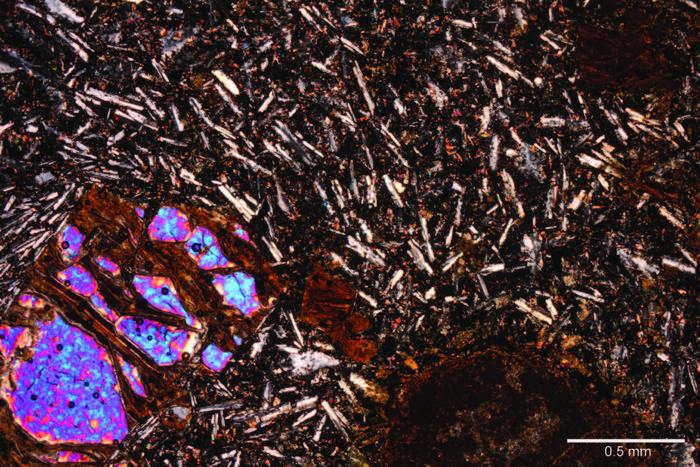
A recent groundbreaking study published in Scientific Reports has unveiled remarkable insights into the cognitive abilities and technological sophistication of ancient hominins nearly 800,000 years ago at the Acheulian site of Gesher Benot Ya‘aqov (GBY) in Israel. This research sheds new light on how these early human ancestors strategically selected basalt, a volcanic rock, for making stone tools, demonstrating not only advanced planning but also a profound understanding of their changing environment through geochemical fingerprinting techniques.
Gesher Benot Ya‘aqov, a key archaeological site located along the paleo-shores of ancient Lake Hula, offers a rich record of Acheulian hominin activity from the early Middle Pleistocene. Excavations at GBY have unearthed a diverse array of artifacts, ranging from flint and limestone tools to extensive evidence of early fire use, as well as dietary traces including animal processing and fish consumption. Among these artifacts, basalt holds particular significance owing to its role in producing large cutting implements such as handaxes and cleavers—tools requiring intricate craftsmanship and raw material knowledge.
The crux of this latest research centers on detailing the procurement strategies employed by early hominins for basalt raw material, delving into the geological sources and their accessibility in ancient landscapes that have since transformed due to tectonic and sedimentary processes. Utilizing geochemical analyses, including examination of major and trace elements as well as rare earth elements, the study compares the compositional fingerprints of basalt artifacts recovered from multiple archaeological layers with basalt flows exposed in the surrounding region. A pivotal part of the methodology involved analyzing basalt samples extracted from the Eshel Ya‘aqov borehole, offering unprecedented access to subsurface basalt units currently buried beneath the modern site.
The results reveal a nuanced picture: many of the basalt tools correlate closely with local geological sources within roughly one kilometer of GBY, indicating the hominins exploited nearby raw materials effectively. However, a remarkable facet of the findings is the match of certain lithic materials with basalt flows that are no longer visible on the surface, having been buried or eroded by geological forces over hundreds of thousands of years. This discovery of “lost” basalt sources underscores the importance of integrating borehole stratigraphy and geochemistry to reconstruct vanished parts of the prehistoric landscape, highlighting the dynamic tectonic activity along the Dead Sea Transform fault system.
A particularly striking outcome of the research is the clear differentiation in raw material selection based on specific tool types. While giant cores—a primary stage in tool production—were predominantly fashioned from locally accessible basalt, cleavers frequently trace back to basalt sources not identified among currently exposed basalt outcrops. This distinction suggests a deliberate selection process whereby hominins sought out basalt flows that possessed unique properties deemed ideal for crafting certain specialized tools, pointing toward sophisticated knowledge of the material’s physical qualities such as slab size, textural uniformity, and fracture mechanics.
This degree of selectivity and material discrimination also implies advanced cognitive planning and extended territorial knowledge. The fact that such procurement strategies persisted continuously across multiple stratigraphic layers at GBY provides compelling evidence for the transmission of technological traditions and environmental expertise over extended periods. This continuity manifests a kind of cultural inheritance, with hominins repeatedly returning to or recalling specific basalt sources to fulfill particular tool-making requirements, thereby demonstrating behavioral complexity previously underestimated for this era.
Moreover, the study strengthens the interpretation that Acheulian hominins possessed a sophisticated “toolkit economy”: a structured approach to raw material exploitation that involved anticipating the lifecycle of artifacts from source selection through blank production to finished tool modification. The linkage of geological data and archaeological evidence exemplifies how early technology was embedded within a broader environmental and geospatial framework, requiring deep familiarity with the landscape—a landscape that, crucially, was subject to constant reshaping through seismic and erosional forces.
The novel integration of geochemistry and archaeological context at GBY offers a valuable methodological blueprint for understanding early human adaptation in tectonically active regions. It challenges prior assumptions that early hominins indiscriminately utilized whatever stone was locally available and instead positions them as strategic agents exercising foresight and discrimination in raw material procurement. This emerging perspective reverberates far beyond GBY, inviting reevaluation of early hominin behaviors associated with toolmaking across various geographic and temporal contexts.
Importantly, the findings spotlight the role of buried prehistoric landscapes, urging archaeologists to consider subsurface geology alongside surface surveys to gain a complete picture of raw material availability and exploitation. The Eshel Ya‘aqov borehole data exemplifies how geochemical sourcing anchored in deep stratigraphy can illuminate past environmental conditions hidden beneath contemporary exposure, illustrating the benefits of multidisciplinary approaches combining geology, chemistry, and archaeology.
In summary, this pioneering research portrays the Acheulian hominins at Gesher Benot Ya‘aqov as innovative and knowledgeable toolmakers who mastered the procurement and transformation of basalt resources within a complex and evolving landscape. Their ability to identify “the right rock for the right tool at the right time” reflects cognitive capabilities and cultural traditions that substantially enhance our understanding of early human technological evolution and environmental interaction during the Middle Pleistocene.
By spotlighting the strategic behaviors of hominins 780,000 years ago, this study enriches the narrative of human prehistory, revealing that our ancestors’ technological sophistication and environmental savvy extend far deeper into time than previously recognized. It emphasizes that technological traditions were not static but repeatedly refined through intergenerational knowledge transfer molded by the challenges and opportunities presented by their dynamic environment.
News Publication Date: 14-May-2026
Web References: http://dx.doi.org/10.1038/s41598-026-51905-0
Cite Scienmag News
Courtney Benton. (June 8, 2026). Ancient Hominins Exhibited Long-Term Planning in Toolmaking Nearly 800,000 Years Ago. Scienmag. https://scienmag.com/ancient-hominins-exhibited-long-term-planning-in-toolmaking-nearly-800000-years-ago/
Courtney Benton. "Ancient Hominins Exhibited Long-Term Planning in Toolmaking Nearly 800,000 Years Ago." Scienmag, 8 June 2026, https://scienmag.com/ancient-hominins-exhibited-long-term-planning-in-toolmaking-nearly-800000-years-ago/. Accessed 4 September 2026.
Courtney Benton. "Ancient Hominins Exhibited Long-Term Planning in Toolmaking Nearly 800,000 Years Ago." Scienmag. June 8, 2026. https://scienmag.com/ancient-hominins-exhibited-long-term-planning-in-toolmaking-nearly-800000-years-ago/


