


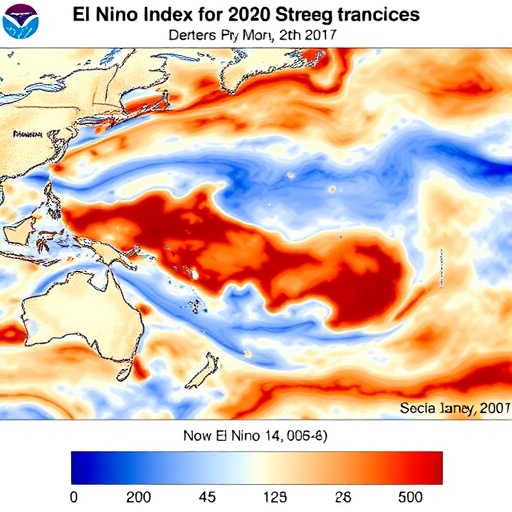
The European Centre for Medium-Range Weather Forecasts (ECMWF) has announced the introduction of a groundbreaking El Niño index designed to provide a more climate-resilient measure of El Niño phenomena. This new index, coined the Relative Niño Index, aims to revolutionize how meteorologists and climatologists interpret El Niño signals amidst the ever-changing backdrop of global climate warming. Given the recent assessments by the World Meteorological Organisation (WMO), which predict an 80% chance of El Niño developing between June and August 2026, along with a 90% likelihood of persistence through November, the scientific community is now more urgently in need of precise and reliable diagnostic tools.
Traditional Niño indices have long relied on contrasting present sea surface temperature (SST) anomalies against static historical baselines, which do not adjust for ongoing oceanic and atmospheric warming trends. This conventional method risks overestimating the magnitude of modern El Niño events because it fails to account for the upward shift in background ocean temperature caused by anthropogenic climate change. Conversely, La Niña events could appear artificially diminished under these measures. The newly formulated Relative Niño Index takes a more nuanced approach by comparing localized warming within the central Pacific Ocean to temperature variations across the broader tropical region. This relative comparison filters out background shifts in temperature, offering a clearer differentiation between anomalous El Niño temperatures and steady-state tropical warming.
Dr. Tim Stockdale, ECMWF’s Principal Scientist involved in this advancement, emphasizes the challenges posed by interpreting climate anomalies within the context of a warming planet. He notes, “As the climate warms, interpreting anomalies becomes more challenging. Rising background temperatures can make recent El Niño events appear stronger than they are, and La Niña events seem weaker.” The core innovation of the Relative Niño Index lies in its calculation methodology, where temperature anomalies in Niño 3.4 and other key regions are simultaneously calibrated against the overall tropical ocean temperature at corresponding times. This comparative framework offers a perspective less confounded by long-term climate trends, thus providing meteorologists with a more reliable estimate of the potential intensity of forthcoming El Niño events.
The significance of this new index extends beyond improved event strength forecasting. By diminishing sensitivity to ongoing global warming trends, the Relative Niño Index better facilitates historical comparability. It allows researchers to more accurately distinguish between natural interannual climate variability—typified by El Niño and La Niña phenomena—and the long-term baseline shifts driven by anthropogenic climate factors. As a result, climatologists can monitor decadal and multi-decadal variations with greater confidence, isolating true anomalies from background climate noise. This enhanced accuracy holds promise for advancing climate science, improving forecast skill, and refining climate models’ inputs.
Despite its novel approach, the Relative Niño Index maintains compatibility with existing Niño indices, which remain invaluable for various scientific applications. These legacy indices—Niño 3.4, Niño 3, Niño 4, and Niño 1+2—track sea-surface temperature anomalies in distinct tropical Pacific zones, each illuminating different facets of ocean-atmosphere coupling and the spatial evolution of ENSO (El Niño-Southern Oscillation) events. While traditionally serving as primary diagnostic metrics, their fixed baseline limitations urged the development of the Relative Niño measure. Given that the Relative Niño Index is calibrated on approximately the same scale as conventional Niño indices, forecasters and researchers can integrate this new tool into their methodologies without significant disruption or need for recalibration of thresholds.
Florian Pappenberger, ECMWF’s Director-General, highlighted the collaborative scientific and operational efforts underpinning the index’s launch. He remarked on the swift adoption potential of the index following WMO’s recent endorsement, asserting that “producing it has been a huge collective endeavour from ECMWF and its partners.” The timing of the index’s availability is critical: current climate indicators suggest that the 2026 El Niño event could be one of the most significant and intense occurrences in the last half-century. The Relative Niño Index will therefore be pivotal in communicating the potential severity of upcoming El Niño conditions, providing governments, scientists, and industries with crucial advance warnings for planning and adaptation.
The need for a more sophisticated El Niño metric has gained urgency as climate change continues to alter baseline conditions globally. Sea surface temperatures now trend upward due to sustained greenhouse gas emissions, complicating the detection of anomalies superimposed on this shifting baseline. The Relative Niño Index’s relative framework effectively normalizes these baseline shifts, yielding climate trend-corrected assessments. As a result, forecasts derived from this index promise improved reliability, reducing the risk of false positives or negatives in El Niño alerts. This advance is expected to enhance decision-making in sectors spanning agriculture, disaster preparedness, fisheries management, and climate policy.
Importantly, the Relative Niño Index complements an array of ENSO-monitoring tools developed over decades, each designed to elucidate different dimensions of this complex climate pattern. Together, these indices provide an interconnected scientific narrative detailing ENSO’s spatial dynamics, temporal evolution, and teleconnections with global weather. However, the Relative Niño Index’s unique capability to adjust for global warming marks an essential methodological milestone in climatology. It bridges the gap between traditional anomaly detection and climate-adaptive interpretation—a transition necessary for the modern climate context.
The development of this index was facilitated by ECMWF’s extensive computational resources and sophisticated modeling frameworks. Utilizing one of the world’s largest meteorological data archives, including the ERA5 reanalysis funded by Europe’s Copernicus programme, researchers were able to analyze vast datasets covering decades of SST observations. This thorough data underpinning ensures the reliability and robustness of the Relative Niño Index across varying climatic conditions, enabling consistent retrospective and prospective analyses.
Given the high stakes presented by an emerging El Niño in 2026, the adoption of the Relative Niño Index will likely become a cornerstone in climate forecasting pipelines internationally. Its easier interpretability—stemming from similarity to existing scales—and its enhanced scientific rigor equip forecasters with a more potent instrument for hazard assessment. This technological step forward represents a paradigm shift in how ENSO phenomena are monitored in an era increasingly characterized by rapid climatic change.
In sum, the introduction of the Relative Niño Index by ECMWF heralds a transformative advancement in meteorological science, providing a climate-adjusted lens through which to view ENSO events. As global temperatures continue to climb, methodologies like this will be crucial in disentangling natural climate variability from anthropogenic trends, ultimately supporting better preparedness and resilience in the face of extreme weather and climate anomalies.
News Publication Date: Not specified in the provided content
Cite Scienmag News
Russell Cooper. (June 8, 2026). New El Niño Index Offers More Accurate Measurement of El Niño Strength. Scienmag. https://scienmag.com/new-el-nino-index-offers-more-accurate-measurement-of-el-nino-strength/
Russell Cooper. "New El Niño Index Offers More Accurate Measurement of El Niño Strength." Scienmag, 8 June 2026, https://scienmag.com/new-el-nino-index-offers-more-accurate-measurement-of-el-nino-strength/. Accessed 3 September 2026.
Russell Cooper. "New El Niño Index Offers More Accurate Measurement of El Niño Strength." Scienmag. June 8, 2026. https://scienmag.com/new-el-nino-index-offers-more-accurate-measurement-of-el-nino-strength/


