


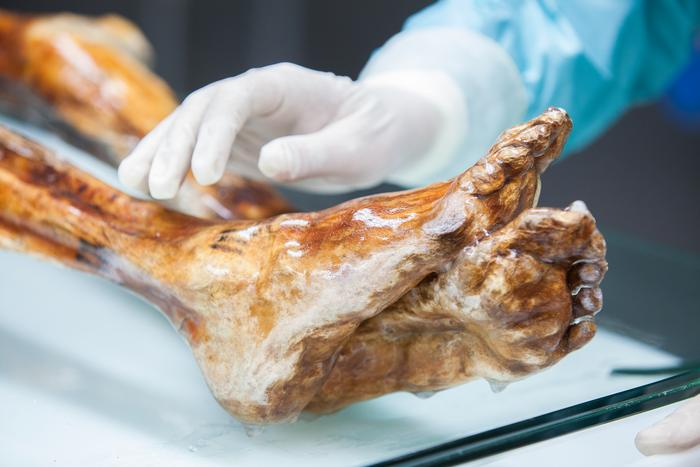
In the heart of the Alpine glaciers lies an extraordinary archive of prehistoric biology—Ötzi the Iceman. Preserved for over 5,000 years at a steady -6°C and nearly 99% relative humidity, Ötzi’s remarkably intact body has long fascinated scientists exploring ancient human life. Recently, a team of researchers unveiled groundbreaking discoveries about the diverse microorganisms that have endured within and around this ancient mummy, shedding light on microbial evolution, preservation, and potential biotechnological applications.
Through a sophisticated combination of genetic sampling and microbiological analysis, the researchers succeeded in distinguishing microbial species that existed within Ötzi during his lifetime from those that colonized him after death. Samples were meticulously collected from both the mummy’s external environment—ice and meltwater inside his refrigeration chamber—and internal tissues, including preserved samples of intestinal tissue and stomach contents. Swab samples augmented these data to create a comprehensive microbial profile, tracing both ancient and modern microbial communities.
The study revealed genetic material from bacteria consistent with Ötzi’s original gut flora, tightly linking his microbiome to those of early human populations. This microbiota composition diverges markedly from that seen in modern industrialized societies, where such bacteria are rare or absent. This remarkable preservation offers an unprecedented glimpse into the microbial ecosystems inhabited by humans during the Copper Age, highlighting evolutionary trajectories and host-microbe relationships dating back millennia.
A particularly surprising discovery emerged from the analysis of yeasts inhabiting Ötzi’s skin, stomach contents, and internal meltwater. These yeasts are highly specialized and extant cold-adapted species, genetically related to strains found in the extreme environments of Antarctica. This affiliation strongly suggests that these microorganisms originated from the glacial setting surrounding Ötzi and have survived, likely in a dormant state, throughout his frozen journey across thousands of years.
What is equally fascinating is the presence of both heavily degraded, ancient DNA and well-preserved modern DNA within these yeasts. This duality indicates that the microbial environment surrounding Ötzi is not static but dynamic—continuously shaped by conditions within the preservation chamber. Frank Maixner, director of the Institute for Mummy Studies at Eurac Research, underscores this by describing Ötzi as more than a lifeless relic; instead, it is a living biological system wherein these yeasts persist and evolve under current conservation parameters.
Furthermore, the study casts new light on how past conservation efforts have inadvertently influenced microbial ecology on the mummy’s surface. For example, phenol, an antifungal agent applied to Ötzi after his discovery in 1991, appears to have selected for yeasts genetically equipped to metabolize phenol. This adaptation suggests that human interventions, even those aimed at preservation, can lead to ecological shifts favoring resilient microbial populations capable of exploiting introduced chemical compounds.
Mohamed S. Sarhan, the study’s lead microbiologist, affirms the unique nature of Ötzi’s microbiome, emphasizing its composition of ancient and newly introduced microbes. Such a complex microbiome challenges traditional notions that ancient microbial life inevitably succumbs to decomposition or becomes fully replaced over time. Instead, Ötzi provides a living laboratory where microbial continuity and evolution can be observed under stable preservation conditions.
Elisabeth Vallazza, director of the South Tyrol Museum of Archaeology, whose institution oversees the Iceman’s conservation, emphasizes the critical role of ongoing microbiological monitoring to safeguard against damage. Although conditions in the refrigeration chamber are currently stable, the researchers highlight that sustained efforts and further studies remain essential to ensure this invaluable specimen lasts for future generations to study and marvel at.
Marco Samadelli, an expert in conservation and a co-author of the research, notes that glacial mummies represent complex biological systems preserved in environments that are not yet fully understood. This investigation enriches existing knowledge about glacial preservation by identifying microbial processes and interactions that affect long-term biological conservation. Understanding these factors is crucial for improving preservation protocols globally.
Beyond its historical and archaeological importance, the discovery of cold-adapted yeasts associated with Ötzi opens promising new avenues for biotechnology. Microorganisms that can perform metabolic functions at low temperatures are highly desirable for energy-efficient industrial processes, such as low-temperature fermentation, which save resources and reduce environmental impact. These extremophile yeasts could serve as models or sources for developing novel bio-catalytic processes.
This detailed microbiome study of the Iceman also contributes to broader microbiological science by juxtaposing ancient human microbiomes with those resulting from modern interventions and environmental changes. The intermingling of age-old microbes with contemporary species paints a complex picture of microbial persistence and adaptability that extends far beyond the mummy itself, informing research into ancient diseases, human evolution, and microbiome-environment interactions.
In essence, Ötzi’s frozen microbiome is a testament to persistence and change, a biological time capsule that simultaneously preserves a microbial community from 5,000 years ago while reflecting thousands of years of environmental influence and recent conservation efforts. This unique interplay offers an unparalleled opportunity to deepen our understanding of life at the microscopic level over archaeological time scales.
The research was published in the esteemed journal Microbiome on June 3, 2026. By integrating multidisciplinary approaches involving molecular biology, archaeology, microbiology, and conservation science, this study underscores the potential hidden within ancient remains to revolutionize biotechnology and biological conservation strategies going forward.
News Publication Date: 3-Jun-2026
Web References: 10.1186/s40168-026-02417-6
Cite Scienmag News
Morgan Morrow. (June 3, 2026). Ötzi and His Microbiome: Exploring a 5,300-Year-Old Human-Microbial Connection. Scienmag. https://scienmag.com/otzi-and-his-microbiome-exploring-a-5300-year-old-human-microbial-connection/
Morgan Morrow. "Ötzi and His Microbiome: Exploring a 5,300-Year-Old Human-Microbial Connection." Scienmag, 3 June 2026, https://scienmag.com/otzi-and-his-microbiome-exploring-a-5300-year-old-human-microbial-connection/. Accessed 4 September 2026.
Morgan Morrow. "Ötzi and His Microbiome: Exploring a 5,300-Year-Old Human-Microbial Connection." Scienmag. June 3, 2026. https://scienmag.com/otzi-and-his-microbiome-exploring-a-5300-year-old-human-microbial-connection/


