


The ancient climate of the Eastern Mediterranean has long intrigued scientists seeking to understand how environmental changes influenced human civilizations. Recent research reveals that this climate was far more erratic and volatile than previously assumed, yet human societies demonstrated remarkable adaptability amidst such turmoil. An interdisciplinary team of researchers, led by UC San Diego’s Center for Cyber-Archaeology and Sustainability (CCAS) and the University of Haifa’s Recanati Institute for Maritime Studies (RIMS), employed a pioneering multi-proxy method to decode climate patterns spanning 4,000 years along Israel’s Carmel Coast, offering unprecedented insight into the region’s environmental and cultural evolution.
This research focuses on a pivotal climatic phase known as the end of the African Humid Period, during which the Southern Levant transitioned dramatically from wet, verdant landscapes to increasingly arid conditions. Contrary to the notion of a gradual desiccation, the team’s findings indicate sharp oscillations between wet and dry extremes. These oscillations occurred at variable timescales—some shifts unfolded within a single generation, while others spanned several centuries—indicating a highly dynamic and unstable climate system. Such complexity challenges traditional linear models of environmental decline and suggests societies faced pressures demanding continual innovation.
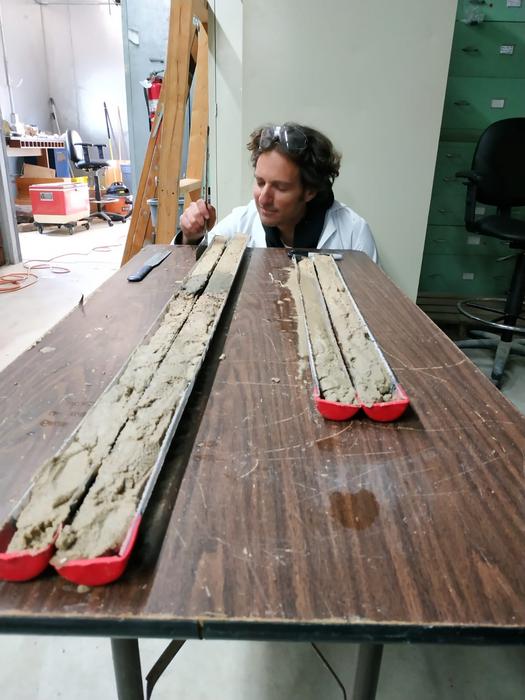
Central to this breakthrough is a novel analytic framework integrating paleoecological and geochemical data from sediment cores extracted up to 16 meters deep from ancient wetlands. These wetlands act as natural archives, preserving finely layered sediments that accumulate organic and inorganic markers over millennia. Within individual sediment strata, the researchers identified indicators such as preserved fossilized freshwater snails and mussels signaling humid intervals, while salt-tolerant species pointed to episodes of drought and wetland contraction. Charcoal deposits recorded ancient fire events and erosion dynamics, while phytoliths and pollen grains reconstructed surrounding vegetation and, by extension, prevailing climatic conditions.
This multi-proxy analysis enabled the creation of an exquisitely detailed climate chronology, stretching back as far as 8,000 years before present. A particularly notable feature is an anomalously wet period approximately between 7,800 and 7,600 years ago, succeeded by a steady trend toward aridity. Additionally, recurrent drought episodes evident around 4,200 years ago coincide temporally with widespread societal disruptions documented elsewhere in the Near East, raising compelling questions about resilience and vulnerability within ancient communities.
Importantly, archaeological data juxtaposed with the paleoclimate timeline indicates that while climatic stress served as a significant background factor influencing human settlement and subsistence strategies, it did not directly precipitate population collapse or mass migrations. Instead, ancient groups appear to have exercised remarkable ingenuity in adapting to environmental challenges by developing innovative agricultural techniques, such as early floodwater farming—a form of rudimentary irrigation—and sophisticated herd management practices optimal for semi-arid landscapes. These adaptive responses facilitated continued occupation and expansion into drier territories despite the shifting climate stressors.
Senior author Tom Levy, co-director of CCAS, emphasizes the human dimension, noting, “People are problem solvers. They respond to environmental stress by inventing new technologies and strategies.” This perspective challenges deterministic views that attribute cultural decline solely to climatic forces, highlighting instead the dynamic interplay between human agency and natural conditions. The research underscores that ancient societies were neither passive victims nor inevitably doomed by climate variability; rather, they were active agents seeking solutions to complex challenges.
From a methodological standpoint, the study exemplifies interdisciplinary synergy, combining paleoenvironmental science with cutting-edge cyber-archaeological tools. Sediment core extraction involved precise stratigraphic drilling techniques, ensuring intact layers for laboratory analyses of microfossils, charcoal particles, and chemical proxies such as stable isotopes and elemental composition. These complementary datasets were synthesized into cohesive climate reconstructions using robust statistical and geospatial models, marking a significant advance over single-proxy approaches prone to ambiguity.
Beyond reconstructing ancient environments, the project connects to contemporary technological innovations spearheaded by CCAS researchers such as Neil Smith, who integrates AI-driven virtual reality frameworks to create immersive reconstructions of prehistoric landscapes. By digitizing and visualizing complex archaeological and geoscientific data, these tools afford researchers and the public alike novel ways of engaging with deep time environmental narratives, fostering deeper understanding of humanity’s enduring relationship with climate.
This research also holds promise for global applications. Given the ubiquity of wetland sediment archives worldwide, the team’s integrative methodology offers a replicable blueprint for investigating ancient climate-human interactions across diverse ecological and cultural contexts. Such expanded application could transform our broader comprehension of how societies have historically negotiated environmental risks and how lessons from the past might inform current climate resilience strategies.
The comprehensive climate record developed elucidates key historical periods, including the transition from the late Neolithic era village-based societies to more complex Early Bronze Age urban systems. This long temporal lens allows for nuanced explorations of how incremental climatic oscillations intertwined with evolving social dynamics, contributing fresh perspectives on the processes underpinning cultural shifts and technological innovations in one of the world’s earliest cradles of civilization.
In sum, this study redefines our understanding of Eastern Mediterranean Holocene climate dynamics, revealing a turbulent environmental backdrop against which humanity’s capacity for adaptation and innovation shines. Through meticulous sediment analysis, interdisciplinary collaboration, and the infusion of emerging digital technologies, the researchers have crafted a detailed narrative of resilience in the face of climatic volatility, offering a vital window into both our past and potentially our future.
News Publication Date: 13-May-2026
Web References:
DOI link: 10.1016/j.quascirev.2026.110028
References:
Shtienberg, G., Levy, T.E., Norris, R.D., Mahony, K., Plat, K., Rittenour, T.M., Mischke, S., Langgut, D., Yasur-Landau, A., Sivan, D., Bárta, M. (2026). Early to Mid-Holocene Climate Oscillations and Cultural Shifts in the Eastern Mediterranean. Quaternary Science Reviews.
Cite Scienmag News
Gavin Prescott. (May 18, 2026). Centuries of Climate Turmoil and Human Resilience Revealed by Scientists. Scienmag. https://scienmag.com/centuries-of-climate-turmoil-and-human-resilience-revealed-by-scientists/
Gavin Prescott. "Centuries of Climate Turmoil and Human Resilience Revealed by Scientists." Scienmag, 18 May 2026, https://scienmag.com/centuries-of-climate-turmoil-and-human-resilience-revealed-by-scientists/. Accessed 4 September 2026.
Gavin Prescott. "Centuries of Climate Turmoil and Human Resilience Revealed by Scientists." Scienmag. May 18, 2026. https://scienmag.com/centuries-of-climate-turmoil-and-human-resilience-revealed-by-scientists/


