


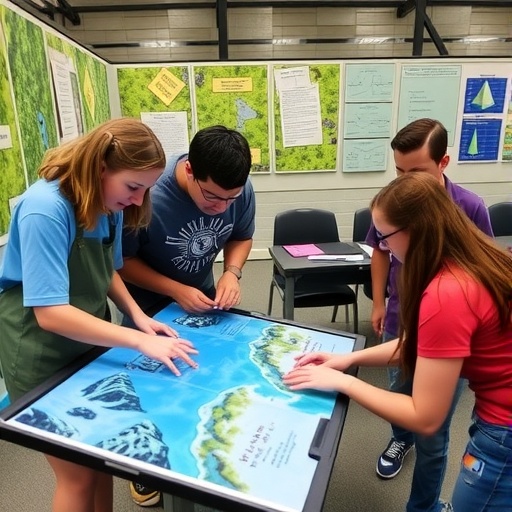
In an era marked by escalating climate crises, the imperative to comprehend flooding mechanisms has never been more critical. Floods, shaped by a complex interplay of atmospheric phenomena, terrestrial dynamics, and anthropogenic factors, pose a formidable challenge for educators and scientists alike. The multifaceted nature of hydrological processes, which govern how rainfall transforms into runoff and ultimately rivers swell, demands educational methodologies that can make this complexity accessible without compromising scientific depth.
The Institute of Industrial Science at The University of Tokyo has pioneered a breakthrough in this educational domain with the development of “SplashTune,” a scientifically robust yet intuitively designed rainfall-runoff model presented through gamification. This initiative represents a paradigm shift from traditional didactic methods by engaging learners interactively, thus bridging the gap between abstract scientific theory and comprehensible practice.
At the heart of SplashTune lies its capacity to emulate real-time hydrological phenomena such as infiltration—the process by which water permeates soil surfaces—and surface runoff, where water flows overland toward streams and rivers. Utilizing animated water particles as visual metaphors, the model allows users to observe these processes dynamically, an approach that has dramatically enhanced the ability of non-specialists to visualize and internalize these critical mechanisms.
Such abstraction remains a significant hurdle in hydrology education due to the invisible and often intangible nature of subterranean water flows and soil moisture dynamics. The interactive framework of SplashTune overcomes these barriers by converting simulation parameters into manipulable variables within a virtual environment. This enables learners to actively “tune” environmental inputs—ranging from precipitation intensity to land cover characteristics—and witness the consequent variances in river flow patterns and flood events.
This methodological innovation is more than mere engagement; it facilitates a systemic understanding of flood genesis, where simultaneous factors coalesce to produce emergent behaviors. Traditional models or lectures may treat flooding as a linear chain reaction, whereas SplashTune elucidates the nonlinear interactions—how soil saturation levels influence runoff speed or how urbanization alters flood peaks—thus fostering a comprehensive grasp of hydrological feedback loops.
The pedagogical efficacy of this interactive model was rigorously evaluated via a controlled study involving 136 Japanese high school students. Pre- and post-intervention assessments revealed statistically significant improvements in students’ conceptual understanding of hydrological processes, suggesting that active experimentation and immediate visual feedback catalyze meaningful learning. The model particularly enhanced comprehension of nuanced topics such as the temporal sequencing of flood response and the modulatory effects of land use on hydrologic timing and intensity.
Lead author Dai Yamazaki emphasized the intrinsic complexity of hydrological modeling, noting that domain experts often grapple with its abstract constructs. The impetus behind SplashTune was to lower this cognitive barrier, making these scientific insights accessible to broader audiences beyond academic circles. Coauthor Taishi Yazawa articulated the value of “playable hydrology,” underscoring the synergy between immersive gameplay and learning that empowers students to discover phenomena independently rather than passively receive information.
Beyond the classroom, the implications of SplashTune extend into public education and risk communication. As climate change intensifies flood frequencies globally, empowering communities with intuitive understanding of flood genesis can enhance preparedness and informed decision-making. The platform’s capacity to demystify hydrology could foster greater public engagement with water resource management and resilience strategies, which are critical in mitigating disaster impacts.
SplashTune’s design synthesizes advances in environmental modeling, computer graphics, and behavioral science. It leverages real-world hydrologic equations simplified into user-friendly algorithms. These strike a balance between computational fidelity and pedagogical clarity, ensuring that simulated outcomes fairly represent natural phenomena without overwhelming learners with technical minutiae.
Furthermore, the adaptability of the model allows educators to tailor scenarios to specific geographic contexts or teaching goals, incorporating diverse factors such as varying soil types, vegetation cover, or urban infrastructure. This flexibility bolsters the tool’s relevance across a spectrum of educational settings and environmental conditions, enhancing its potential for widespread adoption.
The project exemplifies the fruitful convergence of academic rigor and innovative teaching methodologies, highlighting the role of technology in transforming STEM education. It aligns with a growing trend toward experiential learning, where interactivity, feedback loops, and user agency are harnessed to deepen conceptual understanding and retention.
In sum, SplashTune represents a significant advancement in environmental education technology. It underscores the power of gamified models to elucidate complex Earth systems processes, playing a pivotal role in preparing future generations to address the hydrological challenges posed by a changing climate.
Web References: DOI: 10.1029/2025WR041550
Cite Scienmag News
Violet Maxwell. (May 18, 2026). Students Dive into Interactive Hydrology for a Hands-On Learning Experience. Scienmag. https://scienmag.com/students-dive-into-interactive-hydrology-for-a-hands-on-learning-experience/
Violet Maxwell. "Students Dive into Interactive Hydrology for a Hands-On Learning Experience." Scienmag, 18 May 2026, https://scienmag.com/students-dive-into-interactive-hydrology-for-a-hands-on-learning-experience/. Accessed 3 September 2026.
Violet Maxwell. "Students Dive into Interactive Hydrology for a Hands-On Learning Experience." Scienmag. May 18, 2026. https://scienmag.com/students-dive-into-interactive-hydrology-for-a-hands-on-learning-experience/


