


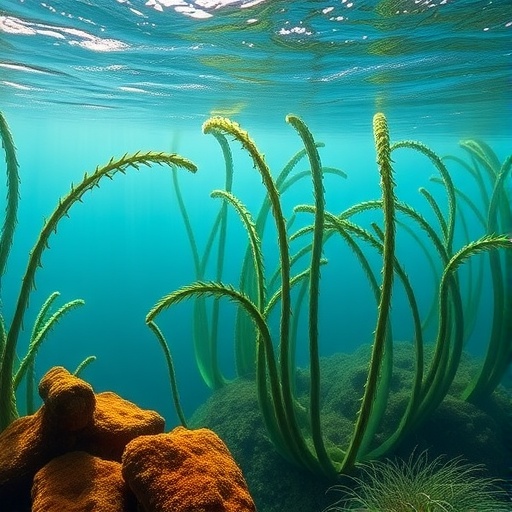
New research spearheaded by the University of Victoria has uncovered startling evidence indicating that the disappearance of kelp forests along the coasts of Vancouver Island began decades earlier than scientists previously realized. This revelation not only reframes our understanding of the timing of these crucial ecosystem losses but underscores a much longer history of climate-driven environmental change than commonly acknowledged. The findings highlight the necessity to revisit historical baselines if we are to fully comprehend and effectively respond to marine ecosystem transformations in the context of ongoing global warming.
Kelp forests, dense underwater canopies of large macroalgae, serve as foundational species in coastal environments, providing habitat, food, and shelter for myriad organisms including commercially important fish species, such as salmon and rockfish. Historically celebrated as vibrant hubs of biodiversity and productivity, the current state of these forests has been severely compromised. Their decline deeply affects ecological function, fisheries, and coastal resilience, yet until now, the scale and timing of this degradation remained elusive.
Brian Timmer, a PhD student at UVic and National Geographic Explorer, led a comprehensive study utilizing an innovative approach to reconstruct the historical extent of kelp forests in the northern Salish Sea, particularly near Comox and Denman Island. By meticulously collating archival aerial photographs, navigational maps, and scuba survey data dating back to 1972, and replicating the same survey methods in 2023, Timmer and colleagues were able to generate a comparative timeline of kelp forest coverage and species composition spanning more than fifty years.
This reconstruction revealed that the expanse of bull kelp forests once exceeded 550 hectares—a tenfold increase over previously accepted baselines. Crucially, none of these historically expansive kelp beds remain today. The most profound losses were documented between 1972 and 1984, predating the well-documented marine heatwaves such as the “Blob” event that garnered scientific and public attention in the last decade. This shift in understanding indicates that climate-induced changes in kelp ecosystems have been unfolding over a much longer temporal window than originally assumed.
To ascertain the role of climate change as a driving force behind kelp forest decline, the research team analyzed historical sea surface temperature data recorded at lighthouses throughout the Salish Sea region. The data elucidated a significant warming trend commencing in the early 20th century, with accelerated temperature increases noted by the late 1970s concurrent with kelp forest collapse. Importantly, this warming trajectory has continued unabated into the present day, exacerbating the inhospitable conditions for cold-adapted kelp species.
Underwater surveys further revealed drastic reductions in the abundance of cold-adapted kelp and red macroalgae species, with losses ranging between 60 and 99% in shallow waters. Perhaps more alarmingly, the void left by these foundational cold-water species has not been filled by warm-water tolerant algae. This absence of ecological replacement signifies a substantive deborealization of the kelp forest community, implicating ecosystem simplification and reduced habitat complexity, with serious implications for dependent marine fauna such as herring and rockfish, which rely on kelp beds for shelter and feeding grounds.
The research challenges the prevailing notion of what constitutes a “normal” or baseline state for kelp forests in this region. The previously held baselines appear to have been established post-collapse, effectively masking the extent of historical loss and skewing perceptions of marine ecosystem health. As UVic’s Brian Timmer emphasizes, refining these baselines is critical if conservation, restoration, and climate mitigation efforts are to be designed on a foundation of ecological truth rather than diminished expectations.
Kelp forests act as natural coastal infrastructure, buffering shorelines against erosion, supporting economically valuable fisheries, and sustaining Indigenous cultural practices intimately linked with marine biodiversity. Their decline, therefore, is not solely an ecological crisis but also a socioeconomic and cultural one, warranting urgent cross-sectoral attention. This study’s illumination of early and ongoing climate impacts on these ecosystems calls for a re-evaluation of management priorities and climate resilience strategies in marine conservation.
This research was made possible through the support of Fisheries and Oceans Canada, the Natural Sciences and Engineering Research Council, the National Geographic Society, and the Royal Canadian Geographic Society’s Trebek Initiative. The interdisciplinary collaboration and funding acknowledge the growing recognition of kelp forest ecosystems’ vulnerability and importance.
The methodology employed—a combination of remote sensing, historical data reconstruction, and direct underwater observations—demonstrates a powerful integrative approach to marine ecological research. Innovative use of long-term historical photographs and temperature records enabled a reconstruction of ecological baselines otherwise unreachable through conventional means, setting a precedent for future studies in marine ecology and climate impact assessments.
Looking forward, this work raises critical questions about the resilience thresholds of kelp forests in the face of accelerating ocean warming and other anthropogenic stressors. If the observed patterns hold across broader spatial scales, it may indicate that many coastal marine systems are far more compromised than anticipated, necessitating immediate and robust restoration and protection efforts informed by accurate historical baselines.
In conclusion, the discovery that kelp forests along the northern Salish Sea coast were already in precipitous decline by the 1970s compels a reconsideration of marine ecological timelines and resilience models. It is a clarion call to scientists, policymakers, and conservationists alike to integrate historical ecological data into their frameworks, ensuring that interventions target genuine ecosystem recovery rather than illusions of an already altered ‘normal.’ As climate change continues to shape coastal and marine environments, the imperative to understand past baselines and trajectories becomes central to sustaining ocean biodiversity and ecosystem services in perpetuity.
News Publication Date: 6-Apr-2026
Web References: Ecological Applications Article
Cite Scienmag News
Sloane Callahan. (June 8, 2026). Five Decades of Data Uncover the True Impact of Climate Change on Kelp Forests. Scienmag. https://scienmag.com/five-decades-of-data-uncover-the-true-impact-of-climate-change-on-kelp-forests/
Sloane Callahan. "Five Decades of Data Uncover the True Impact of Climate Change on Kelp Forests." Scienmag, 8 June 2026, https://scienmag.com/five-decades-of-data-uncover-the-true-impact-of-climate-change-on-kelp-forests/. Accessed 4 September 2026.
Sloane Callahan. "Five Decades of Data Uncover the True Impact of Climate Change on Kelp Forests." Scienmag. June 8, 2026. https://scienmag.com/five-decades-of-data-uncover-the-true-impact-of-climate-change-on-kelp-forests/


