


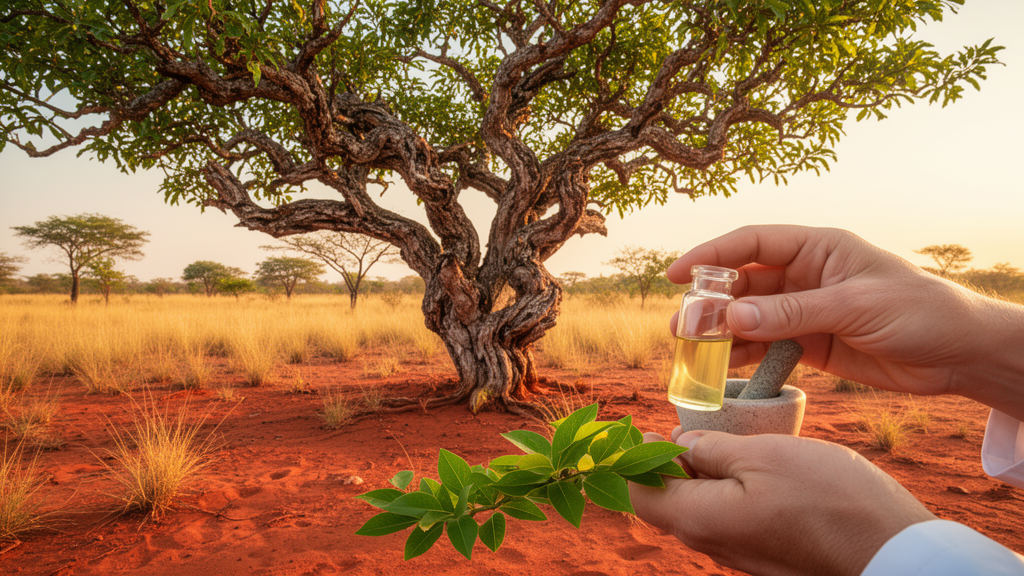
Deep in the Brazilian cerrado, a gnarled tree known locally as marolo or araticum has long been a fixture of folk medicine, its seeds used against snakebites and diarrhea, its leaves brewed for rheumatism and pain. Now a team of Brazilian researchers has subjected those leaves to a rigorous modern interrogation, combining high-resolution analytical chemistry with machine-learning-driven target prediction, and the results suggest that Annona crassiflora may harbor far more therapeutic potential than its traditional reputation implies. The study, published in Frontiers in Natural Products, offers one of the most comprehensive looks yet at the chemical arsenal packed into the leaves of this savanna tree.
The researchers, based at the Federal University of Minas Gerais, the State University of Minas Gerais, and the Ezequiel Dias Foundation, focused on a hydroalcoholic fraction extracted from the leaves. Using high-performance liquid chromatography coupled to electrospray ionization quadrupole time-of-flight tandem mass spectrometry, they tentatively identified fifteen compounds in the fraction. Among them were flavonoid glycosides such as peltatoside, trifolin, hyperoside, and rutin, alongside the flavan-3-ols catechin and epicatechin. Molecular networking on the GNPS2 platform revealed an additional layer of chemical complexity, pointing to procyanidins, cyanidin glycosides, and a suite of aporphine and oxoaporphine alkaloids that had not been isolated in earlier conventional phytochemical work on the species.
With the chemical inventory in hand, the team turned to biological testing. In a DPPH radical scavenging assay, the fraction and several of its isolated flavonoids displayed antioxidant activity statistically comparable to gallic acid, a widely used reference antioxidant. Trifolin, hyperoside, and quercetin-3-O-β-L-arabinopyranoside all produced IC50 values in the same range as the positive control, while rutin fell slightly short under the experimental conditions. The findings reinforce earlier reports that the polar fractions of A. crassiflora leaves are rich in radical-scavenging polyphenols, and they suggest that the antioxidant reputation of the plant rests on solid quantitative ground.
More striking were the results of the acetylcholinesterase inhibition assay. Acetylcholinesterase is the enzyme that breaks down the neurotransmitter acetylcholine in the brain, and its inhibition is the mechanism behind several approved Alzheimer’s disease drugs, including galantamine, itself derived from a plant. At a concentration of 1.0 milligram per milliliter, the hydroalcoholic leaf fraction inhibited the enzyme by roughly 72 percent, while the isolated flavonoid quercetin-3-O-β-L-arabinopyranoside reached nearly 87 percent, a level statistically indistinguishable from galantamine under the same conditions. Rutin, the other flavonoid tested, achieved about 63 percent inhibition. These are preliminary results from a single in vitro assay, but they place A. crassiflora flavonoids in the conversation alongside compounds that have already reached the clinic.
The team also evaluated tyrosinase, the enzyme responsible for melanin production and a common target in cosmetic and dermatological research. Here the results were more modest. The fraction and the two tested flavonoids inhibited tyrosinase by roughly 51 to 65 percent, significantly below the kojic acid positive control, which reached 96 percent. Still, the authors note that tyrosinase inhibitors hold commercial interest for skin-lightening and anti-aging formulations, and the moderate activity of the fraction warrants further exploration of its composition.
The most ambitious part of the study, however, lay beyond the laboratory bench. The researchers deployed Active-IT, an in-house ligand-based virtual screening system built on approximately 4,000 predictive models trained on PubChem BioAssay data using Support Vector Machine and Naïve Bayes algorithms. Before making any predictions about the A. crassiflora flavonoids, the team validated the system against known activities, achieving an area under the ROC curve of 0.97 for the SVM models in internal validation and an extraordinary 0.999 in external validation, where models containing the test compounds in their training sets were excluded. The Naïve Bayes models performed somewhat less impressively but still respectably, with AUC values of 0.82 and 0.882 respectively.
Armed with this validated computational engine, the team predicted biological activities for the six characterized flavonoids across roughly 2,000 biological activities drawn from 3,700 PubChem BioAssay datasets. The predictions spanned an extraordinary pharmacological breadth. Both flavonoid glycosides and monomeric flavan-3-ols were flagged as candidates for antitumor activity, with predicted targets including DNA repair helicases such as RECQ1 and WRN, the transcription factor RUNX1/CBFB, the tumor suppressor PTEN, and components of the SUMOylation machinery. Anti-inflammatory targets, including Toll-like receptor 2 and phospholipase A2 group VII, also emerged prominently, consistent with prior experimental work showing anti-inflammatory effects of the leaf fraction in animal models.
Perhaps most intriguingly, the computational screen pointed toward antimalarial and antiviral potential. The flavonoid glycosides were predicted to inhibit Plasmodium falciparum Protein Kinase 6 and the M1 alanyl aminopeptidase, both considered promising but underexplored antimalarial targets. Both compound classes were predicted to inhibit the Zika virus NS2B-NS3 protease, a finding consistent with prior reports that rutin shows activity against this viral enzyme. The predictions also extended to Yersinia pestis DNA topoisomerase I and Mycobacterium tuberculosis helicases, hinting at antibacterial relevance for pathogens of global concern. In the neurodegenerative arena, both compound classes were predicted to interact with targets including microtubule-associated protein tau, acetylcholinesterase itself, and several CNS receptors, dovetailing neatly with the in vitro cholinesterase results.
The authors are careful to frame these predictions as hypotheses rather than conclusions. Ligand-based virtual screening identifies statistical similarities between compounds and known actives, but it cannot guarantee that a molecule will reach its target in a living organism, where absorption, distribution, metabolism, excretion, and toxicity all intervene. The team explicitly recommends that the predicted targets be treated as tools for pharmacological prioritization, with experimental validation through in vitro and in vivo studies as the essential next step. They also acknowledge the limitations of their computational metrics, noting that severe class imbalance in the training data produced low positive predictive values in some internal validations, a known challenge in virtual screening.
What emerges from the study is a portrait of a plant whose therapeutic promise extends well beyond its folk medicine pedigree. The combination of rigorous analytical chemistry, quantitative enzyme inhibition assays, and machine-learning-driven target prediction offers a template for how underexplored biodiversity might be systematically mined for drug leads. The cerrado, one of the world’s most biodiverse savannas and one of its most threatened, continues to yield chemical surprises. If the predicted activities of A. crassiflora flavonoids survive experimental scrutiny, this humble savanna tree could find itself at the center of a new chapter in natural product drug discovery, one written as much by algorithms as by traditional knowledge.
Subject of Research: Phytochemical profiling and in vitro and in silico bioactivity evaluation of Annona crassiflora leaf flavonoids
Article Title: Therapeutic prospects of Annona crassiflora based on in vitro and in silico approaches
Article References: Pimenta, L. P. S., Lage, G. A., Filho, J. D. D. S., Machado, A. R. T., Almeida, V. L., & Lopes, J. C. D. (2026). Therapeutic prospects of Annona crassiflora based on in vitro and in silico approaches. Frontiers in Natural Products, 5, Article 1907968. https://doi.org/10.3389/fntpr.2026.1907968
Image Credits: AI Generated
DOI: 10.3389/fntpr.2026.1907968
Keywords: Annona crassiflora, flavonoids, antioxidant, acetylcholinesterase, tyrosinase, in silico target fishing, machine learning, Brazilian cerrado, natural products, phytochemistry, drug discovery, neurodegenerative diseases
Cite Scienmag News
Diana Fleming. (October 17, 2026). Brazilian Cerrado Tree Yields Flavonoids With Alzheimer’s Drug Potential. Scienmag. https://scienmag.com/brazilian-cerrado-tree-yields-flavonoids-with-alzheimers-drug-potential/
Diana Fleming. "Brazilian Cerrado Tree Yields Flavonoids With Alzheimer’s Drug Potential." Scienmag, 17 October 2026, https://scienmag.com/brazilian-cerrado-tree-yields-flavonoids-with-alzheimers-drug-potential/. Accessed 17 October 2026.
Diana Fleming. "Brazilian Cerrado Tree Yields Flavonoids With Alzheimer’s Drug Potential." Scienmag. October 17, 2026. https://scienmag.com/brazilian-cerrado-tree-yields-flavonoids-with-alzheimers-drug-potential/


