


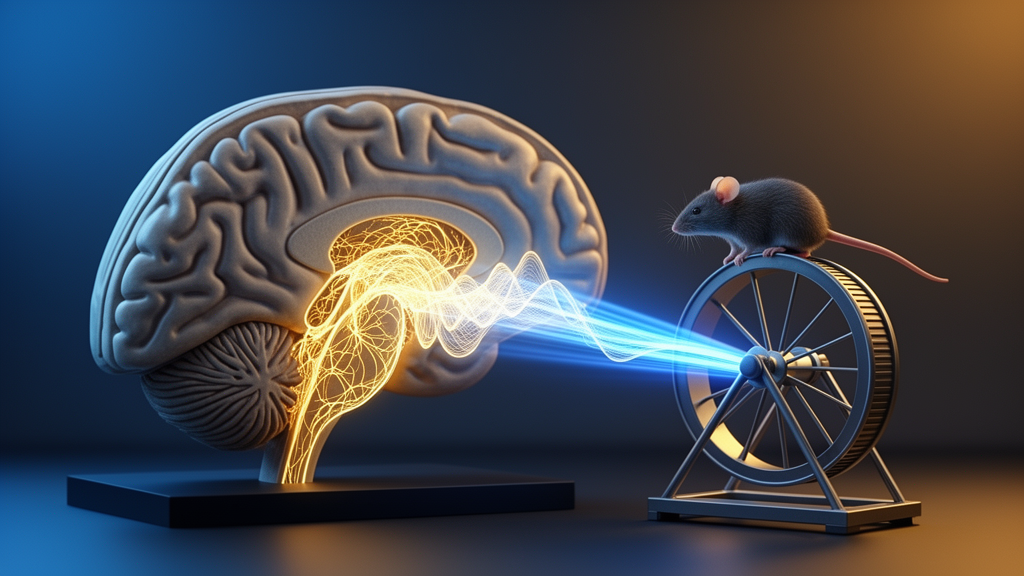
A short, one-week combination of blue light exposure and physical exercise has rescued memory deficits in a mouse model of Alzheimer’s disease, according to a new study published in Behavioral and Brain Functions. Remarkably, neither intervention achieved this on its own: blue light alone or exercise alone produced no detectable behavioral improvement over the same brief window, while the combined regimen did.
The study, led by Yuanrong Qiu, Yifei Tan and colleagues with senior author Xiaoxia Jiang, focused on 5xFAD mice, a widely used transgenic model of Alzheimer’s disease, and their wild-type littermates. The animals were randomized into five groups of eight each: a wild-type control group, an Alzheimer’s disease control group, and three groups of Alzheimer’s mice receiving blue light alone, exercise alone, or the combined intervention. All mice completed seven days of exercise acclimatization before the formal intervention began.
This pathway has drawn growing interest because non-pharmacological interventions acting through it, like patterned or flickering light, have shown beneficial effects on cognitive function, and physical exercise has independently been linked to cognitive benefits. What remained unclear, the authors note, was whether combining the two could deliver added benefits within a short intervention window where single interventions lack obvious efficacy.
In both measures, the one-week combined intervention effectively rescued the cognitive deficits seen in the Alzheimer’s model mice, while the single-treatment groups showed no detectable behavioral improvement at that time point.
What sets the study apart is its electrophysiological arm. The researchers used wireless recordings to capture local field potentials, the summed electrical activity of large ensembles of neurons, from the hippocampal CA1 region, a structure central to memory formation. Recordings were made both during rest and while animals performed the behavioral tasks, allowing the team to link changes in brain rhythms directly to task performance.
The combined intervention corrected a pathological elevation of delta band power, a slow oscillation that was abnormally increased in the Alzheimer’s mice, and restored deficits in the gamma band, a faster rhythm implicated in cognition. It also selectively enhanced theta-gamma phase-amplitude coupling, a form of cross-frequency interaction in which the phase of the theta rhythm modulates the amplitude of gamma activity, and which is thought to support memory processing.
Intriguingly, the neural restoration showed clear task-dependent patterns. In the novel object recognition task, the combined treatment produced an additional elevation of theta power, while in the Y-maze task the improvement appeared as concurrent restoration of both delta-gamma and theta-gamma phase-amplitude coupling. This task specificity suggests that the combined intervention does not simply normalize brain rhythms uniformly, but reshapes oscillatory dynamics in ways that track the cognitive demands of the moment.
The authors conclude that short-term combined treatment with ipRGC-sensitive blue light and physical exercise ameliorates cognitive impairment at a time point when monotherapies have not yet produced significant beneficial effects, and that the regimen remodels hippocampal oscillatory activity and phase-amplitude coupling. They position the combined approach as a promising therapeutic strategy for mitigating cognitive impairment.
As with all animal research, the findings are preliminary with respect to human health: the results come from a transgenic mouse model with small group sizes of eight animals per condition, and the published version is an early-release, peer-reviewed accepted manuscript that remains subject to further editorial edits. Nevertheless, the study offers a striking demonstration that two interventions with modest individual effects over one week can, in combination, rapidly reverse both behavioral deficits and pathological neural oscillations in an Alzheimer’s model, pointing to a potentially accessible, non-pharmacological avenue worth further investigation.
Subject of Research: Combined blue light exposure and exercise as a short-term non-pharmacological intervention for cognitive impairment in a mouse model of Alzheimer's disease
Article Title: ipRGC-sensitive blue light exposure combined with exercise alleviates cognitive disorders and reverses pathological oscillations in mice
Article References: Qiu, Y., Tan, Y., Chen, H., Kuang, G., Ruan, H., Zou, F., & Jiang, X. (2026). ipRGC-sensitive blue light exposure combined with exercise alleviates cognitive disorders and reverses pathological oscillations in mice. Behavioral and Brain Functions. https://doi.org/10.1186/s12993-026-00371-9
Image Credits: AI Generated
DOI: 10.1186/s12993-026-00371-9
Keywords: Alzheimer's disease, 5xFAD mice, blue light therapy, physical exercise, hippocampus, neural oscillations, gamma band, theta-gamma coupling, local field potentials, cognitive function, ipRGC, non-pharmacological intervention
Cite Scienmag News
Cassandra Pierce. (October 28, 2026). Blue Light Plus Exercise Restores Memory and Brain Rhythms in Alzheimer’s Mice. Scienmag. https://scienmag.com/blue-light-plus-exercise-restores-memory-and-brain-rhythms-in-alzheimers-mice/
Cassandra Pierce. "Blue Light Plus Exercise Restores Memory and Brain Rhythms in Alzheimer’s Mice." Scienmag, 28 October 2026, https://scienmag.com/blue-light-plus-exercise-restores-memory-and-brain-rhythms-in-alzheimers-mice/. Accessed 28 October 2026.
Cassandra Pierce. "Blue Light Plus Exercise Restores Memory and Brain Rhythms in Alzheimer’s Mice." Scienmag. October 28, 2026. https://scienmag.com/blue-light-plus-exercise-restores-memory-and-brain-rhythms-in-alzheimers-mice/


