


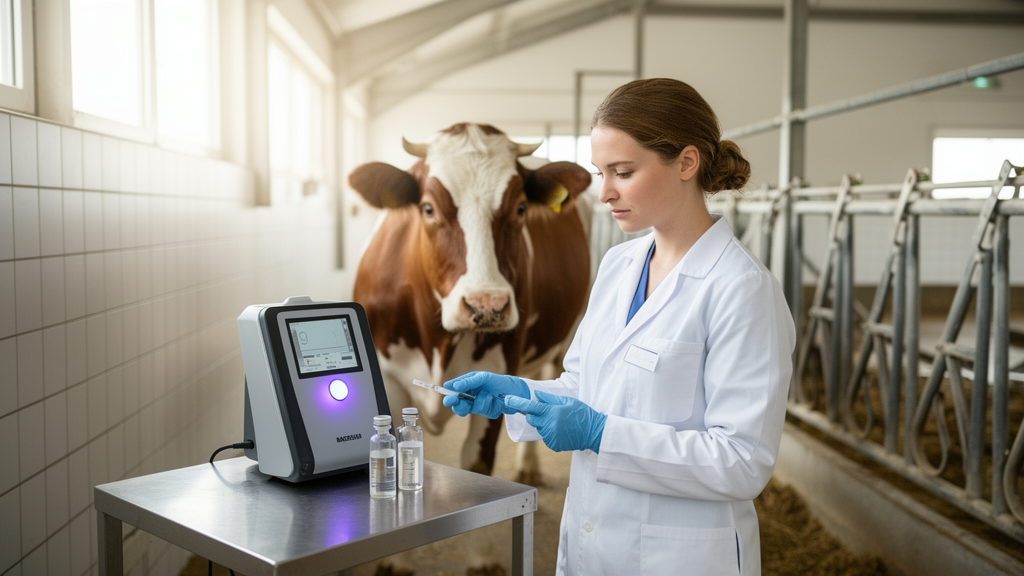
A newly published narrative review argues that keeping dangerous zoonotic pathogens out of meat, dairy, eggs, and seafood requires two arms working together: traditional veterinary public health measures spanning the entire farm-to-fork chain, and modern biosensor technologies capable of detecting contaminants in minutes rather than days. The review, published in the journal Food Production, Processing and Nutrition, synthesizes literature from 2019 to 2024, alongside key older background works, to build what its authors describe as a unified One Health framework for food safety.
The scale of the problem is substantial. According to figures cited in the review from the European Food Safety Authority and the European Centre for Disease Prevention and Control, the 27 European Union Member States and the United Kingdom (Northern Ireland) reported 6,558 food-borne outbreaks, 62,481 human cases, 3,336 hospitalizations, and 53 deaths in 2024. Outbreaks rose by 14.5 percent compared with 2023, and human cases and hospitalizations increased by 19.7 percent and 15.2 percent respectively, although deaths fell by 18.5 percent. Globally, the World Health Organization estimates that around 10 percent of the world’s population contracts illnesses linked to contaminated food each year, with 40 percent of foodborne disease cases occurring in children under five and an associated annual fatality rate of 125,000.
The review identifies the major culprits as bacteria including Brucella, Listeria, Campylobacter, and Salmonella, along with foodborne parasites such as Echinococcus and Toxoplasma, whose subtle, long-lasting effects have often been overlooked. Hepatitis E virus is described as the most significant virus causing food-borne illnesses. Contamination can enter at any stage of the supply chain, from primary production through transportation, slaughter, processing, storage, distribution, and consumption, a complexity that has grown with the globalization of the food supply.
On the veterinary side, the review lays out pre-harvest controls centered on farm biosecurity. These include physical barriers such as suitable fencing, quarantine protocols for newly introduced animals, health-requirement testing before animals arrive, and strict hygiene rules for workers, vehicles, and equipment. Because vehicles and visitors are key pathways for introducing disease, the review recommends designating specific trucks for particular routes, disinfecting and cleaning them on a planned schedule, and using heating boxes and air-drying after washing, since abattoir trucks have tested positive for Salmonella even after cleaning. Consistent vaccination of cattle against foot-and-mouth disease, separation of infected buffalo by fencing, and zoning under World Organisation for Animal Health guidelines are cited as measures used by beef-exporting countries in southern Africa to protect both animal health and market access.
Optimal husbandry also matters, the review stresses: clean water, hygienic feed, clean bedding, and avoiding overcrowding reduce stress and pathogen exposure in livestock. It further highlights the danger of excessive antibiotic use, which drives the emergence and spread of multidrug-resistant bacteria that can reach consumers through contaminated animal-derived products. Managing antimicrobial resistance, the authors argue, requires limiting antibiotic use in livestock farming, strict border monitoring through veterinary inspections, testing protocols, and public awareness campaigns aimed at improving consumer behavior.
After harvest, the review calls for hygienic slaughterhouse practices, decontamination procedures, and cold-chain management. A report from Bishoftu, Ethiopia, cited in the review, documented unhygienic practices in cattle abattoirs, including a lack of hot water for knife dipping and hand-washing, with roughly 40 percent of employees lacking hygienic meat-handling training and 53.6 percent not practicing hand-washing, often storing carcasses at room temperature. Mechanized carcass hanging, hide removal, and evisceration can reduce cross-contamination compared with manual methods. Thermal processing parameters are also quantified: Campylobacter jejuni is killed at 53 degrees Celsius with a D value of 293.4 in ground chicken breast, while E. coli O157:H7 is killed at 65 degrees Celsius with a D value of 13.8 in beef patties. High-pressure processing at 300 to 600 megapascals for 3 to 10 minutes at chilled temperatures can achieve a 2 to 5 log reduction of zoonotic pathogens in fish and meat products.
During handling and distribution, the review emphasizes refrigerated transport, routine sanitization of vehicles, and antimicrobial packaging innovations, including chitosan-based films with inherent antibacterial properties, biodegradable polymer composites, and micro- and nano-encapsulated antimicrobial agents. At the consumer level, the review points to evidence that people more knowledgeable about foodborne pathogens are more likely to follow food safety procedures, but notes that knowledge alone does not always translate into practice, with socio-economic factors, time constraints, and financial barriers shaping behavior. Social media and accessible education programs are identified as effective channels for improving consumer food handling.
The review’s most distinctive contribution is its treatment of biosensors as complements to, rather than replacements for, veterinary inspection. It catalogs a striking range of detection technologies. A wireless magnetoelastic biosensor can detect Salmonella enterica serovar Typhimurium on eggshells at concentrations between 0.6 and 1.6 times ten to the seventh colony-forming units per square centimeter within 30 minutes. A lateral flow aptamer-based biosensor detects E. coli O157:H7 at 10 CFU per milliliter, and surface-enhanced Raman spectroscopy using metal-based nanoparticles can detect that pathogen in food and water in just twenty minutes. CRISPR/Cas12a-based systems combined with recombinase-aided amplification have detected E. coli O157:H7 at roughly 1 CFU per milliliter using fluorescence within a 55-minute run time, and a Cas12a biosensor for Listeria monocytogenes achieved detection limits of 0.68 attomolar of genomic DNA and 940 CFU per gram in spiked meat samples within two hours.
For poultry, the review describes immunological, nucleic acid-based, and label-free biosensors that have detected Campylobacter, Salmonella, E. coli, Clostridium perfringens, and Mycoplasma gallisepticum in hens. Nucleic acid-based sensors hold promise for detecting Campylobacter in eggs at concentrations as low as 1 CFU per milliliter, and aptamer-based sensors offer advantages over antibodies because of their stability in ambient field conditions. A lateral flow test verified detection of C. jejuni in barn litter at a limit of 6.7 log CFU per gram and in cecal contents at 7.1 log CFU per gram, though the review cautions that immuno-based methods can suffer from cross-reactivity and false positives. Electrochemical biosensors using potentiometry, conductometry, and impedimetry, enhanced by nanomaterials such as carbon nanotubes and metal oxide nanoparticles, offer portable, low-cost, point-of-care detection.
On the regulatory front, the review traces the evolution of the risk-based meat safety assurance system, born from the inability of traditional visual meat inspection to detect invisible hazards such as antimicrobial-resistant bacteria and chemical contaminants. Under Commission Implementing Regulation (EU) 2019/627, post-mortem inspection remains mandatory for all carcasses, and the review notes that a recent study found post-mortem inspection was omitted based on ante-mortem findings in over 99 percent of cases, suggesting potential redundancies that risk-based approaches could refine rather than replace. The authors conclude that future priorities include validating portable biosensors under field conditions, developing multiplex platforms that detect multiple pathogens and resistance markers simultaneously, integrating biosensor data with digital traceability systems, and training veterinary personnel in biosensor deployment, all in service of a coordinated, technology-enabled One Health defense against foodborne zoonotic threats.
Subject of Research: An integrated review of veterinary strategies and biosensor technologies for controlling zoonotic pathogens in animal-derived food supply chains.
Article Title: Mitigating zoonotic pathogens in the food supply chain: veterinary strategies and biosensor technologies for ensuring the safety of animal-derived products
Article References: Liang, X., Xu, C., Sun, T., Lu, S., Li, K., & Peng, L. (2026). Mitigating zoonotic pathogens in the food supply chain: veterinary strategies and biosensor technologies for ensuring the safety of animal-derived products. Food Production, Processing and Nutrition, 8(1), Article 80. https://doi.org/10.1186/s43014-026-00428-2
Image Credits: AI Generated
DOI: 10.1186/s43014-026-00428-2
Keywords: zoonotic pathogens, food safety, biosensors, veterinary surveillance, biosecurity, One Health, meat inspection, Salmonella, Campylobacter, food supply chain, antimicrobial resistance, traceability
Cite Scienmag News
Kristina Jarvis. (October 28, 2026). Veterinary Controls and Biosensors Join Forces to Keep Zoonotic Pathogens Out of Food. Scienmag. https://scienmag.com/veterinary-controls-and-biosensors-join-forces-to-keep-zoonotic-pathogens-out-of-food/
Kristina Jarvis. "Veterinary Controls and Biosensors Join Forces to Keep Zoonotic Pathogens Out of Food." Scienmag, 28 October 2026, https://scienmag.com/veterinary-controls-and-biosensors-join-forces-to-keep-zoonotic-pathogens-out-of-food/. Accessed 4 November 2026.
Kristina Jarvis. "Veterinary Controls and Biosensors Join Forces to Keep Zoonotic Pathogens Out of Food." Scienmag. October 28, 2026. https://scienmag.com/veterinary-controls-and-biosensors-join-forces-to-keep-zoonotic-pathogens-out-of-food/




