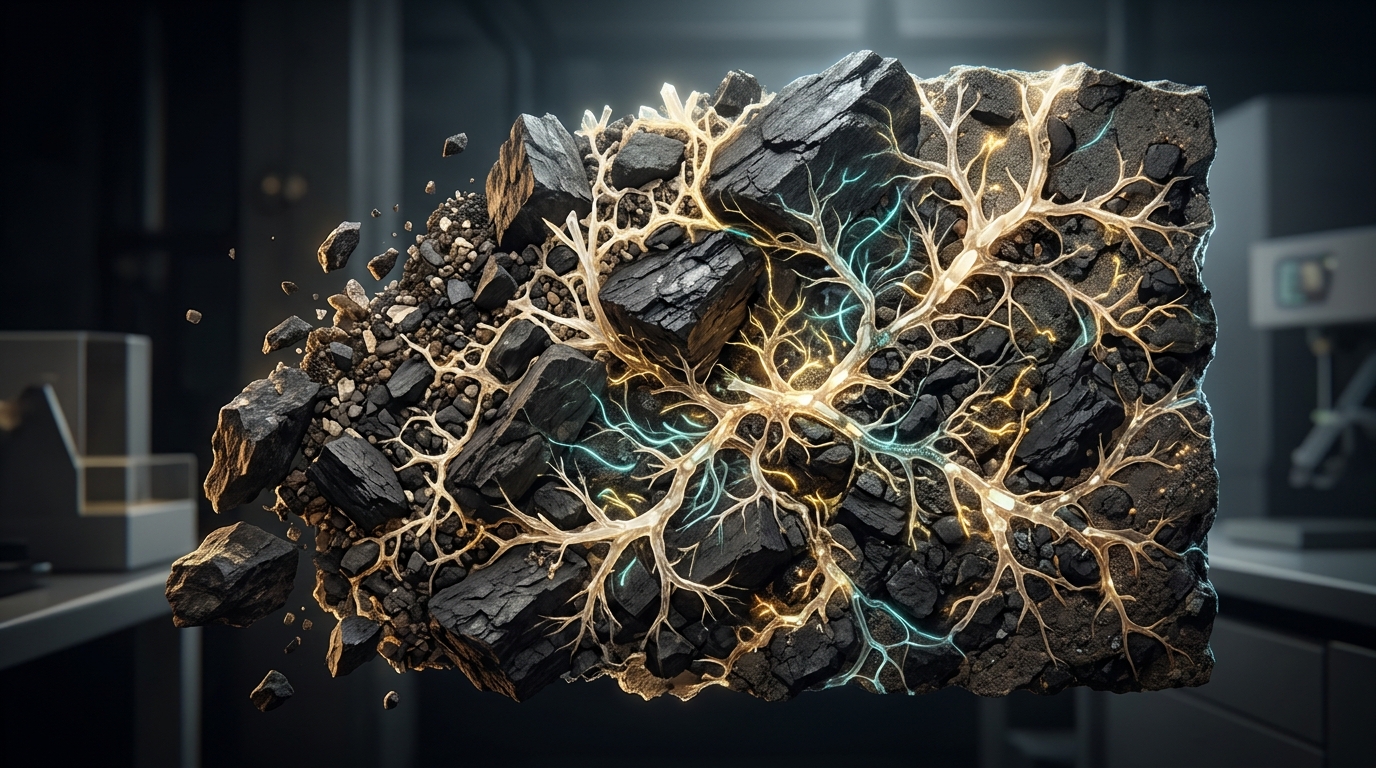
Coal mining leaves behind two stubborn problems: mountains of gangue, the rocky waste separated from usable coal, and empty underground voids that can leak water, gas, or slurry into active workings. A study published in Environmental Earth Sciences reports a laboratory recipe that tackles both at once, using microbially induced carbonate precipitation, or MICP, to cement coal gangue and biomass ash into a backfill material. The team, led by Rui Wu and Chule Liu, found that adding the right amount of biomass ash and treating the mix with Bacillus pasteurii raised compressive strength by 29.26 percent and tensile strength by 28.68 percent compared with an untreated control.
The researchers prepared cylindrical specimens 50 millimeters in diameter, either 100 or 50 millimeters tall, from coal gangue collected at the Wulanmulun Coal Mine in Inner Mongolia and biomass ash from a power plant in Jiangxi Province. The gangue was dominated by silicon dioxide at 51.9 percent by weight, with 20.60 percent aluminum oxide, 4.89 percent iron oxide, and 1.02 percent calcium oxide. The biomass ash contained roughly 50 percent silicon dioxide, 10.3 percent aluminum oxide, and 4.4 percent each of calcium oxide and potassium oxide.
MICP relies on a simple biochemical chain. Bacillus pasteurii, a bacterium chosen for its high urease activity, secretes an enzyme that splits urea into ammonium and carbonate ions. The carbonate then binds calcium from calcium chloride in the nutrient solution, precipitating calcium carbonate directly onto particle surfaces and inside pores. In the experimental mixes, the nutrient solution contained 60 grams of urea and 111 grams of anhydrous calcium chloride per liter. As the crystals accumulate, they bridge neighboring grains, filling voids and turning a loose granular packing into a bonded solid. The authors note that preparing one liter each of bacterial and nutrient solution cost about 9.09 yuan, and that cutting cement use by 20 percent at a scale of one ton of backfill would save roughly 33.8 yuan per ton while lowering energy use and carbon dioxide emissions tied to cement production.
Mechanical testing followed standard curing at 20 degrees Celsius and 90 percent relative humidity for 7, 14, and 28 days, with three replicate specimens per mix for each test. Stress–strain curves showed the familiar four stages of crack closure, elastic deformation, plastic deformation, and unloading failure. At 20 percent biomass ash, the microbially treated group reached compressive strengths of 0.338 megapascals at 7 days, 0.496 megapascals at 14 days, and 0.698 megapascals at 28 days, exceeding the untreated group’s 0.223, 0.403, and 0.540 megapascals by 51.57, 23.08, and 29.26 percent respectively. Splitting tensile strength at 28 days rose from 0.038 megapascals in the control to 0.0489 megapascals after microbial treatment.
The benefit was not unlimited. When biomass ash climbed to 25 percent, compressive and tensile strengths fell to 0.382 and 0.028 megapascals, well below the 20 percent optimum. The authors describe biomass ash content as exerting a dual regulatory effect: a moderate dose improves bearing capacity, while an excessive dose weakens it. X-ray diffraction supported this pattern. Characteristic peaks at 2-theta angles of 29.41 and 35.97 degrees signaled calcium carbonate and calcium silicate hydrate products, and the calcium carbonate peak was strongest in the 20 percent mix but weakened or nearly vanished at 25 percent, indicating that too much ash undermined the microbial modification.
Scanning electron microscopy with energy-dispersive X-ray spectroscopy revealed what the strengthening looked like up close. In the treated specimens, microbial deposits and hydration products clung to particle surfaces, with carbon, oxygen, and calcium dominating the spectra. At 25 percent ash, those flocculent structures thinned out, the aggregation continuity weakened, and calcium content dropped by 7.89 percent relative to B-4. Together with the diffraction data, the microscopy points to a synergy between microbially precipitated calcium carbonate and the pozzolanic reactions of biomass ash with cement hydration products.
Acoustic emission monitoring during compression added a dynamic view of failure. Sensors recorded ringing counts, amplitudes, and energy as cracks nucleated and grew. Treated specimens showed more moderate overall activity, fewer sudden count surges, and a steadier cumulative count, suggesting crack growth shifted from concentrated bursts to gradual accumulation. The team also computed the acoustic emission b value, a statistical measure in which higher values indicate dominance of small-scale microcracks and more stable propagation, and tracked the cumulative energy proportion across loading stages. Specimen B-4, at 20 percent ash, held a relatively high maximum b value before peak stress and dissipated 71.17 percent of cumulative energy in the pre-peak stages, indicating that more input energy was absorbed through stable cracking, interfacial friction, and structural adjustment rather than released violently at failure.
The low and high ends of the ash range told cautionary stories. At 10 percent ash, treated specimens still showed marked b value drops near peak stress and released 29.79 percent of cumulative energy in the failure stage, evidence that too little ash could not build an effective reinforced structure. At 25 percent, specimen B-5 released 20.42 percent of its energy in the initial loading stage, far more than any other specimen, and its pre-peak b value fell below that of B-4, signaling that excess ash increased early damage accumulation without improving stable crack growth. The authors interpret these signatures as a transition from rapid instability toward progressive, damage-tolerant failure at the optimal dosage.
The practical motivation is safety in closely spaced coal seams. Mining the lower seam of such a pair opens fractures that can connect pores and channels, raising risks of gas seepage, air leakage, water inrush, and slurry inrush into the working stope. Grouting a cemented gangue slurry into goafs and fracture zones could reinforce the coal body and block those channels, and the authors propose that bacterial and nutrient solutions migrating through the backfill’s pore network would precipitate calcium carbonate underground, consolidating the fill in place and reducing pollutant migration. They also point to waste management benefits: long-term stockpiled gangue can spontaneously combust as pyrite oxidizes, releasing sulfur dioxide, carbon monoxide, and hydrogen sulfide, so converting gangue into fill material addresses a disposal liability.
The authors are careful about the gap between laboratory cylinders and mine conditions. They note that Bacillus pasteurii remains active across 20 to 40 degrees Celsius, a range covering typical underground temperatures, and shows some adaptability to neutral and weakly alkaline groundwater, but that high temperatures, strongly acidic or alkaline water, and complex ion chemistry could suppress bacterial activity and calcium carbonate precipitation. Mining disturbance may redistribute stress and alter how bacterial and nutrient solutions move through the fill. As presented, the work establishes a preliminary MICP-based formulation for coal gangue backfilling and a microstructural explanation for why it works, leaving underground performance as the decisive next test.
Subject of Research: Microbially induced calcium carbonate precipitation used to strengthen coal gangue and biomass ash cemented mine backfill
Article Title: Study on the performance of coal gangue and biomass ash cemented backfill under microbial induced calcium carbonate deposition
Article References: Wu, R., Li, B., Hu, K., Liu, Y., Wang, S., Ma, X., Liu, W., & Liu, C. (2026). Study on the performance of coal gangue and biomass ash cemented backfill under microbial induced calcium carbonate deposition. Environmental Earth Sciences, 85(17), Article 452. https://doi.org/10.1007/s12665-026-13197-5
Image Credits: AI Generated
DOI: 10.1007/s12665-026-13197-5
Keywords: coal gangue, biomass ash, MICP, backfill, Bacillus pasteurii, calcium carbonate, compressive strength, acoustic emission, coal mining, solid waste utilization, performance, coal
Cite Scienmag News
Violet Maxwell. (November 4, 2026). Microbes Turn Coal Waste Into Stronger Mine Backfill in Lab Tests. Scienmag. https://scienmag.com/microbes-turn-coal-waste-into-stronger-mine-backfill-in-lab-tests/
Violet Maxwell. "Microbes Turn Coal Waste Into Stronger Mine Backfill in Lab Tests." Scienmag, 4 November 2026, https://scienmag.com/microbes-turn-coal-waste-into-stronger-mine-backfill-in-lab-tests/. Accessed 4 November 2026.
Violet Maxwell. "Microbes Turn Coal Waste Into Stronger Mine Backfill in Lab Tests." Scienmag. November 4, 2026. https://scienmag.com/microbes-turn-coal-waste-into-stronger-mine-backfill-in-lab-tests/