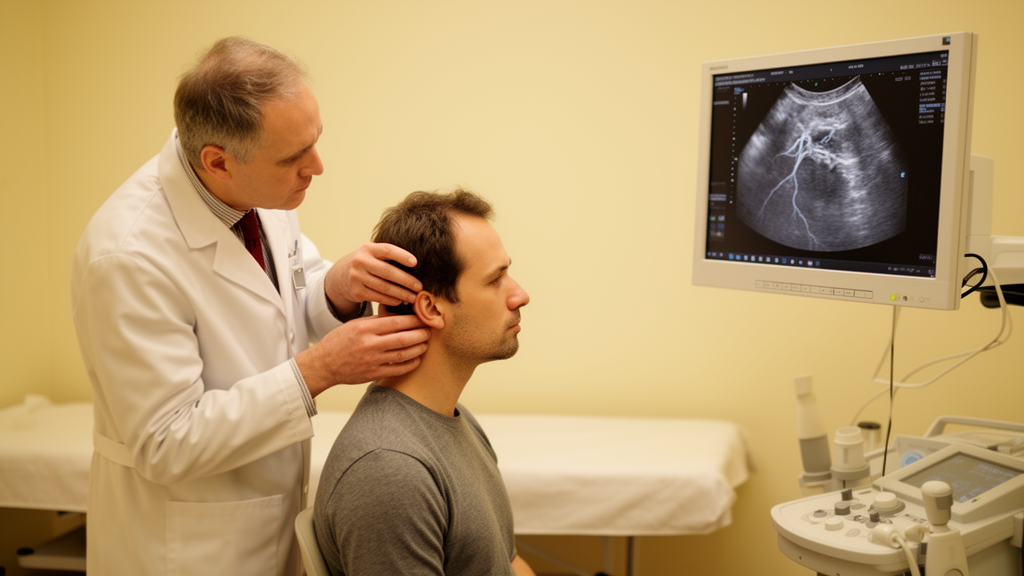
A four-item screening tool designed to help chiropractors and other outpatient clinicians spot cervical artery dissection before it progresses to stroke has produced mixed results in a preliminary test, with accuracy that varied widely between clinicians and agreement levels below the benchmarks usually demanded of a clinical decision aid. The findings, published in Chiropractic & Manual Therapies, led the project team to conclude that the tool should not be rolled out in ambulatory clinics in its current form.
Cervical artery dissection, or CeAD, is a tear in the inner lining of the vertebral or carotid arteries. It is rare but life-threatening, and it is the most common cause of stroke in younger adults. Its earliest warning signs are often nothing more dramatic than head or neck pain, symptoms that fill chiropractic offices, physical therapy clinics and primary care waiting rooms every day. Because those complaints are so common and so non-specific, distinguishing an evolving arterial dissection from an ordinary musculoskeletal ache is one of the most difficult calls an outpatient clinician has to make.
The stakes are high. CeAD can progress to ischemic stroke or transient ischemic attack, producing neurological deficits tied to the affected brain region. Some cases present with cranial nerve problems, cervical radiculopathy or Horner syndrome, but many begin with subtle prodromal symptoms that are easy to miss. Early recognition matters because the condition evolves quickly, and prompt escalation of care is tied to better outcomes. The incidence of spontaneous CeAD was reported at 4.69 per 100,000 person-years between 2002 and 2020, with a near four-fold increase in incidence rate over that period.
Confirming a dissection requires advanced imaging. Computed tomography angiography and magnetic resonance angiography are the recommended first-line techniques, with digital subtraction angiography as the gold standard. Their sensitivity varies considerably, with CTA ranging between 65 and 100 percent and MRA between 30 and 100 percent when compared against digital subtraction angiography. Those services are largely confined to tertiary hospital centers, so ambulatory providers rarely have immediate access to them. Routine advanced imaging for every case of non-specific neck or head pain would be costly, inefficient and contrary to guidance that discourages imaging in acute non-specific neck pain without red flags.
That gap is what diagnostic decision support tools are meant to fill. The CeAD tool tested here was devised, refined and validated by Thomas and colleagues for patients presenting with neck pain or headache. It scores four items: recent trauma or infection, acute or sudden onset, unusual head or neck pain, and the presence of two or more neurological features. A total score of three or four indicates moderate or high risk and should trigger urgent referral for vascular imaging, while a score of two or less suggests low risk and consideration of alternative diagnoses. In the original validation, conducted prospectively with an emergency department case-control design, the tool achieved 100 percent sensitivity and 73.75 percent specificity.
The new project, led by Tyler H. Snodgrass with Zachary A. Cupler, Christopher J. Farrell and Lindsay R. Rae, asked whether that performance would carry over to an ambulatory setting. Seven experienced chiropractors were recruited; five completed both assessment rounds and formed the final analysis. They each reviewed 40 standardized clinical vignettes simulating a new patient visit at a chiropractic clinic. Ten positive cases were drawn from published case reports of imaging-confirmed CeAD whose first encounter occurred in an outpatient setting. Thirty negative cases were drafted with generative artificial intelligence, informed by the 2025 National Board of Chiropractic Examiners Practice Analysis and clinical guidelines, then refined by senior authors with a combined 44 years of clinical experience. The negative vignettes all scored two or less on the tool.
Raters worked through the cases independently in randomized order during two two-week periods beginning November 11, 2025 and January 7, 2026, scoring each vignette and giving a refer-or-not-refer decision without knowing the true case mix or the answers of their colleagues. Accuracy of identification ranged from 72.5 to 95.0 percent across raters and rounds, and no rater classified every case correctly. False positives outnumbered false negatives, but both appeared in both rounds. Specific cases proved consistently troublesome: most raters misidentified one CeAD-positive case in both rounds, and majorities also misclassified vignettes representing mild traumatic brain injury, migraine with aura and an unspecified headache.
The reliability numbers were similarly uneven. Inter-rater agreement on threshold scoring was moderate to substantial, with a kappa of 0.609 in round one and 0.540 in round two, corresponding to raw agreement of just 65 and 60 percent. Referral decisions agreed at similar levels. Intra-rater consistency, meaning how steadily each clinician scored the same cases across the two rounds, ranged from 0.457 to 0.931, spanning moderate to almost perfect agreement. The authors noted that clinical decision tools are generally expected to exceed 80 percent absolute agreement or a kappa of 0.60, with higher values desirable in high-stakes contexts, and the current data fell short of that benchmark.
Why did a tool that caught every dissection in an emergency department stumble in the clinic simulation? The authors point to several possibilities. The validation population came from emergency departments, where patients tend to present with more advanced pathology and more obvious neurological features. Thomas and colleagues noted that roughly a quarter of their validation cases had first been seen in ambulatory settings and were misdiagnosed, consistent with the idea that early CeAD produces symptoms too subtle to trip the tool’s thresholds. The simulated format may also have limited the clinical picture available to raters, and the team deliberately provided no training beyond the scoring rubric, mimicking real-world implementation. The variability that emerged suggests the criteria themselves are ambiguously defined.
The conclusion is cautious rather than dismissive. The authors report that the tool showed moderate to good accuracy and reliability in a simulated ambulatory setting, but that the presence of false negatives and inter-rater reliability below recommended benchmarks preclude a recommendation for implementation at this time, given the urgent nature of the condition and the risk to patient safety. They also flagged a discrepancy in the original validation paper, in which reported values labeled as predictive values appear instead to be likelihood ratios, underscoring the need for further evaluation. Next steps include refining the tool’s operational definitions, incorporating end-user feedback, possibly adding established red-flag frameworks such as the SNNOOP10 criteria or an age criterion, and, crucially, prospective testing with real clinical data rather than simulated vignettes before any return to the clinic workflow.
Subject of Research: Accuracy and reliability of a four-item cervical artery dissection screening tool tested by chiropractors on simulated ambulatory cases
Article Title: Preliminary accuracy, inter- and intra-rater reliability of a 4-point cervical artery dissection diagnostic decision support tool in an ambulatory setting using real and simulated cases: a quality improvement project
Article References: Snodgrass, T. H., Cupler, Z. A., Farrell, C. J., & Rae, L. R. (2026). Preliminary accuracy, inter- and intra-rater reliability of a 4-point cervical artery dissection diagnostic decision support tool in an ambulatory setting using real and simulated cases: a quality improvement project. Chiropractic & Manual Therapies, 34(1), Article 59. https://doi.org/10.1186/s12998-026-00679-3
Image Credits: AI Generated
DOI: 10.1186/s12998-026-00679-3
Keywords: cervical artery dissection, diagnostic decision support tool, chiropractic, ambulatory care, inter-rater reliability, intra-rater reliability, stroke, clinical vignettes, false negatives, screening tool, veterans affairs clinic, quality improvement
Cite Scienmag News
Ophelia Keating. (October 28, 2026). Chiropractic screening tool for artery dissection falls short in test. Scienmag. https://scienmag.com/chiropractic-screening-tool-for-artery-dissection-falls-short-in-test/
Ophelia Keating. "Chiropractic screening tool for artery dissection falls short in test." Scienmag, 28 October 2026, https://scienmag.com/chiropractic-screening-tool-for-artery-dissection-falls-short-in-test/. Accessed 28 October 2026.
Ophelia Keating. "Chiropractic screening tool for artery dissection falls short in test." Scienmag. October 28, 2026. https://scienmag.com/chiropractic-screening-tool-for-artery-dissection-falls-short-in-test/