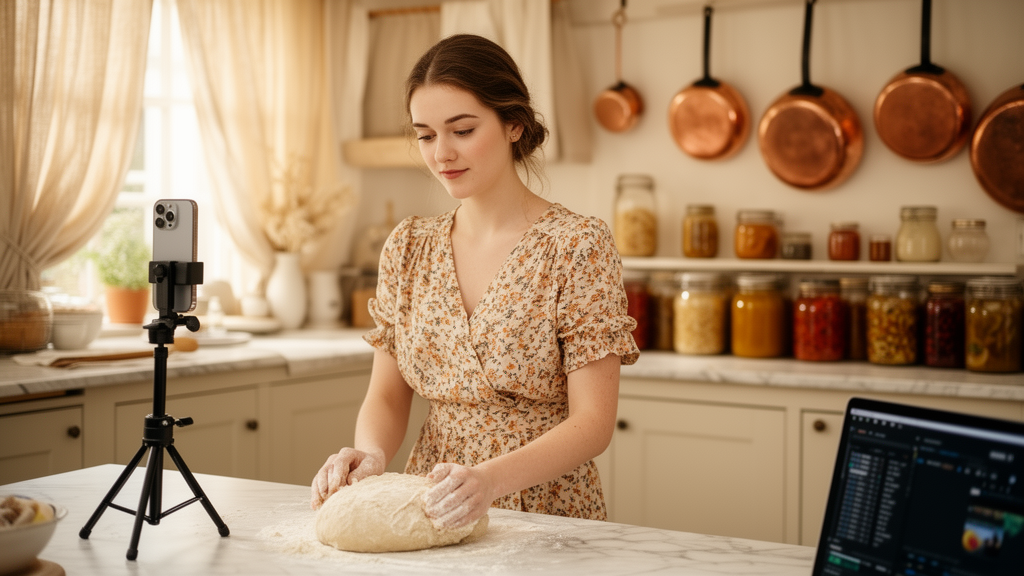
A new mixed-methods study of women who use the #tradwife hashtag on Instagram finds that they resolve an apparent contradiction in their online lives largely by making one side of it invisible. The creators, who promote supposedly traditional values in which men are breadwinners and women homemakers, simultaneously run profitable businesses as content creators. The research, published in the journal Creator and Influencer Studies, shows that these women obscure their entrepreneurial labor, foreground religion and family, and rarely discuss politics explicitly, presenting what the authors call a “soft sell” of conservative ideology alongside their products.
The study, conducted by Roxana Mika Muenster and Margaret E. Foster, analyzed 23 creators through two complementary datasets. The first was a computational text analysis of the creators’ website texts, including 23 introductory “About me” pages and 14 pages advertising their own products or services. The second was a qualitative audiovisual analysis of Instagram Story Highlights, the permanently saved collections of otherwise ephemeral 24-hour Stories. After categorizing 751 total Highlights into 13 topical categories, the researchers randomly sampled within categories and reviewed all Q&A, About Me, and Miscellaneous Highlights, yielding a final sample of 212 Highlights containing more than 2,000 individual image and video Stories, with content dating from 2017 onward.
The sample was built through a four-pronged approach: hashtag searches for #tradwife and #tradwives on Instagram, parallel searches of public posts between 2020 and 2023 on CrowdTangle, a then widely used Meta research tool, and review of prior academic case studies and news coverage. From 144 candidate accounts, the researchers kept creators who produced personal lifestyle content in English, plausibly self-identified as tradwives rather than commenting on the trend, used Story Highlights, and maintained a website linked to their profile that advertised their own products, services, or affiliate links.
The computational analysis used Linguistic Inquiry and Word Count, a dictionary-based psycholinguistic text analysis program, comparing the creators’ texts against a baseline corpus of 1,000 English-language blogs drawn from more than 37,000 collected blogs, and comparing About and Product pages to each other with paired tests among the 14 creators who had both. The results were striking for what was absent. Explicit ideology was largely missing: only 2 of 14 product pages and 4 of 23 About pages referenced politics even once, significantly less than the comparison blogs, and most political matches turned out to be false positives such as the clothing brand Banana Republic.
Religion, by contrast, was prominent. Twenty-five of 37 sampled texts, or 68 percent, referenced religion, mostly Christianity, and discussed it significantly more extensively than the baseline blogs. Religious language was woven directly into commerce: one creator offered “15% off your immaculate blessed purchase,” another wrote “we pray these products bless your family,” and one described using social media to “help evangelize for the Church.” Family language appeared in 84 percent of texts and significantly more than in comparison blogs, while work-related language appeared in all product pages and 21 of 23 About pages, more extensively than expected and even more than home-related language within the sample. Money language, however, featured significantly less than family language. Notably, plural first-person pronouns, though more common than in baseline blogs, were outnumbered by singular pronouns overall, partially contradicting the hypothesis that creators would frame their ventures as communal family efforts.
Only four creators explicitly called themselves influencers or content creators, and just six described themselves as business owners, with others presenting their ventures as side hustles or co-ownership with husbands. Many adopted a “sharing, not selling” approach reminiscent of twentieth-century Tupperware parties and multi-level marketing, in which women earned money at home without challenging gender norms: one creator invited readers into a community of “like-minded skill sharers,” another sold subscription access to a mothers’ community. Almost half of all work-related matches in About pages came from just two creators who openly advertised their businesses.
The qualitative analysis of Instagram Stories showed the same pattern of obfuscation. Few creators framed content creation as entrepreneurial labor. Only one, a former fashion influencer, openly discussed the time and skills behind her polished presence, showing her video editing software alongside her staged cooking videos. Others acknowledged income but minimized it as “hustling for their family” or a “side income,” and none publicly identified as the main earner in her household. Domestic labor, though central to the content, was framed as a fulfilling or divinely ordained task requiring little effort. Religion appeared as the “Proverbs 31 woman” or “Titus 2 woman” ideal, with creators stressing women’s duty to bear children and submit to husbands, while preparation for godly womanhood was celebrated as work in a way their own paid labor was not.
Explicit politics were rare but, when present, leaned conservative: one creator recounted voting for Donald Trump, another derided then-Canadian Prime Minister Justin Trudeau, and some alluded to COVID-19 vaccine conspiracy theories using deliberate misspellings like “v@xx” apparently to evade algorithmic moderation. Creators expressed anti-LGBTQ+ and antifeminist sentiments, sometimes amplifying other pages’ posts rather than authoring their own, which the authors read as creating plausible deniability. A subset of more secular creators, including three Women of Color in a predominantly white sample, embraced entrepreneurship more openly and used the hashtag to reach clientele, profiting from the trend’s visibility without professing its ideology.
The authors introduce the term “tradwife creator” to distinguish this larger, more diverse second generation from the explicitly political first wave rooted in white supremacist and Christian nationalist ideology, whose figures once promoted eugenicist stunts like the “#whitebabychallenge.” Where first-generation tradwives merged the personal and political, the new cohort skews personal, aligning with influencer norms of brand-friendly authenticity. The researchers caution that their sample is not representative of all tradwives, that LIWC baseline comparisons may be affected by genre and gendered blogging differences, that content output varied widely from 3 to 461 Stories per creator, and that self-presentation reveals nothing certain about creators’ actual motivations or beliefs.
Subject of Research: How tradwife content creators reconcile entrepreneurial labor with traditional gender ideology in their online self-presentation
Article Title: Breadwinner or breadmaker: analyzing contradictions in tradwife creators’ entrepreneurial labor, political ideology, and digital self-presentation
Article References: Muenster, R. M., & Foster, M. E. (2026). Breadwinner or breadmaker: analyzing contradictions in tradwife creators’ entrepreneurial labor, political ideology, and digital self-presentation. Creator and Influencer Studies, 1(1), Article 5. https://doi.org/10.1007/s44538-026-00005-w
Image Credits: AI Generated
DOI: 10.1007/s44538-026-00005-w
Keywords: tradwife, Instagram, content creators, creator economy, gender roles, religious influencers, conservative ideology, social media self-presentation, computational text analysis, LIWC, Instagram Stories, antifeminism
Cite Scienmag News
Courtney Benton. (October 28, 2026). Tradwife creators soften politics while hiding the labor behind their brands. Scienmag. https://scienmag.com/tradwife-creators-soften-politics-while-hiding-the-labor-behind-their-brands/
Courtney Benton. "Tradwife creators soften politics while hiding the labor behind their brands." Scienmag, 28 October 2026, https://scienmag.com/tradwife-creators-soften-politics-while-hiding-the-labor-behind-their-brands/. Accessed 28 October 2026.
Courtney Benton. "Tradwife creators soften politics while hiding the labor behind their brands." Scienmag. October 28, 2026. https://scienmag.com/tradwife-creators-soften-politics-while-hiding-the-labor-behind-their-brands/