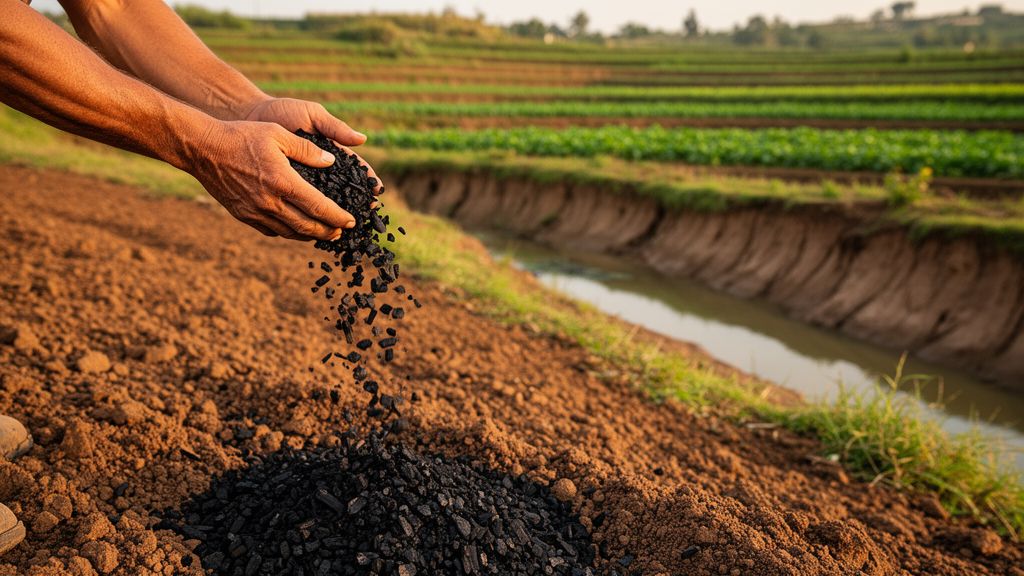
Applying biochar to soil could deliver measurable economic co-benefits through reduced soil erosion, worth tens of euros per hectare each year under high-erosion conditions, according to a new scenario-based valuation framework published in the journal Carbon Neutral Systems. The study, led by Behrouz Gholamahmadi, is presented by its authors as the first to attach monetary values specifically to the ecosystem-service benefits arising from biochar-mediated soil erosion control, spanning climate regulation, agricultural productivity and avoided sediment-management costs.
The framework builds on global meta-analytical evidence showing that biochar application reduces soil erosion by 16 percent and surface runoff by 25 percent on average, with stronger effects observed in erosion-prone environments. Soil erosion is a major driver of land degradation, with global losses exceeding billions of tonnes annually. In Europe, approximately 24 percent of land is affected by unsustainable water-driven erosion, with total soil losses of around one billion tonnes per year, making the continent a natural calibration ground for the new valuation exercise.
The analysis rests on three illustrative baseline erosion scenarios: low, at 3 tonnes per hectare per year; moderate, at 10 tonnes per hectare per year; and high, at 20 tonnes per hectare per year. Using a central parameterisation, the study calculated gross ecosystem-service benefits of €2.80, €9.33 and €24.19 per hectare per year under the low, moderate and high erosion scenarios respectively. Because these estimates exclude biochar production, transport and application costs, the authors stress that they represent gross co-benefits rather than net economic returns from deploying biochar.
To capture uncertainty, the researchers propagated literature-derived parameter ranges through 100,000 Monte Carlo simulations with a fixed random seed. The simulations yielded median total values of €2.95 per hectare per year, with a 95 percent uncertainty interval of €1.36 to €7.48, under low erosion; €9.85, ranging from €4.54 to €24.92, under moderate erosion; and €25.52, ranging from €13.81 to €56.21, under high erosion. The wide intervals reflect substantial uncertainty in soil carbon content, the fate of eroded carbon, the social value of carbon dioxide and the magnitude of the erosion response itself.
The valuation is organised around three distinct pathways. In the climate pathway, avoided soil erosion preserves soil organic carbon that would otherwise be displaced. Because eroded carbon may be mineralised, redeposited or buried, only the fraction assumed to undergo mineralisation is converted to carbon dioxide equivalents and valued using the social value of avoided emissions. Under the central parameterisation, this pathway was worth €1.68 per hectare per year under low erosion, rising to €5.60 under moderate erosion and €11.19 under high erosion, with Monte Carlo medians of €1.76, €5.87 and €11.75 respectively. The authors emphasise that this figure represents a social-value estimate of potentially avoided emissions from native soil organic carbon, not a market valuation of durable biochar carbon-removal credits.
The food pathway applies a European agricultural-sector income-loss benchmark of €34.50 per hectare per year, drawn from an assessment of severely eroded land where erosion rates exceed 11 tonnes per hectare per year. Because the low and moderate scenarios fall below this threshold, no food-system value was assigned to them. In the high-erosion scenario, the central avoided income loss was €5.52 per hectare per year, with a Monte Carlo median of €5.65 and a 95 percent interval of €3.23 to €8.87. The authors caution that this is an annualised benchmark for severely eroded land rather than a universal relationship between soil loss and crop yield, and that its applicability depends on crop, soil, climate, management and erosion history.
The water pathway quantifies avoided off-site sediment accumulation in reservoirs. Reduced gross erosion is translated into avoided sediment volume using an effective European sediment-volume delivery coefficient of 0.139 cubic metres per tonne of soil, valued at a sediment-removal cost of €16.80 per cubic metre. Central avoided sediment-management values rose from €1.12 per hectare per year under low erosion to €3.74 under moderate erosion and €7.48 under high erosion, with Monte Carlo medians of €1.16, €3.87 and €7.73. Runoff reduction, observed independently in the underlying meta-analysis, is deliberately retained as a non-monetised hydrological co-benefit to avoid double counting with the sediment value.
A variance-based global sensitivity analysis for the high-erosion scenario identified soil organic carbon content, the social value of carbon dioxide, the mineralisation fraction of displaced carbon and the biochar-induced erosion reduction as the principal sources of uncertainty, with total-order Sobol indices of 0.33, 0.29, 0.28 and 0.16 respectively. The carbon enrichment ratio contributed less strongly at 0.05, while sediment-removal cost, agricultural income loss and the sediment-volume coefficient had comparatively small effects. At the central estimates, gross ecosystem-service value per tonne of avoided soil loss came to €5.83, €5.83 and €7.56 under the low, moderate and high erosion scenarios.
As an illustrative break-even analysis, assuming constant annual benefits and a 3 percent real discount rate, the present values of the benefits amount to €23.90, €79.60 and €206.30 per hectare over ten years, and €41.70, €138.90 and €359.80 per hectare over twenty years, under the low, moderate and high scenarios respectively. Implementation costs above these thresholds would not be recovered from erosion-related benefits alone, reinforcing the authors’ interpretation of erosion control as a co-benefit alongside biochar’s carbon-removal and agronomic functions rather than a stand-alone economic justification for its deployment.
Context dependence emerges strongly from the experimental evidence. The global meta-analysis found that erosion decreased by roughly 12 percent in bare-soil experiments but 27 percent where vegetation cover was present. Two multi-season lysimeter experiments using Mediterranean vineyard soils treated with 4 percent woody biochar under natural rainfall reported annual erosion reductions of 67 percent for bare soil when splash, fine-earth and coarse-fragment erosion were considered, and 63 percent for fine-earth erosion in vegetated soil. The authors note that these Mediterranean results, substantially above the global mean, illustrate the strong context dependence of biochar responses but do not provide a basis for regional economic extrapolation; instead, they support site-specific parameterisation of the framework. The study also acknowledges key limitations: the biochar erosion response derives mainly from plot-scale experiments while the sediment calibration reflects regional reservoir accumulation, so the proportional translation of plot-scale reductions into downstream sediment reduction requires catchment-scale validation. The persistence of the erosion-reduction effect over time remains unknown, making the discounted values illustrative thresholds rather than forecasts. The framework, whose data and code are openly available, is presented as a transparent screening tool for future site- and region-specific valuation, not as a universal biochar price, carbon-credit value or investment return, and the authors advise that biochar be assessed alongside alternative soil-conservation measures such as cover crops, reduced tillage and mulching when erosion mitigation is the primary objective.
Subject of Research: Economic valuation of ecosystem-service benefits from biochar-mediated soil erosion control
Article Title: A scenario-based economic valuation framework for ecosystem service benefits of biochar-mediated soil erosion control
Article References: Gholamahmadi, B. (2026). A scenario-based economic valuation framework for ecosystem service benefits of biochar-mediated soil erosion control. Carbon Neutral Systems, 2(1), Article 22. https://doi.org/10.1007/s44438-026-00042-2
Image Credits: AI Generated
DOI: 10.1007/s44438-026-00042-2
Keywords: biochar, soil erosion, ecosystem services, economic valuation, soil organic carbon, Monte Carlo analysis, sediment management, Mediterranean vineyards, land degradation, climate regulation, agricultural productivity, uncertainty analysis
Cite Scienmag News
Alan Morgan. (October 27, 2026). Biochar’s erosion-control co-benefits valued at up to €25 per hectare yearly. Scienmag. https://scienmag.com/biochars-erosion-control-co-benefits-valued-at-up-to-e25-per-hectare-yearly/
Alan Morgan. "Biochar’s erosion-control co-benefits valued at up to €25 per hectare yearly." Scienmag, 27 October 2026, https://scienmag.com/biochars-erosion-control-co-benefits-valued-at-up-to-e25-per-hectare-yearly/. Accessed 28 October 2026.
Alan Morgan. "Biochar’s erosion-control co-benefits valued at up to €25 per hectare yearly." Scienmag. October 27, 2026. https://scienmag.com/biochars-erosion-control-co-benefits-valued-at-up-to-e25-per-hectare-yearly/