
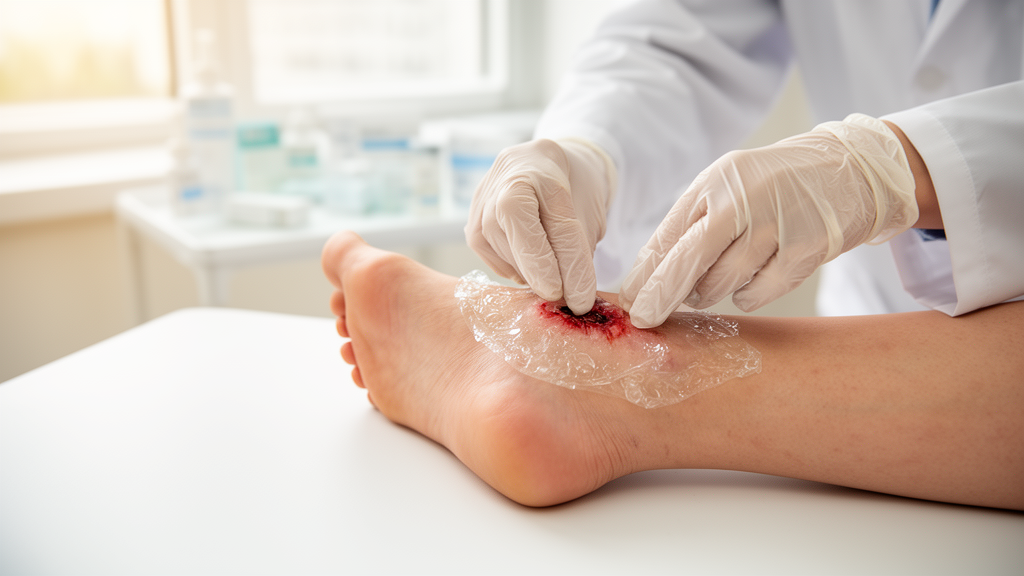
Diabetic foot ulcers remain one of the most disabling and financially draining complications of diabetes, and a new comprehensive review argues that the field is finally moving beyond palliative dressings toward therapies that attack the molecular roots of non-healing wounds. Published in Biotechnology for Sustainable Materials, the review synthesises recent developments in biomaterial-based strategies, from nanocarriers and gene-activated matrices to biosensor-equipped smart bandages, that aim to restore angiogenesis and tissue regeneration in wounds that standard care routinely fails to close.
The scale of the problem is considerable. Roughly 18.6 million people worldwide are affected by diabetic foot ulcers each year, corresponding to an estimated prevalence of 6.3 percent among diabetic patients. Unhealed ulcers raise the risk of infection and gangrene and frequently end in lower limb amputation, with amputation rates reaching approximately 31 percent. Recurrence compounds the burden: more than half of patients experience re-ulceration within three years. Hospitalisations account for about 88 percent of direct medical costs, and in many low- and middle-income countries the absence of comprehensive care services forces patients onto suboptimal therapies, creating a further barrier to adopting advanced, cost-intensive biomaterial treatments.
The review attributes the chronicity of these wounds to a hostile, self-reinforcing microenvironment. Persistent hyperglycaemia drives the formation of advanced glycation end products, elevated oxidative stress and a deregulated inflammatory response that prevents the transition from inflammation to proliferation and remodelling. Macrophage behaviour is central to this failure: the shift from pro-inflammatory M1 macrophages to pro-healing M2 macrophages, which is necessary for normal repair, is disrupted in diabetic wounds, sustaining the secretion of inflammatory cytokines and matrix-degrading enzymes. Vascular dysfunction compounds the problem. Endothelial cells damaged by prolonged hyperglycaemia show impaired nitric oxide signalling, and in diabetic patients with foot ulcers the levels of advanced glycation end products, malondialdehyde and tumour necrosis factor alpha are increased, driving secretion of soluble VEGF receptor-1 that suppresses vascular endothelial growth factor and interrupts healing. Endothelial progenitor cells, the bone marrow-derived repair cells responsible for vascular regeneration, become scarce and dysfunctional, with increased stress-induced apoptosis and reduced expression of the CXCR4 receptor needed for migration to the wound site.
Against this backdrop, the review frames biomaterials as active modulators of the wound milieu rather than passive coverings. Natural polymers bring inherent biological advantages: chitosan shows antimicrobial activity through electrostatic interactions with bacterial membranes, particularly at the acidic pH of diabetic wounds, while collagen supports fibroblast proliferation and granulation tissue formation. In a controlled study of fifty patients divided into two groups of twenty-five, collagen dressings achieved full ulcer healing in twenty-one patients in the experimental group, whereas the saline-treated control group showed no ulcer healing and only six patients had a considerably reduced ulcer area. Sodium alginate maintains a moist wound environment and enhances collagen production, and silk fibroin dressings exhibit anti-inflammatory and pro-angiogenic properties that accelerate healing compared with commercially available dressings. Natural polymers nevertheless suffer from batch-to-batch variability, potential immunogenicity and inconsistent mechanical strength, which is why the review devotes equal attention to synthetic polymers such as PLGA, polycaprolactone, PEG and polyurethane, whose degradation rates and mechanical properties can be precisely tuned, though they lack the cell-recognition signals of natural materials. Composite biomaterials blend the two: a prospective multi-centre clinical trial of a synthetic hybrid-scale fibre matrix for chronic, non-responsive diabetic foot ulcers reported a complete wound closure rate of 75 percent at twelve weeks.
A particularly striking strand of the review concerns smart, stimuli-responsive materials engineered to read the wound environment and react. Diabetic wounds sit at a lower pH than healthy skin, and pH-responsive systems exploit this difference, remaining stable at physiological pH while hydrolysing in the acidic wound bed to trigger controlled drug release. A pH-responsive hyaluronic acid collagen hydrogel containing double hydrogen bonds showed dual responsiveness to pH and glucose, establishing what the authors describe as a benign feedback loop that regulates pH and glucose levels, reduces oxidative stress and promotes angiogenesis. Self-healing chemistry offers another route to durability: an oxidised dextran, bovine serum albumin and zinc hydrogel cross-linked through reversible Schiff base bonds achieved a wound healing rate of 94.80 percent within fourteen days in preclinical work, with increased collagen deposition and accelerated macrophage M1-to-M2 transition, while an injectable silver-coordinated hydrogel withstood repeated mechanical stress and paired self-healing with the inherent antibacterial action of silver ions. Thermo-responsive polymers that gel at body temperature and photo-crosslinkable sprayable systems, including an exosome-loaded hydrogel with tunable release kinetics, round out the toolbox, though the review notes that the complexity and cost of synthesising self-healing hydrogels remain barriers to clinical adoption.
Drug delivery technology occupies the core of the review’s translational argument. Nanocarriers such as liposomes, nanoparticles and micelles protect therapeutic agents from enzymatic degradation, improve the solubility of hydrophobic compounds and can be functionalised to target macrophages or endothelial cells at the wound site. Silver and gold nanoparticles contribute anti-inflammatory activity, zinc oxide nanoparticles are antibacterial, and PLGA nanoparticles enhance cell proliferation in diabetic wounds. Yet the review is candid about safety: certain metal nanoparticles, including silver, may show dose-dependent cytotoxicity through excessive reactive oxygen species generation and mitochondrial dysfunction, and the systemic accumulation of non-biodegradable particles raises chronic toxicity concerns. Hydrogels for topical delivery face their own regulatory bottleneck, with only three hydrogel-based products, Apilgraf, Leucopatch and Regranet, currently FDA approved.
Angiogenesis emerges as the review’s central therapeutic target, and the strategies described for rebuilding blood supply are among its most technically detailed. Growth factors such as VEGF, FGF and PDGF are present at significantly reduced levels in diabetic foot ulcers, and the wound’s high protease activity degrades what little remains. Biomaterial carriers, including electrospun scaffolds, hydrogels and extracellular matrix-mimetic matrices, shield these factors from degradation and maintain therapeutic concentrations over time. The review highlights the importance of timing: sequential delivery in which VEGF is released early to stimulate vessel sprouting, followed by PDGF applied five to seven days later to promote cell migration and vascular maturation, has shown better results in preclinical studies than simultaneous delivery. Human platelet lysate, which naturally combines VEGF, TGF-beta, PDGF and EGF, offers a more complex alternative, and suckerins, structural proteins purified from cephalopod sucker-ring teeth, are presented as next-generation carriers whose beta-sheet structure stabilises delicate growth factors against proteolytic breakdown. Gene-activated matrices go further, embedding plasmid DNA, mRNA or viral and non-viral vectors in scaffolds so that host cells become local bioreactors producing angiogenic factors continuously; VEGF gene-activated scaffolds have shown enhanced neovascularisation and improved healing in diabetic models, and SDF-1alpha gene-activated scaffolds restored angiogenic capacity in diabetic adipose-derived stem cells to near healthy levels in vitro. A meta-analysis of 31 randomised controlled trials involving 2174 patients found that growth factor therapies improved diabetic foot ulcer healing compared with controls.
The review also maps an emerging ecosystem of cell-free, oxygen-modulating and infection-targeting technologies. Exosomes and extracellular vesicles, particularly those derived from mesenchymal stem cells, enhance fibroblast proliferation, keratinocyte migration and collagen deposition, with exosomal microRNAs such as miR-21, miR-126 and miR-146a regulating new blood vessel formation and suppressing inflammation through PI3K/Akt, NF-kappaB and MAPK signalling; their non-replicative, low-immunogenicity profile avoids the tumour and vascular obstruction risks of cell therapy, though large-scale production and standardisation remain unsolved. Oxygen-releasing biomaterials using calcium peroxide or magnesium peroxide, often paired with catalase to neutralise hazardous hydrogen peroxide, and manganese dioxide nano-enzymes that convert excess hydrogen peroxide into oxygen while limiting oxidative damage, address the hypoxia that stalls collagen synthesis, while hypoxia-mimicking materials stabilise HIF-1alpha to switch on endogenous VEGF transcription. On the infection front, antimicrobial peptide-releasing systems, metal nanoparticle-loaded dressings with antibiofilm activity, and enzyme-responsive hydrogels that exploit bacterial proteases to degrade biofilm matrices have all reduced bacterial load and promoted granulation tissue in infected diabetic wound models, and immunomodulatory scaffolds releasing IL-4 or IL-10 push macrophages toward the pro-healing M2 phenotype.
The review closes with a sober assessment of what stands between these laboratory advances and routine clinical practice. Preclinical models have shown accelerated re-epithelialisation, enhanced neovascularisation and reduced bacterial burden for multifunctional hydrogels, and early-phase clinical trials of cell-laden biomaterials have demonstrated favourable safety profiles and improved microvascular perfusion. Wearable and wireless biosensors tracking plantar pressure, temperature and wound biochemistry, together with machine learning models for predicting healing outcomes, point toward closed-loop, personalised wound care. But translation is constrained by large-scale manufacturing challenges, batch-to-batch reproducibility, regulatory classification of combination products under FDA and EMA frameworks, cost-effectiveness uncertainties and, for AI tools, heterogeneous datasets and limited interpretability. The authors argue that future progress depends on standardised material design, well-designed multicentre clinical trials and streamlined regulatory pathways, so that mechanism-targeted biomaterial platforms can move from promising preclinical data to accessible therapies for the millions of patients whose diabetic wounds refuse to heal.
Subject of Research: Biomaterial-based drug delivery strategies for promoting angiogenesis and wound regeneration in diabetic foot ulcers
Article Title: Biotechnological advances in biomaterial-based strategies for diabetic foot ulcers: drug delivery-based approaches for enhanced angiogenesis and regeneration
Article References: Lamba, K., Ahuja, S., Garg, I., Mahajan, S., Chauhan, S., Mehta, S., & Dhankhar, S. (2026). Biotechnological advances in biomaterial-based strategies for diabetic foot ulcers: drug delivery-based approaches for enhanced angiogenesis and regeneration. Biotechnology for Sustainable Materials, 3(1), Article 12. https://doi.org/10.1186/s44316-026-00061-6
Image Credits: AI Generated
DOI: 10.1186/s44316-026-00061-6
Keywords: diabetic foot ulcers, biomaterials, drug delivery, angiogenesis, nanocarriers, hydrogels, gene therapy, exosomes, growth factors, smart dressings, wound healing, biosensors
Cite Scienmag News
Gregory Coleman. (October 28, 2026). Biomaterials and smart drug delivery aim to heal stubborn diabetic foot ulcers. Scienmag. https://scienmag.com/biomaterials-and-smart-drug-delivery-aim-to-heal-stubborn-diabetic-foot-ulcers/
Gregory Coleman. "Biomaterials and smart drug delivery aim to heal stubborn diabetic foot ulcers." Scienmag, 28 October 2026, https://scienmag.com/biomaterials-and-smart-drug-delivery-aim-to-heal-stubborn-diabetic-foot-ulcers/. Accessed 28 October 2026.
Gregory Coleman. "Biomaterials and smart drug delivery aim to heal stubborn diabetic foot ulcers." Scienmag. October 28, 2026. https://scienmag.com/biomaterials-and-smart-drug-delivery-aim-to-heal-stubborn-diabetic-foot-ulcers/