A new open-access research article published on 1 October 2026 in the journal Carbon Neutral Systems lays out a complete framework for oilfield-geothermal co-development (OGC) in the Bohai Bay Basin, combining theory, key technologies and a working field demonstration at Shengli Oilfield. The paper, led by Huanquan Sun and colleagues, argues that the same basins that produced decades of oil can now supply low-carbon heat, using wells, pipelines and processing stations that already exist.
The argument rests on a striking geological coincidence. In the Jiyang Depression, the southern part of the Bohai Bay Basin and the main eastern producing area of Sinopec Shengli Oilfield, the intervals that yield oil and gas are also the intervals that hold geothermal resources. The basin is classified as a hot basin, with a mean geothermal gradient of about 35.5 degrees Celsius per kilometre against a global mean of 30.0, and reported terrestrial heat flow ranging from 52.8 to 81.6 milliwatts per square metre with a mean near 65.7. At depths of 3,000 to 5,500 metres, formation temperatures reach 130 to 200 degrees Celsius, temperatures that both satisfy shale-oil generation conditions and form medium- to high-temperature geothermal resources.
The authors describe a dual-system configuration in which heat source, geothermal reservoir, caprock and pathway overlap with source rock, reservoir rock, caprock and trap. Heat comes from mantle-derived flow generated during fault-basin evolution and radiogenic heat from Archean-Proterozoic granites, transmitted upward through faults that also channel hydrocarbons. Major geothermal reservoirs sit in the Neogene Guantao Formation, the Paleogene Dongying Formation and Cambrian-Ordovician carbonates, each capped by thick mudstone intervals that limit heat loss. In the same structural unit, high-yield oil and gas areas strongly overlap with high-yield geothermal areas, giving the region what the authors call the resource endowment for large-scale co-development, estimated at roughly 28.07 billion metric tons of standard coal equivalent in geothermal resources.
The practical driver is water. Mature oilfields in China account for more than 70 percent of both developed reserves and annual oil production, and their average overall water cut exceeds 60 percent; in many fields produced fluids now run above 90 percent water. That water carries large amounts of low-grade thermal energy that conventional development simply reinjects into the ground. Shengli Oilfield has proposed four development modes to capture it: waste-heat recovery from produced fluids at central processing stations, integrated use of waste heat from high-temperature oil wells, same-well co-production of oil and geothermal resources, and same-layer enhanced fluid production and heat extraction. In the last mode, enlarging the production pressure differential increases produced-liquid volume, shortens wellbore residence time, reduces heat loss and raises the temperature and grade of the waste heat recovered at surface.
The enabling technologies form an integrated system built on four pillars: evaluation and conversion of existing oil and gas wells, reservoir stimulation and efficient heat extraction, surface energy conversion and integrated utilization, and life-cycle system integration with intelligent control. Well conversion relies on integrity evaluation and repair, structural adjustment through sidetracking and deepening, and completion designs rated for temperature and corrosion. For reservoirs with low porosity and permeability, the authors propose acidizing, hydraulic fracturing and high-energy gas fracturing, alongside enhanced-geothermal-system concepts such as artificial fracture networks and volumetric fracturing of deep reservoirs. On the surface, organic Rankine cycle and Kalina cycle systems are recommended for the 60 to 150 degree Celsius fluids typical of oilfield geothermal resources, arranged in cascade so that high-temperature heat generates power first, medium-temperature heat serves production processes, and low-temperature waste heat warms offices, greenhouses and aquaculture.
The facility synergy is substantial. Shengli Oilfield has accumulated more than 60 years of geological, logging, well-testing and production data, and published oilfield reports describe more than 20,000 abandoned wells, of which 813 have been screened as having geothermal-conversion potential. Converting an abandoned well through wellbore repair, pump-chamber modification and completion conversion can reduce drilling requirements and construction time compared with drilling a new geothermal well, although the authors note the savings depend on well condition and conversion scope. Existing gathering networks can carry geothermal fluids, raise crude-oil pipeline temperatures, prevent solidification and replace in-line heating furnaces, enabling what the paper calls one network with multiple energy streams and one station with shared facilities.
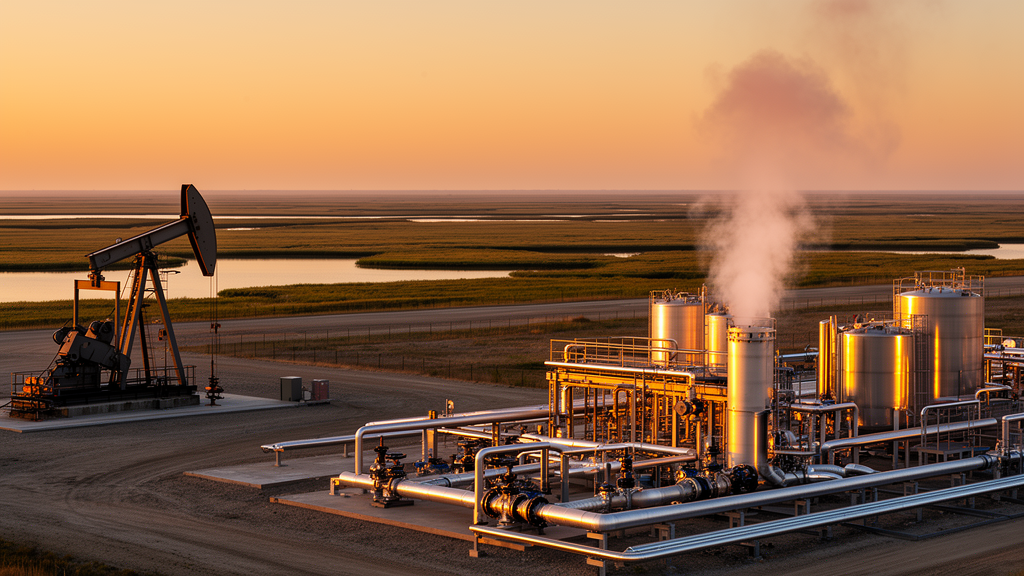
The field demonstration comes from the Dongyi Central Processing Station in Gudong Oilfield, a mature waterflooded field that entered industrial development in 1986, peaked at 5.21 million metric tons of annual crude oil in 1991 and has since declined to 1.10 million metric tons with an overall water cut of 97.4 percent. The station’s heating had relied on natural-gas water-jacket heaters. Screening of abandoned wells within two kilometres identified Gudonggu-1 and Gudong-4 as penetrating the Ordovician geothermal reservoir; integrity evaluation with 40-arm caliper logging, electromagnetic inspection and casing pressure testing confirmed convertibility. Conversion involved plugging hydrocarbon-bearing intervals, casing patching and wellhead reconstruction, at a reported cost of CNY 3.5 million per well, more than 50 percent lower than newly drilled geothermal wells. Acid fracturing raised daily fluid deliverability from 960 to 1,680 cubic metres, and the project integrated four central processing stations and replaced 16 gas-fired heating furnaces.
The Dongyi process runs in two stages. In the low-temperature stage, ten high-temperature electric submersible pump oil wells in the Shahejie Formation feed new heat-transport pipelines and an oil-gas separation unit, with silicon-carbide shell-and-tube heat exchangers raising the heat-transfer coefficient from 79.2 to 98.6 watts per square metre per kelvin and extending the cleaning interval from three months to one year. Incoming fluids are preheated to 65 degrees Celsius. In the high-temperature stage, two converted abandoned exploration wells extract heat through production and reinjection, and a new plate heat exchanger lifts the crude to 85 degrees Celsius. Geothermal tailwater is completely reinjected into the subsurface reservoir, and an intelligent control system monitors production-reinjection dynamics and surface operations in real time.
Following commissioning on 10 December 2025, the ten electric submersible pump oil wells produced 34 metric tons of oil per day and one converted abandoned well produced 500 cubic metres of natural gas per day, figures the authors explicitly state are not estimates of incremental production attributable to geothermal utilization. The project reports an annual heat-supply capacity of 209,000 gigajoules, with heating costs falling from CNY 85.35 per gigajoule before the retrofit to CNY 35.2, a calculated reduction of 58.8 percent. The authors caution that these are projected rather than measured full-year totals, that the cost comparison does not establish a levelized cost of heat or payback period, and that net emissions benefits depend on the accounting boundary, including electricity used for lifting and reinjection.
Challenges remain considerable. The authors identify long-term reliability of materials and equipment in high-temperature, high-pressure, corrosive environments; difficulty in accurately predicting multiphysics coupling of temperature, seepage, stress and chemical fields in heterogeneous deep reservoirs; and the risk that large-volume geothermal production and reinjection could cause rapid water breakthrough and declines in remaining oil recovery. Looking forward, they expect OGC to extend into deeper and ultra-deep domains including hot dry rock, to integrate recovery of lithium from geothermal water and helium from associated gas, and to require breakthroughs in key equipment, cross-industry standards and a new industrial ecosystem. A separate January 2026 field report documented the Donggaore-1 well in the Zhuangxi area, drilled in 2025, with a wellhead water temperature of 138 degrees Celsius and a test discharge of 101.3 cubic metres per hour, supporting a high-temperature geothermal target whose sustained production and project economics still require further assessment. The Dongyi case, the authors conclude, indicates that reusing oilfield assets can reduce heating costs and support low-carbon transformation, while wider applicability depends on reservoir conditions, operating performance and project-specific economic assessment.
Subject of Research: Oilfield-geothermal co-development theory, technologies and field practice in the Bohai Bay Basin
Article Title: Theory, technologies, and practice of oilfield-geothermal co-development in the Bohai Bay Basin
Article References: Sun, H., Yang, Y., Yang, Y., Wang, J., Chen, A., Xu, F., Fang, J., & Mao, J. (2026). Theory, technologies, and practice of oilfield-geothermal co-development in the Bohai Bay Basin. Carbon Neutral Systems, 2(1), Article 18. https://doi.org/10.1007/s44438-026-00039-x
Image Credits: AI Generated
DOI: 10.1007/s44438-026-00039-x
Keywords: geothermal energy, oilfield-geothermal co-development, Bohai Bay Basin, Shengli Oilfield, Dongyi project, abandoned well conversion, waste heat recovery, Jiyang Depression, low-carbon energy, enhanced heat extraction, cascade heat utilization, China energy transition
Cite Scienmag News
Denise Maddox. (October 28, 2026). Research report: Theory, technologies, and practice of oilfield-geothermal co-development in the Bohai Bay Basin. Scienmag. https://scienmag.com/research-report-theory-technologies-and-practice-of-oilfield-geothermal-co-development-in-the-bohai-bay-basin/
Denise Maddox. "Research report: Theory, technologies, and practice of oilfield-geothermal co-development in the Bohai Bay Basin." Scienmag, 28 October 2026, https://scienmag.com/research-report-theory-technologies-and-practice-of-oilfield-geothermal-co-development-in-the-bohai-bay-basin/. Accessed 28 October 2026.
Denise Maddox. "Research report: Theory, technologies, and practice of oilfield-geothermal co-development in the Bohai Bay Basin." Scienmag. October 28, 2026. https://scienmag.com/research-report-theory-technologies-and-practice-of-oilfield-geothermal-co-development-in-the-bohai-bay-basin/