


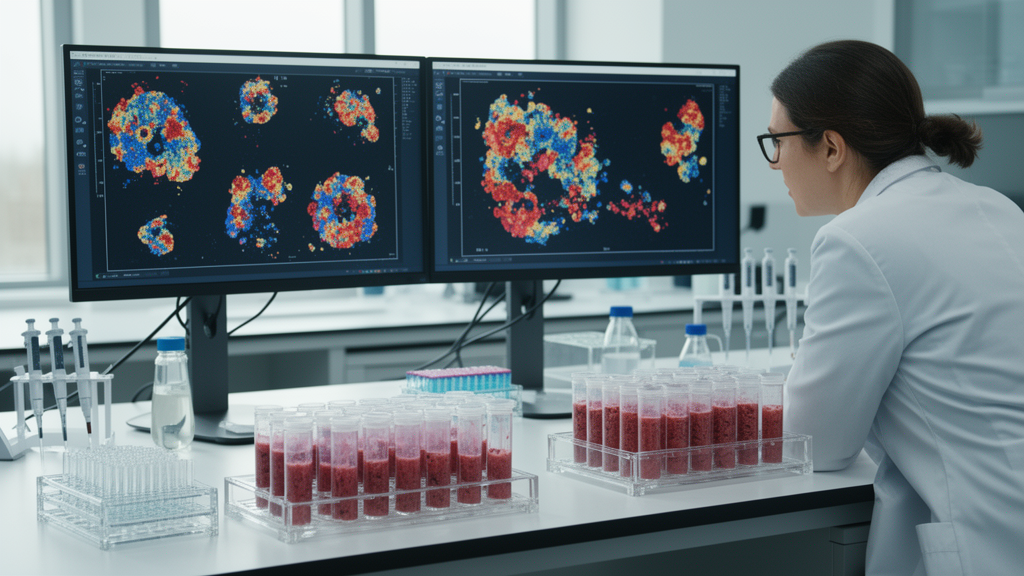
Bioinformatics and big-data analyses are expanding the pool of candidate biomarkers for solid tumors and blood cancers, but the 11 original studies in a research collection show that most remain research tools rather than clinically ready tests. The collection covers breast, ovarian, renal, lung, pancreatic and skin cancers, alongside diffuse large B-cell lymphoma (DLBCL) and chronic myeloid leukemia (CML). Its methods range from bulk-transcriptome machine-learning models to single-cell profiling, medical imaging, liquid biopsy and comorbidity-based prediction, collectively illustrating how heterogeneous datasets can be converted into prognostic associations and treatment-response hypotheses that require independent testing.
Several studies focused on transcriptomic risk models designed to estimate outcomes. In breast cancer, one investigation combined weighted gene co-expression network analysis, protein–protein interaction networks and LASSO-Cox regression to define a six-gene signature related to NETosis and inflammation. The genes were ZMYND10, IL12B, CXCL13, TFF1, LTB and SPIB, and the resulting risk score was reported to be independent of age and other clinical features. Five genes were confirmed by RT-qPCR; LTB was excluded because of limited tissue availability. A separate breast-cancer analysis derived and validated a seven-gene metastasis-associated signature in the TCGA-BRCA, AURORA US, SCAN-B and GEO cohorts. Tumors classified as low risk were described as immune-hot, with activated CD8+ T cells, whereas high-risk tumors showed T-cell exclusion and enrichment of kinase and metabolic pathways. RTN1 and TLR10 were proposed as candidate drivers, but their functional roles were not established.
In clear-cell renal cell carcinoma, investigators used single-cell and bulk transcriptomic data to construct a nucleotide-metabolism prognostic signature that was reported to outperform 122 previously published models. IFI30 was validated in laboratory experiments both in vitro and in vivo. That work did not establish that the signature can guide treatment decisions or improve outcomes in patients. Another breast-cancer study moved from prognosis toward prediction of response to neoadjuvant chemotherapy. A pretreatment 15-gene score achieved an area under the curve of 0.809 in one external cohort and 0.876 in another when predicting non-pathological complete response. The authors traced part of the signal to a pyruvate–CCND1–YAP1–HIF1A/ARNT–MET axis, found that serum pyruvate was elevated in tumors without a complete pathological response, and reported that capmatinib, a MET inhibitor, attenuated pyruvate-driven phenotypes. These findings nominate a pathway and compound for further testing, but they do not demonstrate clinical benefit from capmatinib in this setting.
In pancreatic ductal adenocarcinoma, investigators combined genes related to lactylation and programmed cell death to identify HMGA1 and KIF2C as core prognostic drivers. They supported the model with drug-sensitivity analyses and clinical specimens, connecting a molecular signature with candidate therapeutic compounds. The blood-cancer studies used complementary approaches spanning molecular prognosis, imaging prediction and routine clinical risk assessment. In DLBCL, SYTL4 was reported to be upregulated and independently associated with adverse outcome in a tissue-microarray subgroup, with a multivariable hazard ratio of 25.5, a 95% confidence interval of 1.8 to 367.3 and P = 0.017. The unusually wide confidence interval reflects the subgroup’s small size of 48 cases. SYTL4-high tumors were enriched for extracellular-matrix remodeling, whereas mitochondrial translation and oxidative phosphorylation were negatively enriched.
Another DLBCL study trained deep-learning models on features extracted from 18F-FDG PET/CT images to predict cancer-related cognitive impairment in patients without central nervous system involvement. This was a single-center study with a modest sample of 112 patients, making external validation a prerequisite before the approach could support clinical use. In chronic-phase CML, investigators compared three comorbidity indices—CCI, ACE-27 and CIRS-G—among 559 patients receiving flumatinib. CIRS-G contributed the largest incremental value for predicting 12-month major molecular response, with a change in area under the curve of 0.078. SHAP analysis exposed a nonlinear threshold at CIRS-G ≥ 8, above which predicted response declined, although the authors framed the finding as exploratory. The analysis therefore identifies a pattern in the model rather than demonstrating that comorbidity scoring can prospectively improve treatment selection.
Liquid biopsy contributed one candidate diagnostic panel to the collection. A study of publicly available microRNA-sequencing data identified a circulating three-miRNA panel—hsa-miR-29b-3p, hsa-miR-19b-3p and hsa-miR-30e-5p—for early-stage ovarian cancer. A random-forest classifier reached 91.7% accuracy and an area under the curve of 0.991, while pathway analysis implicated TP53 and VEGFA signaling. These retrospective performance figures do not establish accuracy in population screening or among symptomatic patients, both of which require confirmation. The editorial also notes that platelets and extracellular vesicles can carry tumor-derived material, including in cholangiocarcinoma. That observation raises the same unresolved question for these sample types: whether analytically detectable signals can be converted into reliable diagnostic measurements.
Two single-cell studies examined interactions among tumor, immune and stromal cell populations at a resolution that homogenized tissue samples can obscure. One profiled 70,760 cells from 11 melanoma samples, resolved nine subpopulations and used CellChat to infer signaling relationships. Prognostically favorable subpopulations engaged MIF–CD74/CD44/CXCR4 and MHC-I signaling, with CD8+ T cells as the predominant receivers. A derived 15-gene signature reached a mean concordance index of 0.675, and high EIF5A expression was associated with poor outcome. The other study combined single-cell transcriptomics with Mendelian randomization in lung adenocarcinoma, identifying seven prognostic genes related to endoplasmic-reticulum stress and butyrate metabolism: VDAC1, TXNRD1, GDF15, TRIB3, LPL, KCNQ1 and PKP2. The genes were validated by RT-qPCR, and the analysis placed macrophages centrally in progression. Both studies provide biological candidates that could be diluted when cells of different types and states are averaged together.
Across the collection, the most conspicuous limitation is the absence of prospective validation. Most analyses rely on public repositories, retrospective cohorts or data from a single institution, and the editorial states that none of the signatures is ready for inclusion in a clinical guideline. Prospective, multicenter validation with harmonized preprocessing will be needed to determine whether the reported associations persist in independent patients and translate into useful clinical decisions. Reporting standards also need to tighten as models become more complex. The authors recommend routine use of TRIPOD+AI for prediction-model studies and CLEAR for radiomics, with bias, calibration and failure modes assessed explicitly before deployment. Methods used to interpret model behavior, including SHAP attribution, attention weights and pathway mapping, should appear in the main report rather than only in supplementary material.
The authors identify spatial multi-omics as a natural next step for connecting single-cell inference with tissue architecture. Signatures that account for regional heterogeneity and distinguish immune-excluded from inflamed niches may generalize better than those derived from homogenized bulk tissue, while combining spatial context with liquid-biopsy dynamics could permit non-invasive tracking of spatial evolution. Spatial profiling was an explicit aim of the research call, however, and was absent from the collection. Multimodal frameworks that encode genomics, imaging, clinical text and longitudinal outcomes in one model are also attractive, but their bias, calibration and failure modes require explicit evaluation before clinical deployment. Eight of the 11 studies paired a computational hypothesis with orthogonal validation, providing useful examples of how bioinformatics findings can be checked experimentally. Taken together, the evidence supports a cautious conclusion: computational integration is generating cancer-biomarker candidates and illuminating biological pathways for investigation, while prospective testing, standardized reporting and clinical validation remain the decisive steps toward patient use.
Subject of Research: Computational cancer-biomarker discovery across solid tumors and blood malignancies
Article Title: Editorial: Bioinformatics and big data driving the discovery of clinical biomarkers for solid tumors and blood malignancies
Article References: Chen, M., Zhang, J., & Jiang, X. (2026). Editorial: Bioinformatics and big data driving the discovery of clinical biomarkers for solid tumors and blood malignancies. Frontiers in Genetics, 17, Article 1999998. https://doi.org/10.3389/fgene.2026.1999998
Image Credits: AI Generated
DOI: 10.3389/fgene.2026.1999998
Keywords: cancer biomarkers, bioinformatics, machine learning, single-cell analysis, liquid biopsy, multi-omics, PET/CT, prognostic signatures, prospective validation, solid tumors, hematologic malignancies, Editorial
Cite Scienmag News
Nathaniel Bowman. (October 20, 2026). Big Data Cancer Biomarker Studies Advance Discovery but Await Clinical Validation. Scienmag. https://scienmag.com/big-data-cancer-biomarker-studies-advance-discovery-but-await-clinical-validation/
Nathaniel Bowman. "Big Data Cancer Biomarker Studies Advance Discovery but Await Clinical Validation." Scienmag, 20 October 2026, https://scienmag.com/big-data-cancer-biomarker-studies-advance-discovery-but-await-clinical-validation/. Accessed 20 October 2026.
Nathaniel Bowman. "Big Data Cancer Biomarker Studies Advance Discovery but Await Clinical Validation." Scienmag. October 20, 2026. https://scienmag.com/big-data-cancer-biomarker-studies-advance-discovery-but-await-clinical-validation/


