

Tuesday, October 20, 2026
Science
No Result
View All Result
  • Login
  • HOME
  • SCIENCE NEWS
  • CONTACT US
  • HOME
  • SCIENCE NEWS
  • CONTACT US
No Result
View All Result
Scienmag
No Result
View All Result
Home Science News Technology and Engineering

Multimodal AI model combines eye scans for early disease classification

October 20, 2026
in Technology and Engineering
Denise Maddox
By Denise Maddox Scienmag Editorial Profile - Mechanical Engineering
Reading Time: 2 mins read
0
Multimodal AI model combines eye scans for early disease classification

Multimodal AI model combines eye scans for early disease classification

65
SHARES
587
VIEWS
Share on FacebookShare on Twitter
ADVERTISEMENT

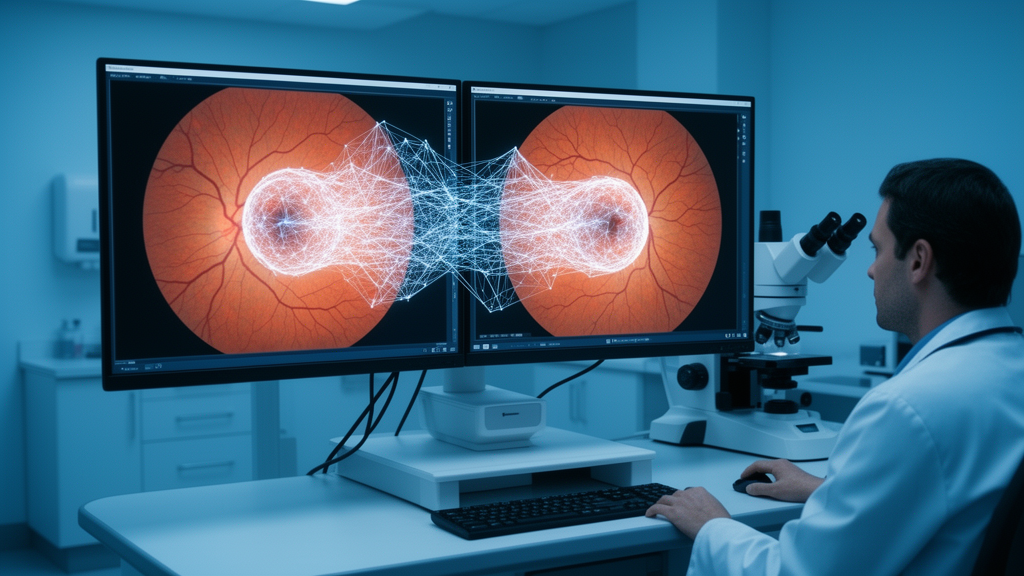
A dual-modality artificial-intelligence model that analyzed both fundus photographs and optical coherence tomography (OCT) scans reported high performance when classifying diabetic retinopathy, macular edema, age-related macular degeneration and glaucoma in a combined benchmark dataset. The optimized hierarchical dual-modality feature pyramid network, or OHDM-FPN, achieved 98.2% accuracy, 97.9% sensitivity, 98.7% specificity, an area under the receiver operating characteristic curve of 0.993 and an F1 score of 98.1%. The study addressed a limitation of single-modality imaging.

Fundus photography captures surface-level vascular and optic-disc information, whereas OCT provides high-resolution cross-sectional detail of retinal layers but does not include the same surface-level cues. OHDM-FPN was designed to combine these complementary representations for eye-disease detection, including early-stage disease detection. For fundus images, the framework used EfficientNetV2-Small as its encoder.

OCT images were processed by GhostNet with dilated residual blocks. Each modality passed through a feature pyramid network using atrous spatial pyramid pooling to develop multi-scale representations before the two streams were brought together. The fusion stage used a cross-modality multi-scale fusion block to align and combine modality-specific features.

This block incorporated channel-spatial attention and deformable convolutions. A lightweight classification head then predicted the disease category, while hyperparameter tuning with the Salmon Salar optimization algorithm was used to address class imbalance and improve generalization. Experiments were conducted on a combined fundus–OCT benchmark dataset assembled from EyePACS and Duke OCT.

Against the study’s comparison models, the reported OHDM-FPN results were described as averaging 6.3% better in accuracy and 5.8% better in AUC than single-modality models. The researchers also reported a 9.1% improvement in early-stage disease detection rates compared with OCT-only baselines. Attention heat maps were used to examine the regions influencing the model’s classifications.

The reported maps showed that OHDM-FPN focused on clinically relevant retinal regions, providing an interpretability aid for ophthalmologists. This visualization was presented as a way to inspect where the network placed emphasis when making predictions. The findings are computational results from benchmark datasets rather than results from a prospective clinical trial.

Consequently, the reported performance does not establish how OHDM-FPN would perform in routine clinical use. Within the study’s stated scope, the results indicate that fusing fundus and OCT features improved classification performance relative to the reported single-modality baselines. OHDM-FPN combined modality-specific feature extraction, multi-scale processing, attention, deformable convolutions and optimized classification in one framework for early eye-disease detection.

Subject of Research: Evaluation of a deep-learning model for classifying eye diseases from combined fundus and OCT images

Article Title: Optimized multi-scale dual-modality feature pyramid network for early eye disease classification using fundus and OCT imaging

Article References: Kiruthiga, R., & Kumar, A. S. (2026). Optimized multi-scale dual-modality feature pyramid network for early eye disease classification using fundus and OCT imaging. Complex & Intelligent Systems. https://doi.org/10.1007/s40747-026-02507-w

Image Credits: AI Generated

DOI: 10.1007/s40747-026-02507-w

Keywords: multimodal AI, eye disease detection, fundus photography, optical coherence tomography, deep learning, feature fusion, diabetic retinopathy, macular edema, glaucoma, interpretable AI, Optimized, multi-scale

Cite Scienmag News

Denise Maddox. (October 20, 2026). Multimodal AI model combines eye scans for early disease classification. Scienmag. https://scienmag.com/multimodal-ai-model-combines-eye-scans-for-early-disease-classification/

Denise Maddox. "Multimodal AI model combines eye scans for early disease classification." Scienmag, 20 October 2026, https://scienmag.com/multimodal-ai-model-combines-eye-scans-for-early-disease-classification/. Accessed 20 October 2026.

Denise Maddox. "Multimodal AI model combines eye scans for early disease classification." Scienmag. October 20, 2026. https://scienmag.com/multimodal-ai-model-combines-eye-scans-for-early-disease-classification/


Tags: attention mechanisms in multimodal retinal diagnosisCombiningcross-modality feature fusion in medical AIdeep learningdeep learning models using EfficientNetV2 and GhostNetdiabetic retinopathydual-modality imaging in ophthalmologyearly detection of diabetic retinopathy and macular degenerationeye disease detectionfeature fusionfundus photographyfundus photography and OCT scan analysisglaucomahierarchical feature pyramid network for retinal disease detectionhigh accuracy ophthalmic disease classification modelshyperparameter tuning in medical image analysisinterpretable AImacular edemamulti-scalemulti-scale feature extraction in eye imagingmultimodal AImultimodal AI for eye disease classificationoptical coherence tomographyoptimized
Share26Tweet16
Previous Post

Phase I NK510-PD-1 combination shows preliminary safety in nine lung cancer patients

Next Post

Synthetic wheat reveals broad and isolate-specific blotch resistance loci

Related Posts

MRI heterogeneity maps predict pancreatic cancer nerve invasion
Science News

MRI heterogeneity maps predict pancreatic cancer nerve invasion

October 20, 2026
Explainable machine learning reveals limits in nanoparticle tumor-delivery prediction
Science News

Explainable machine learning reveals limits in nanoparticle tumor-delivery prediction

October 20, 2026
Crack Position Changes Stress Patterns in Semi-Rigid Asphalt Pavements
Technology and Engineering

Crack Position Changes Stress Patterns in Semi-Rigid Asphalt Pavements

October 20, 2026
Raman barcodes distinguish 20 SARS-CoV-2 variants in laboratory study
Technology and Engineering

Raman barcodes distinguish 20 SARS-CoV-2 variants in laboratory study

October 20, 2026
Adaptive neural control improves disturbance rejection in laboratory gyroscope tests
Technology and Engineering

Adaptive neural control improves disturbance rejection in laboratory gyroscope tests

October 20, 2026
Flow-through deposition yields smoother ZnO nanocomposite coatings
Technology and Engineering

Flow-through deposition yields smoother ZnO nanocomposite coatings

October 20, 2026
Next Post
Synthetic wheat reveals broad and isolate-specific blotch resistance loci

Synthetic wheat reveals broad and isolate-specific blotch resistance loci

  • Mothers who receive childcare support from maternal grandparents show more optimized

    Mothers who receive childcare support from maternal grandparents show more parental warmth, finds NTU Singapore study

    27656 shares
    Share 11059 Tweet 6912
  • University of Seville Breaks 120-Year-Old Mystery, Revises a Key Einstein Concept

    1061 shares
    Share 424 Tweet 265
  • Bee body mass, pathogens and local climate influence heat tolerance

    682 shares
    Share 273 Tweet 171
  • Researchers record first-ever images and data of a shark experiencing a boat strike

    546 shares
    Share 218 Tweet 137
  • Groundbreaking Clinical Trial Reveals Lubiprostone Enhances Kidney Function

    531 shares
    Share 212 Tweet 133
Science

Embark on a thrilling journey of discovery with Scienmag.com—your ultimate source for cutting-edge breakthroughs. Immerse yourself in a world where curiosity knows no limits and tomorrow’s possibilities become today’s reality!

RECENT NEWS

  • Synthetic wheat reveals broad and isolate-specific blotch resistance loci
  • Multimodal AI model combines eye scans for early disease classification
  • Phase I NK510-PD-1 combination shows preliminary safety in nine lung cancer patients
  • Electroacupuncture lowers salt-induced hypertension in mice and alters PVN excitability

Categories

  • Agriculture
  • Anthropology
  • Archaeology
  • Athmospheric
  • Biology
  • Biotechnology
  • Blog
  • Bussines
  • Cancer
  • Chemistry
  • Climate
  • Earth Science
  • Editorial Policy
  • Marine
  • Mathematics
  • Medicine
  • Pediatry
  • Policy
  • Psychology & Psychiatry
  • Science Education
  • Science News
  • Social Science
  • Space
  • Technology and Engineering

Subscribe to Blog via Email

Enter your email address to subscribe to this blog and receive notifications of new posts by email.

Join 5,150 other subscribers

© 2025 Scienmag - Science Magazine

Welcome Back!

Login to your account below

Forgotten Password?

Retrieve your password

Please enter your username or email address to reset your password.

Log In
No Result
View All Result
  • HOME
  • SCIENCE NEWS
  • CONTACT US

© 2025 Scienmag - Science Magazine

Discover more from Science

Subscribe now to keep reading and get access to the full archive.

Continue reading