

Tuesday, October 20, 2026
Science
No Result
View All Result
  • Login
  • HOME
  • SCIENCE NEWS
  • CONTACT US
  • HOME
  • SCIENCE NEWS
  • CONTACT US
No Result
View All Result
Scienmag
No Result
View All Result
Home Science News Technology and Engineering

Flow-through deposition yields smoother ZnO nanocomposite coatings

October 20, 2026
in Technology and Engineering
Denise Maddox
By Denise Maddox Scienmag Editorial Profile - Mechanical Engineering
Reading Time: 3 mins read
0
Flow-through deposition yields smoother ZnO nanocomposite coatings

Flow-through deposition yields smoother ZnO nanocomposite coatings

65
SHARES
587
VIEWS
Share on FacebookShare on Twitter
ADVERTISEMENT

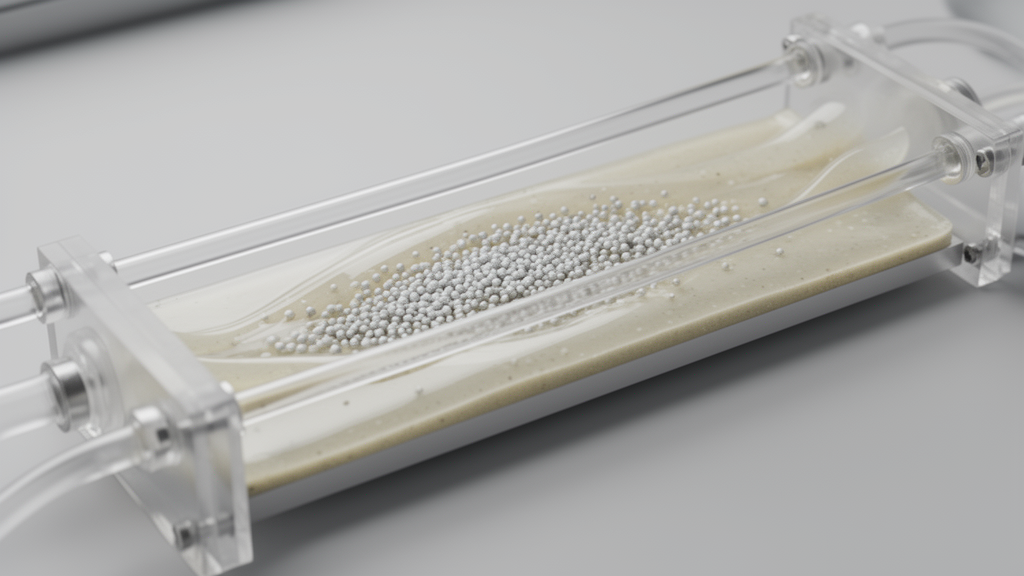
A laboratory comparison of three fabrication methods found that flow-through chemical deposition (FTCD) produced the smoothest ZnO/stearic acid nanocomposite thin films on glass, while chemical bath deposition (CBD) and successive ionic layer adsorption and reaction (SILAR) produced rougher surfaces with higher water contact angles. The study examined how the deposition route affected film morphology and wetting, using scanning probe microscopy and water contact angle measurements alongside structural, chemical, optical and surface characterization.

Scanning probe microscopy measurements gave root-mean-square surface roughness values, expressed as Rq, of 80.91 nm for CBD, 78.18 nm for SILAR and 42.29 nm for FTCD. Thus, the FTCD coating had a markedly lower measured roughness than the two conventionally deposited films. Its Rq value was about 52% of the CBD value and slightly more than half the SILAR value. The authors described the continuous-flow reactor approach as producing a coating with lower surface roughness and better wetting behavior than the conventional coating methods, while the reported contact-angle data provide a more specific picture of the difference in water repellency.

All three coatings were hydrophobic according to their water contact angles. The measured values were 145.26° ± 3.04° for CBD, 141.09° ± 3.50° for SILAR and 130.63° ± 3.78° for FTCD. The CBD and SILAR films therefore had higher water contact angles than the FTCD film, with the FTCD value lower by about 15 degrees than CBD and 10 degrees than SILAR when the reported means are compared. Within this set of three films, the rougher CBD and SILAR surfaces were associated with greater measured water repellency, whereas the smoother FTCD surface had a lower contact angle. The results establish a relationship between surface roughness and wettability for the tested coatings, but they do not isolate roughness as the sole cause of the differences or show that the same relationship applies to other compositions or substrates.

The researchers characterized the nanocomposite films with X-ray diffraction, scanning electron microscopy, energy-dispersive X-ray spectroscopy, ultraviolet–visible spectroscopy, Fourier transform infrared spectroscopy and scanning probe microscopy. These methods were used to examine structural, optical, chemical and morphological properties. Water contact angle measurements assessed the hydrophobic character of the ZnO coatings. The study’s evidence supports a comparison of the fabrication methods through the reported roughness and contact-angle values, together with the broader characterization of film structure and composition; the available summary does not specify individual values for every characterization technique or the full preparation parameters used for each method.

The findings identify a measurable trade-off between surface smoothness and water repellency in ZnO/stearic acid nanocomposite thin films. FTCD produced the lowest roughness, but CBD and SILAR produced the highest contact angles. The results may help inform the design of hydrophobic nanostructured coatings for applications including self-cleaning surfaces and corrosion inhibition, which the authors identified as potential uses for hydrophobic ZnO coatings. Because the reported comparison concerns laboratory thin films deposited on glass, the results describe fabrication-dependent differences in this material system rather than performance across different applications or operating conditions.

Subject of Research: Comparison of fabrication methods for hydrophobic ZnO/stearic acid nanocomposite thin films

Article Title: Effect of the fabrication method on the hydrophobicity of ZnO/stearic acid nanocomposite thin films: comparison of flow-through chemical deposition (FTCD) with SILAR and CBD methods

Article References: Yücel, Y., & Yücel, E. (2026). Effect of the fabrication method on the hydrophobicity of ZnO/stearic acid nanocomposite thin films: comparison of flow-through chemical deposition (FTCD) with SILAR and CBD methods. Journal of Nanoparticle Research, 28(11), Article 274. https://doi.org/10.1007/s11051-026-06794-9

Image Credits: AI Generated

DOI: 10.1007/s11051-026-06794-9

Keywords: ZnO nanocomposites, flow-through chemical deposition, chemical bath deposition, SILAR, surface roughness, water contact angle, hydrophobic coatings, wettability, thin films, Effect, fabrication, method

Cite Scienmag News

Denise Maddox. (October 20, 2026). Flow-through deposition yields smoother ZnO nanocomposite coatings. Scienmag. https://scienmag.com/flow-through-deposition-yields-smoother-zno-nanocomposite-coatings/

Denise Maddox. "Flow-through deposition yields smoother ZnO nanocomposite coatings." Scienmag, 20 October 2026, https://scienmag.com/flow-through-deposition-yields-smoother-zno-nanocomposite-coatings/. Accessed 20 October 2026.

Denise Maddox. "Flow-through deposition yields smoother ZnO nanocomposite coatings." Scienmag. October 20, 2026. https://scienmag.com/flow-through-deposition-yields-smoother-zno-nanocomposite-coatings/


Tags: chemical bath depositioncomparison of chemical bath deposition and SILAR techniquescontinuous flow reactor advantages in nanocoatingEffecteffects of deposition route on film morphologyFabricationflow-through chemical depositionFlow-through chemical deposition of ZnO nanocomposite coatingshydrophobic coatingsinfluence of fabrication method on coating smoothmethodnanostructured thin film fabrication methodsscanning probe microscopy in nanotechnologySILARsurface characterization of ZnO/stearic acid filmssurface roughnesssurface roughness measurement of nanomaterialsthin filmswater contact anglewater contact angle analysis of hydrophobic coatingswettabilitywetting behavior of nanocomposite coatingsZnO nanocomposites
Share26Tweet16
Previous Post

Physics-guided four-channel AI restores AFM images with fewer parameters

Next Post

Hungarian survey links sport interest and awareness to integrated-club openness

Related Posts

Adaptive neural control improves disturbance rejection in laboratory gyroscope tests
Technology and Engineering

Adaptive neural control improves disturbance rejection in laboratory gyroscope tests

October 20, 2026
Physics-guided four-channel AI restores AFM images with fewer parameters
Technology and Engineering

Physics-guided four-channel AI restores AFM images with fewer parameters

October 20, 2026
Alkaloids from Erythrina crista-galli flowers inhibit acetylcholinesterase
Technology and Engineering

Alkaloids from Erythrina crista-galli flowers inhibit acetylcholinesterase

October 20, 2026
Autoencoder clustering boosts federated sentiment analysis under label skew
Technology and Engineering

Autoencoder clustering boosts federated sentiment analysis under label skew

October 20, 2026
Lanthanum-tuned PtCo intermetallic catalyst improves oxygen-reduction activity in fuel-cell study
Technology and Engineering

Lanthanum-tuned PtCo intermetallic catalyst improves oxygen-reduction activity in fuel-cell study

October 20, 2026
Ultrasound-activated channel improves glucose control in diabetic mice within dose window
Technology and Engineering

Ultrasound-activated channel improves glucose control in diabetic mice within dose window

October 20, 2026
Next Post
Hungarian survey links sport interest and awareness to integrated-club openness

Hungarian survey links sport interest and awareness to integrated-club openness

  • Mothers who receive childcare support from maternal grandparents show more optimized

    Mothers who receive childcare support from maternal grandparents show more parental warmth, finds NTU Singapore study

    27656 shares
    Share 11059 Tweet 6912
  • University of Seville Breaks 120-Year-Old Mystery, Revises a Key Einstein Concept

    1061 shares
    Share 424 Tweet 265
  • Bee body mass, pathogens and local climate influence heat tolerance

    682 shares
    Share 273 Tweet 171
  • Researchers record first-ever images and data of a shark experiencing a boat strike

    546 shares
    Share 218 Tweet 137
  • Groundbreaking Clinical Trial Reveals Lubiprostone Enhances Kidney Function

    531 shares
    Share 212 Tweet 133
Science

Embark on a thrilling journey of discovery with Scienmag.com—your ultimate source for cutting-edge breakthroughs. Immerse yourself in a world where curiosity knows no limits and tomorrow’s possibilities become today’s reality!

RECENT NEWS

  • Adaptive neural control improves disturbance rejection in laboratory gyroscope tests
  • Hungarian survey links sport interest and awareness to integrated-club openness
  • Flow-through deposition yields smoother ZnO nanocomposite coatings
  • Physics-guided four-channel AI restores AFM images with fewer parameters

Categories

  • Agriculture
  • Anthropology
  • Archaeology
  • Athmospheric
  • Biology
  • Biotechnology
  • Blog
  • Bussines
  • Cancer
  • Chemistry
  • Climate
  • Earth Science
  • Editorial Policy
  • Marine
  • Mathematics
  • Medicine
  • Pediatry
  • Policy
  • Psychology & Psychiatry
  • Science Education
  • Science News
  • Social Science
  • Space
  • Technology and Engineering

Subscribe to Blog via Email

Enter your email address to subscribe to this blog and receive notifications of new posts by email.

Join 5,150 other subscribers

© 2025 Scienmag - Science Magazine

Welcome Back!

Login to your account below

Forgotten Password?

Retrieve your password

Please enter your username or email address to reset your password.

Log In
No Result
View All Result
  • HOME
  • SCIENCE NEWS
  • CONTACT US

© 2025 Scienmag - Science Magazine

Discover more from Science

Subscribe now to keep reading and get access to the full archive.

Continue reading