

Tuesday, October 20, 2026
Science
No Result
View All Result
  • Login
  • HOME
  • SCIENCE NEWS
  • CONTACT US
  • HOME
  • SCIENCE NEWS
  • CONTACT US
No Result
View All Result
Scienmag
No Result
View All Result
Home Science News Technology and Engineering

Adaptive neural control improves disturbance rejection in laboratory gyroscope tests

October 20, 2026
in Technology and Engineering
Cassandra Pierce
By Cassandra Pierce Scienmag Editorial Profile - Systems Neuroscience
Reading Time: 2 mins read
0
Adaptive neural control improves disturbance rejection in laboratory gyroscope tests

Adaptive neural control improves disturbance rejection in laboratory gyroscope tests

65
SHARES
587
VIEWS
Share on FacebookShare on Twitter
ADVERTISEMENT

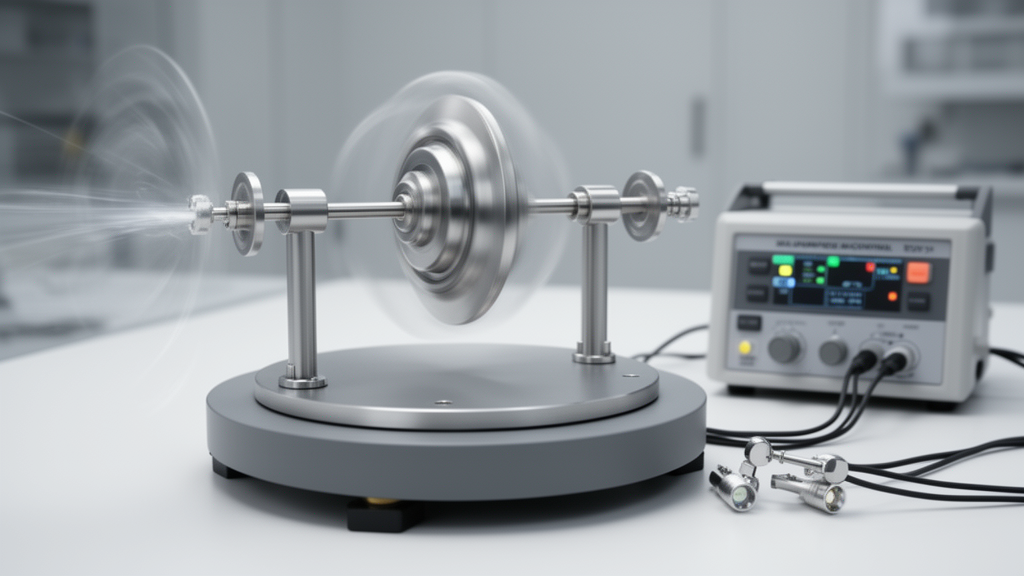
An adaptive neural-network controller using signed power functions outperformed previously proposed controllers in disturbance-rejection tests on an underactuated two-degree-of-freedom control moment gyroscope. Under disturbance-induced conditions, the proposed scheme improved relative root mean square tracking-error performance by 89.7% and control-torque performance by 2.41% compared with the reference controller, according to the study’s abstract. The experiments, reported in Neural Computing and Applications , compared the new controller with control schemes previously proposed in the literature for the same type of gyroscope.

Evaluations were conducted both without an applied disturbance and with induced disturbances. Across those comparisons, the adaptive controller achieved the best relative root mean square performance of the schemes included in the experiment. The approach differs from a neural controller with weights fixed before operation because its network weights are updated online.

The authors state that this design avoids a separate offline training phase and permits real-time disturbance compensation. No pretraining procedure is required for the proposed controller, while its update law incorporates signed power functions. The research also included an analysis of the closed-loop trajectories produced by the proposed control scheme.

These trajectories describe the gyroscope’s behavior under closed-loop operation, complementing the experimental comparisons with the other controllers. The supplied article abstract does not provide the numerical trajectory results or the mathematical details of the closed-loop analysis. The reported tracking result was measured in a laboratory experiment rather than inferred from a simulation or a mathematical prediction.

In the disturbance-induced trials, the adaptive controller’s relative root mean square tracking-error performance improved by 89.7% relative to the reference scheme. The study also reported a 2.41% improvement in control-torque performance under the same conditions. Two kinds of test conditions were used to assess the controller.

Disturbance-free experiments examined its baseline tracking behavior, while disturbance-induced experiments evaluated performance when disturbances were introduced. Adaptive neural networks are used in the study to compensate for incomplete knowledge of a system’s mathematical model, uncertainty in system parameters and external disturbances. Their key operational distinction in this work is the ability to update network weights during the experiment, rather than relying only on weights established beforehand.

Signed power functions form part of that online weight-update law. The evidence is limited to the tested underactuated two-degree-of-freedom control moment gyroscope and the controller configurations included in the experiments. The supplied abstract does not report trial counts, uncertainty intervals, operating environments, deployment tests or results for other gyroscope designs.

The findings therefore demonstrate improved performance in this laboratory setup, not a general advantage across all gyroscopes or control applications.

Subject of Research: Experimental evaluation of online adaptive neural control for disturbance rejection in an underactuated control moment gyroscope

Article Title: Strong disturbance rejection via neuro-adaptive signed power function tracking control for an underactuated control moment gyroscope

Article References: López, S., Montoya–Cháirez, J., Llama, M. A., & Santibáñez, V. (2026). Strong disturbance rejection via neuro-adaptive signed power function tracking control for an underactuated control moment gyroscope. Neural Computing and Applications, 38(20), Article 828. https://doi.org/10.1007/s00521-026-12565-3

Image Credits: AI Generated

DOI: 10.1007/s00521-026-12565-3

Keywords: adaptive neural networks, control moment gyroscope, disturbance rejection, signed power functions, online weight updates, trajectory tracking, underactuated systems, control torque, closed-loop control, Strong, disturbance, rejection

Cite Scienmag News

Cassandra Pierce. (October 20, 2026). Adaptive neural control improves disturbance rejection in laboratory gyroscope tests. Scienmag. https://scienmag.com/adaptive-neural-control-improves-disturbance-rejection-in-laboratory-gyroscope-tests/


Cassandra Pierce. "Adaptive neural control improves disturbance rejection in laboratory gyroscope tests." Scienmag, 20 October 2026, https://scienmag.com/adaptive-neural-control-improves-disturbance-rejection-in-laboratory-gyroscope-tests/. Accessed 20 October 2026.

Cassandra Pierce. "Adaptive neural control improves disturbance rejection in laboratory gyroscope tests." Scienmag. October 20, 2026. https://scienmag.com/adaptive-neural-control-improves-disturbance-rejection-in-laboratory-gyroscope-tests/

Tags: adaptive control performance improvementadaptive neural network controladaptive neural networksclosed-loop controlclosed-loop system trajectoriescontrol moment gyroscopecontrol torquedisturbancedisturbance compensation in laboratory experimentsdisturbance rejectiondisturbance rejection in gyroscopesgyroscope disturbance mitigation strategiesneural controller with online learningneural network control in aerospace systemsonline neural network trainingonline weight updatesreal-time control moment gyroscoperejectionsigned power function-based controlsigned power functionsStrongtrajectory trackingunderactuated system controlunderactuated systems
Share26Tweet16
Previous Post

Hungarian survey links sport interest and awareness to integrated-club openness

Next Post

Raman barcodes distinguish 20 SARS-CoV-2 variants in laboratory study

Related Posts

Raman barcodes distinguish 20 SARS-CoV-2 variants in laboratory study
Technology and Engineering

Raman barcodes distinguish 20 SARS-CoV-2 variants in laboratory study

October 20, 2026
Flow-through deposition yields smoother ZnO nanocomposite coatings
Technology and Engineering

Flow-through deposition yields smoother ZnO nanocomposite coatings

October 20, 2026
Physics-guided four-channel AI restores AFM images with fewer parameters
Technology and Engineering

Physics-guided four-channel AI restores AFM images with fewer parameters

October 20, 2026
Alkaloids from Erythrina crista-galli flowers inhibit acetylcholinesterase
Technology and Engineering

Alkaloids from Erythrina crista-galli flowers inhibit acetylcholinesterase

October 20, 2026
Autoencoder clustering boosts federated sentiment analysis under label skew
Technology and Engineering

Autoencoder clustering boosts federated sentiment analysis under label skew

October 20, 2026
Lanthanum-tuned PtCo intermetallic catalyst improves oxygen-reduction activity in fuel-cell study
Technology and Engineering

Lanthanum-tuned PtCo intermetallic catalyst improves oxygen-reduction activity in fuel-cell study

October 20, 2026
Next Post
Raman barcodes distinguish 20 SARS-CoV-2 variants in laboratory study

Raman barcodes distinguish 20 SARS-CoV-2 variants in laboratory study

  • Mothers who receive childcare support from maternal grandparents show more optimized

    Mothers who receive childcare support from maternal grandparents show more parental warmth, finds NTU Singapore study

    27656 shares
    Share 11059 Tweet 6912
  • University of Seville Breaks 120-Year-Old Mystery, Revises a Key Einstein Concept

    1061 shares
    Share 424 Tweet 265
  • Bee body mass, pathogens and local climate influence heat tolerance

    682 shares
    Share 273 Tweet 171
  • Researchers record first-ever images and data of a shark experiencing a boat strike

    546 shares
    Share 218 Tweet 137
  • Groundbreaking Clinical Trial Reveals Lubiprostone Enhances Kidney Function

    531 shares
    Share 212 Tweet 133
Science

Embark on a thrilling journey of discovery with Scienmag.com—your ultimate source for cutting-edge breakthroughs. Immerse yourself in a world where curiosity knows no limits and tomorrow’s possibilities become today’s reality!

RECENT NEWS

  • Raman barcodes distinguish 20 SARS-CoV-2 variants in laboratory study
  • Adaptive neural control improves disturbance rejection in laboratory gyroscope tests
  • Hungarian survey links sport interest and awareness to integrated-club openness
  • Flow-through deposition yields smoother ZnO nanocomposite coatings

Categories

  • Agriculture
  • Anthropology
  • Archaeology
  • Athmospheric
  • Biology
  • Biotechnology
  • Blog
  • Bussines
  • Cancer
  • Chemistry
  • Climate
  • Earth Science
  • Editorial Policy
  • Marine
  • Mathematics
  • Medicine
  • Pediatry
  • Policy
  • Psychology & Psychiatry
  • Science Education
  • Science News
  • Social Science
  • Space
  • Technology and Engineering

Subscribe to Blog via Email

Enter your email address to subscribe to this blog and receive notifications of new posts by email.

Join 5,150 other subscribers

© 2025 Scienmag - Science Magazine

Welcome Back!

Login to your account below

Forgotten Password?

Retrieve your password

Please enter your username or email address to reset your password.

Log In
No Result
View All Result
  • HOME
  • SCIENCE NEWS
  • CONTACT US

© 2025 Scienmag - Science Magazine

Discover more from Science

Subscribe now to keep reading and get access to the full archive.

Continue reading