


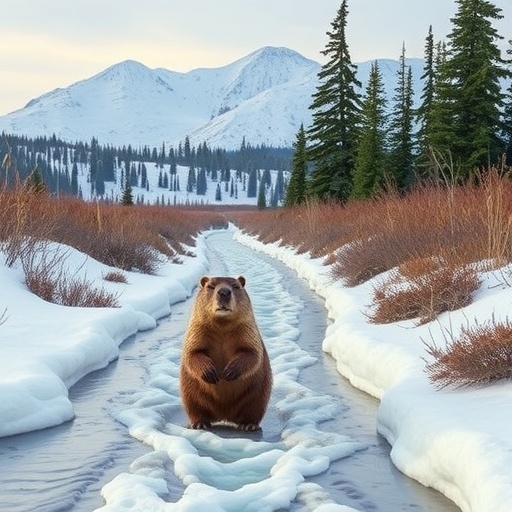
A groundbreaking study published in the journal Ecosphere has unveiled compelling new evidence documenting the northward expansion of the North American beaver (Castor canadensis) into the Canadian Arctic tundra. This pioneering research utilizes a sophisticated combination of dendrochronology—the study of tree rings—and advanced satellite imagery to reconstruct the beavers’ historical presence and landscape transformation in an otherwise remote, difficult-to-access region. The implications are significant, highlighting the ecological ripple effects of climate change in Arctic ecosystems.
Beavers are well-known as ecological engineers, capable of dramatically reshaping their environment through the construction of dams and lodges. These structures alter hydrological patterns, affect permafrost stability, and consequently influence fish populations and the livelihoods of Indigenous communities. However, until now, little was understood about how beaver activity might be expanding as climatic conditions shift and the tundra warms. This study spearheaded by researchers from Anglia Ruskin University (ARU) in Cambridge, UK, pioneers a novel methodology to detect beaver occupancy by correlating physical evidence in shrub growth rings with remotely sensed hydrological changes.
The researchers focused their surveys across the Inuvialuit Settlement Region, spanning from Inuvik northward to the Arctic Ocean coast near Tuktoyaktuk. This vast, sparsely populated area has witnessed altered vegetation patterns, with climate-induced shrubification increasing the abundance of willow (Salix) and alder (Alnus) species, which serve as critical food and building resources for beavers. Partnering closely with the Indigenous environmental guardians of the Imaryuk Monitors, the team mapped 60 beaver lodges and dam sites, collecting stem samples from browsed shrubs that bear telltale scars indicative of beaver activity.
Dendrochronological analysis was performed on these shrub samples, meticulously cross-dated against regional chronologies spanning several decades. The willow ring data ranged from 1973 to 2023, while alder rings extended from 1968 to 2023. This precise dating technique enabled the team to reconstruct browsing histories and pinpoint the initial colonization of the Arctic tundra by beavers, which the data identified around 2008. These results mark a significant extension of the species’ range, emphasizing a dynamic response to environmental changes in the Arctic.
Complementing the ground-based dendrochronology, satellite remote sensing was employed to analyze hydrological transformations linked to beaver engineering. At a prominent lodge and dam complex, researchers observed a sudden and pronounced increase in surface water cover between 2015 and 2019 via satellite imagery. This flooding event corresponded precisely with a period of intense shrub browsing revealed through ring analysis, providing robust, independent verification of beaver colonization at this northern frontier.
Senior author Dr. Helen Wheeler, Associate Professor of Ecology at ARU, emphasized the importance of this multimodal approach: “Beavers leave behind an indelible signature in the landscape. Their biological and engineering activities create an archive that we can now read through tree rings and satellite data. Confirming their presence near the Arctic Ocean underscores the profound ways climate warming is reshaping species distributions and ecosystem dynamics in one of the planet’s most vulnerable biomes.”
These findings also bear substantial consequences for Indigenous communities living in the Arctic. As beavers alter water regimes and fish habitats—components central to subsistence and cultural practices—their encroachment requires careful monitoring and integration into environmental stewardship. The collaboration with the Imaryuk Monitors not only facilitated vital data collection but underscores how Indigenous knowledge and scientific research can coalesce to enhance understanding of rapid Arctic change.
Lead author Dr. Georgia Hole, formerly of ARU and now at Durham University, noted that reconstructing historical ecological baselines in remote northern regions is notoriously challenging due to limited long-term observational data. “Our methods allow us to fill these critical gaps by dating beaver activity backward in time through sclerochronological markers in shrubs and hydrological evidence from satellite platforms. This combined toolkit opens a new window into past ecosystem transformations driven by climate-induced species migrations.”
The relevance of this study extends beyond documenting beaver expansion. It provides a framework for detecting and monitoring other elusive Arctic wildlife activities where field observations may be infrequent or incomplete. As global temperatures continue to rise, the ecological fabric of the Arctic tundra will undergo further rapid shifts, necessitating innovative tools to understand and adapt to these changes.
Moreover, the study reveals intricate linkages between climate warming, shrub growth, and animal behavior, illustrating the complex feedbacks now underway in northern latitudes. By increasing shrub abundance, the warming Arctic inadvertently facilitates beaver colonization, which in turn modifies hydrological and permafrost conditions—potentially accelerating landscape change in unexpected ways.
This research forms part of the broader Canada-Inuit Nunangat-United Kingdom Arctic Research Programme (BARIN), which underscores the power of international cooperation in tackling urgent environmental questions. It highlights the indispensable role of Indigenous partnerships, combining Western scientific methods with traditional knowledge to achieve impactful, culturally sensitive outcomes.
Ultimately, this novel intersection of dendrochronology and remote sensing offers a timely, powerful approach to understanding the ecological consequences of Arctic warming. It captures a vivid portrait of beaver colonization as a dynamic process with far-reaching ramifications, embedded within the accelerating narrative of climate change transforming northern terrestrial landscapes.
Cite Scienmag News
Drew Townsend. (April 23, 2026). Beavers Forge Path Northward into the Arctic. Scienmag. https://scienmag.com/beavers-forge-path-northward-into-the-arctic/
Drew Townsend. "Beavers Forge Path Northward into the Arctic." Scienmag, 23 April 2026, https://scienmag.com/beavers-forge-path-northward-into-the-arctic/. Accessed 3 September 2026.
Drew Townsend. "Beavers Forge Path Northward into the Arctic." Scienmag. April 23, 2026. https://scienmag.com/beavers-forge-path-northward-into-the-arctic/


