


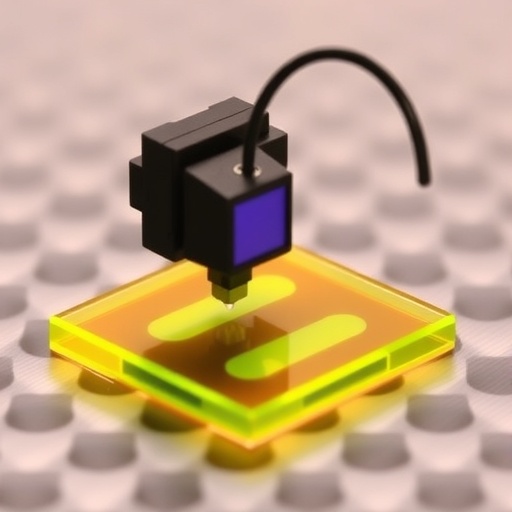
In a groundbreaking advancement poised to transform the precision and accessibility of resin-based 3D printing, scientists at the National Taiwan University of Science and Technology have engineered an ultra-thin, double-sided optical film that dramatically refines the quality of light employed in these manufacturing systems. This innovation holds promise for elevating the print resolution and surface finish of LCD resin printers without enlarging the printer size or substantially increasing costs—a leap towards professional-grade fabrications becoming standard in consumer and industrial 3D printing alike.
Resin-based 3D printing, also known as vat photopolymerization, relies on the careful projection of ultraviolet (UV) light patterns onto liquid photosensitive resin to solidify structures layer by layer with exceptional detail and smoothness. However, despite its potential, many entry-level printers use LCD backlights that struggle to deliver perfectly collated and uniformly distributed light, leading to undesirable surface roughness and dimensional inaccuracies in the printed objects. Addressing these optical shortcomings has been a critical challenge for the industry.
Led by optical engineer Ding-Zheng Lin, the research team ventured to solve this problem with a novel approach: designing a double-sided structure collimation film (DSSCF) that enhances light collimation characteristics far beyond what is achievable with older single-sided films or bulky lens assemblies. The DSSCF operates by employing intricately patterned arrays of micro-lenticules and trapezoidal microstructures on both the front and back sides of the film. These microscopic structures expertly manipulate light paths, significantly reducing the spread of light rays and ensuring they remain highly parallel, a state known as high collimation.
This meticulous control over light angular distribution directly translates to improved print fidelity. Light rays with smaller divergence angles expose the resin layers more precisely, thereby preserving every minute detail of the 3D object’s design. Simultaneously, the trapezoidal microstructures limit leakage of large-angle stray light that typically causes non-uniform illumination, ensuring the printed layer receives consistent intensity across its entire surface area. This uniformity is essential for reproducing objects with both high contrast and quality surface texture.
Crucially, the DSSCF achieves these benefits while maintaining an ultra-thin profile, easily integrating into existing printer architectures without requiring additional bulk. By recycling light that would otherwise escape through reflection into a highly reflective backlight module, the film not only improves uniformity but also enhances energy efficiency. This approach stands in stark contrast to conventional collimation methods that rely on cumbersome and expensive optical arrays or lens elements.
To quantify the film’s performance, the researchers constructed a specialized measurement setup incorporating an angle-dependent photometer. This allowed them to precisely assess both the beam divergence angles and intensity distributions after light passed through the film. The results revealed that the DSSCF markedly narrows the beam divergence, restricting the light spread to below 10 degrees full width at half maximum (FWHM). Moreover, the intensity uniformity across the illuminated area exceeded 81%, demonstrating superior collimation and homogenization capabilities compared to existing solutions.
Integrating two layers of these double-sided films with a diffuser module, the team developed a prototype LCD backlight system for 3D printers. This prototype validated the theoretical advantages, showcasing enhanced directionality and evenness of illumination. Such improved control over the emission profile empowers resin curing to proceed with better precision, thereby minimizing layer inconsistencies and defects that typically plague low-cost additive manufacturing systems.
Beyond the immediate gains in 3D printing, this breakthrough paves the way for meaningful advancements in a spectrum of applications requiring high-performance optical illumination. For instance, dental restoration models, delicate jewelry crafting, and complex engineering prototypes demand both dimensional accuracy and flawless surface aesthetics—qualities the DSSCF-enhanced backlights are uniquely positioned to deliver. Furthermore, the technology’s compactness and cost-effectiveness could democratize professional-grade 3D printing, enabling consumers to fabricate custom-fit earbud shells or precision watch components from the comfort of their homes.
The implications extend deeper into photonics and materials sciences, showcasing an elegant integration of optical simulation, microfabrication, and materials engineering. Utilizing advanced optical film simulation software, the team optimized geometric parameters for lenticular and trapezoidal microstructures to tailor light refraction and reflection properties at a sub-millimeter scale. This synthesis of design and manufacturing expertise embodies a new frontier where nano- and micro-optical elements enhance everyday technologies without compromising usability or affordability.
Currently, the researchers focus on further refining the light utilization efficiency of their films by minimizing residual energy losses during light recycling and improving compatibility across different UV wavelengths. Such enhancements are critical for broadening resin material compatibility and securing consistency across varied 3D printing resins, each with distinct absorption and curing profiles. These ongoing efforts underscore the DSSCF’s transformative potential as a universal optical component for next-generation 3D printers.
This advancement also aligns with broader trends aimed at enhancing additive manufacturing’s environmental footprint. By maximizing energy efficiency and reducing mechanical complexity, optical films like the DSSCF contribute to lowering power consumption and extending device longevity. As sustainability gains prominence, innovations that marry performance with minimal ecological impact will play an essential role in the widespread adoption of 3D printing technologies.
The research, published in the journal Optical Materials Express, represents a significant stride in optical engineering for additive manufacturing. It demonstrates how precision light filtering techniques, traditionally reserved for large-scale industrial applications, can be miniaturized and scaled to fit the stringent spatial constraints of consumer-grade devices. This fusion of micro-optics and practical engineering heralds a new chapter in the journey toward affordable, high-quality, and versatile 3D printing systems.
In summary, the double-sided structure collimation film developed by Lin and colleagues offers a powerful solution to the longstanding challenges of light control in LCD resin-based 3D printing. By delivering improved collimation, uniform light intensity, and energy-efficient light management within an ultra-thin form factor, it enables detailed and accurate printing with fewer artifacts. This technology not only promises to elevate the fabrication quality of industrial prototypes and medical models but also to enhance the capabilities of consumer-grade printers, potentially bringing professional-quality 3D manufacturing into homes worldwide.
Web References:
References:
Z.-J. Zhang, D.-Z. Lin. “Double-sided structure collimation film (DSSCF) for direct-lit backlight in high contrast liquid crystal display and 3D printing,” Opt. Mater. Express 16, 1427-1439 (2026). DOI: 10.1364/OME.593296.
Keywords
Additive manufacturing, Optical collimation, LCD backlight, 3D printing, Optical films, Lenticular lenses, Trapezoidal microstructures, Light uniformity, Resin vat photopolymerization, Optical materials, Micro-optics, Energy efficiency.
Cite Scienmag News
Denise Maddox. (April 23, 2026). Ultra-Thin Optical Film Enhances Precision in 3D Printing. Scienmag. https://scienmag.com/ultra-thin-optical-film-enhances-precision-in-3d-printing/
Denise Maddox. "Ultra-Thin Optical Film Enhances Precision in 3D Printing." Scienmag, 23 April 2026, https://scienmag.com/ultra-thin-optical-film-enhances-precision-in-3d-printing/. Accessed 4 September 2026.
Denise Maddox. "Ultra-Thin Optical Film Enhances Precision in 3D Printing." Scienmag. April 23, 2026. https://scienmag.com/ultra-thin-optical-film-enhances-precision-in-3d-printing/


