


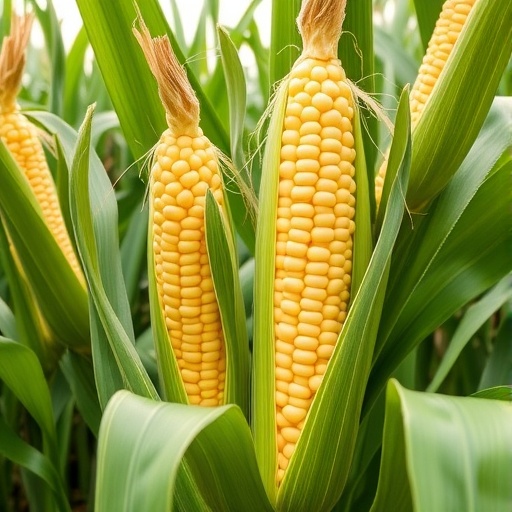
In a groundbreaking study published in Nature, researchers have unveiled a remarkable facet of plant biology that could revolutionize our understanding of nitrogen assimilation in maize. The team, led by Chen et al., has identified critical enzymes that localize within plastoglobules (PGs)—specialized subcellular structures—shedding new light on how nitrogen metabolism is spatially compartmentalized within leaf cells. This discovery not only deepens our knowledge of plant physiology but could also pave the way for improving crop yield and nitrogen use efficiency, a pressing challenge in sustainable agriculture.
Nitrogen assimilation is fundamental to plant growth, with enzymes such as nitrite reductases (NIRs) and glutamine synthetases (GLNs) playing pivotal roles in converting inorganic nitrogen into organic forms usable by the plant. Prior to this work, the subcellular localization and compartmentalization of these enzymes within maize leaf cells remained poorly understood. The current study reveals that plastoglobules, previously known primarily for their association with lipid metabolism, serve as a crucial hub for nitrogen assimilation through the specific localization of ZmNIR2 and ZmGLN1.
By harnessing transcriptomic data from the highly regarded qTeller MaizeGDB database, the researchers examined expression patterns of two maize nitrite reductase genes (ZmNIR1 and ZmNIR2) alongside six glutamine synthetase genes (ZmGLN1-6). Their careful analysis highlighted that ZmNIR2 and ZmGLN1 transcripts are predominantly abundant in leaves, the chief site of photosynthesis and nitrogen metabolism. These expression trends suggested the enzymes’ leaf-centric roles, underlining the potential importance of their plastoglobule localization.
To explore the functional implications of this localization, the team generated eight single mutant maize lines targeting each of the genes involved: nir1, nir2-1, nir2-2, gln1, gln2, gln3, gln4, gln5, and gln6. Assessment of these mutants revealed striking phenotypic differences. Notably, mutants lacking ZmNIR2 displayed severe stunted growth accompanied by leaf chlorosis—hallmarks of compromised nitrogen metabolism—even when nitrogen supply was sufficient. Meanwhile, the gln1 mutants manifested reduced plant height and extended vegetative phases, underscoring the critical roles these genes play in development.
Conversely, mutants for nir1 and gln3-6 exhibited normal morphology, indicating more limited or redundant functions. Among these, gln2 mutants showed diminished height but did not suffer notable losses in biomass, suggesting complex regulation and possible compensatory mechanisms within the glutamine synthetase gene family. These data collectively demonstrate that ZmNIR2 and ZmGLN1 have non-redundant, vital functions in maize nitrogen assimilation linked directly to their plastoglobule localization.
To confirm subcellular localization, the researchers utilized a precise fluorescence-based approach. Fusion proteins of each enzyme with enhanced green fluorescent protein (eGFP) were transiently expressed in tobacco leaf epidermal cells and tracked for co-localization with the mCherry-tagged plastoglobule marker protein PSY3. Strikingly, only ZmNIR2 and ZmGLN1 displayed strong plastoglobule-specific fluorescence, confirming their targeted presence within these organelles.
In contrast, ZmNIR1 localized predominantly to the chloroplast stroma, and ZmGLN2 through ZmGLN6 were primarily cytoplasmic, corroborating previous findings but highlighting the unique compartmentalization of ZmNIR2 and ZmGLN1. Intriguingly, a minor fraction of ZmNIR1 was also detected within plastoglobules, albeit at levels vastly lower than ZmNIR2. This minor localization is unlikely sufficient to compensate for the loss of ZmNIR2 function, thus explaining why mutations in nir1 exhibit less severe phenotypes.
Further transcript abundance analysis revealed that ZmNIR1 is chiefly expressed in roots rather than leaves, elucidating tissue-specific roles among related enzymes. Quantitative mass spectrometry measurements indicated that within plastoglobules, ZmNIR2 protein numbers reach approximately 200,000 molecule copies, orders of magnitude greater than the roughly 2,000 copies detected for ZmNIR1. This stark quantitative disparity underscores the dominant role of ZmNIR2 within leaf plastoglobules in nitrogen assimilation.
The functional compartmentalization within plastoglobules likely confers several advantages. By localizing both nitrite reductase and glutamine synthetase enzymes together, the plant may streamline the sequential steps of nitrogen conversion, reducing diffusion distances and increasing metabolic efficiency. It also highlights an elegant cellular strategy to spatially organize nitrogen metabolism alongside lipid and pigment metabolism within the same subcellular domain, optimizing resource allocation during photosynthesis.
Beyond fundamental biology, these insights have tangible translational potential. Nitrogen fertilizers represent a substantial environmental and economic burden in global agriculture. Unraveling the subcellular dynamics of nitrogen assimilation enzymes opens avenues for genetic engineering or selective breeding aimed at boosting nitrogen use efficiency in crops, potentially reducing fertilizer dependence and mitigating pollution.
This study seamlessly integrates classical genetic analyses with modern molecular and cell biological techniques to unravel enzyme localization mysteries. Its findings challenge traditional views that confined nitrogen assimilation enzymes mainly to chloroplast stroma or cytoplasm, revealing plastoglobules not as passive lipid storage units but as dynamic metabolic microcompartments critical for plant vitality.
As maize serves as a staple crop worldwide, enhancing its nitrogen metabolism bears significant implications for food security and sustainable farming. Follow-up research will likely explore how plastoglobule-associated enzymes interact at a molecular level, their regulation under different environmental stresses, and whether similar compartmentalization exists in other crop species such as rice or wheat.
This research exemplifies a paradigm shift in plant cell biology, demonstrating that subtle subcellular enzyme localizations can profoundly affect whole-plant physiology. As the global community faces climate change and evolving agricultural challenges, such discoveries underscore the power of fundamental science to inform innovative crop improvement strategies that harmonize productivity with environmental stewardship.
In conclusion, the identification of ZmNIR2 and ZmGLN1 as key enzymes compartmentalized within maize plastoglobules represents a landmark advance in understanding nitrogen metabolism. These specialized subcellular structures emerge as important centers integrating nitrogen assimilation pathways, highlighting the significance of intracellular spatial regulation. This work from Chen et al. not only deepens our conceptual models but also offers promising leads for sustainable agriculture innovations worldwide.
Cite Scienmag News
Alan Morgan. (June 4, 2026). Plastoglobules Boost Nitrogen Assimilation in Maize. Scienmag. https://scienmag.com/plastoglobules-boost-nitrogen-assimilation-in-maize/
Alan Morgan. "Plastoglobules Boost Nitrogen Assimilation in Maize." Scienmag, 4 June 2026, https://scienmag.com/plastoglobules-boost-nitrogen-assimilation-in-maize/. Accessed 6 September 2026.
Alan Morgan. "Plastoglobules Boost Nitrogen Assimilation in Maize." Scienmag. June 4, 2026. https://scienmag.com/plastoglobules-boost-nitrogen-assimilation-in-maize/


