


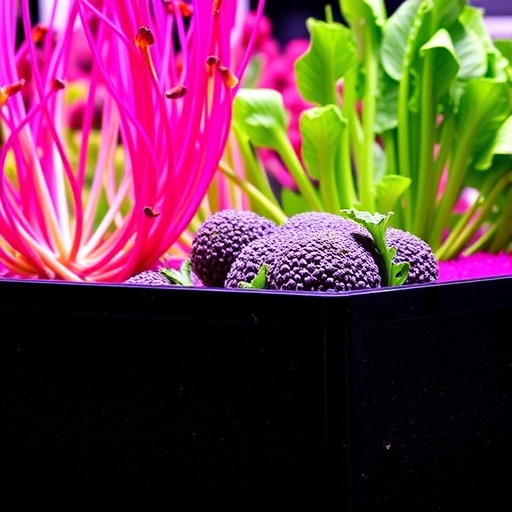
A fertilizer made from marine purple bacteria is drawing attention as a possible way to make vegetable production more efficient while reducing agriculture’s climate footprint. In a study published in npj Sustainable Agriculture, Shruthi, Morey-Yagi, Hanh and colleagues investigated how this microbial product influenced three issues that often determine whether a new fertilizer can succeed in the field: the release of plant-available nutrients, emissions of nitrous oxide, and the final yield of broccoli. The work places an unusual group of photosynthetic microorganisms at the center of a problem usually associated with synthetic nitrogen fertilizers and soil chemistry.
Marine purple bacteria are microorganisms capable of capturing light energy through specialized photosynthetic systems. Unlike green plants, they do not rely on chlorophyll as their only light-harvesting pigment. Many species contain bacteriochlorophylls and carotenoids, which allow them to use wavelengths of light that plants use less efficiently. Depending on the species and growing conditions, these bacteria can also assimilate carbon and nitrogen into their biomass. When that biomass is applied to soil, microbial decomposition can convert organic nutrients into inorganic forms that roots can absorb, a process known as mineralization.
Mineralization is one of the key mechanisms linking soil biology to crop productivity. Organic nitrogen in microbial cells and residues cannot always be taken up directly by plants. Soil microorganisms break complex compounds down, releasing ammonium and, through nitrification, nitrate. These mineral forms are central to plant nutrition, but the transformation is controlled by temperature, moisture, oxygen availability, carbon supply and the composition of the wider soil microbial community. A fertilizer that supplies nutrients in a biologically active form may therefore behave very differently from a conventional, immediately soluble product.
The same biological reactions that make nutrients available can also produce nitrous oxide, a powerful greenhouse gas. Nitrous oxide is generated mainly through nitrification, when microbes oxidize ammonium, and denitrification, when other microbes use nitrate as an electron acceptor under oxygen-limited conditions. Although it is released in much smaller quantities than carbon dioxide, nitrous oxide has a far greater warming effect per molecule and contributes to the depletion of stratospheric ozone. Agricultural soils are among the most important human-influenced sources, particularly when nitrogen inputs exceed what crops can absorb.
That creates a difficult design challenge for any alternative fertilizer. Increasing nutrient release could support stronger plant growth, but an abundant supply of ammonium or nitrate may also provide more substrate for the microbial pathways that emit nitrous oxide. Conversely, a slow or poorly synchronized release might reduce emissions while leaving crops undernourished. The study’s importance lies in examining both sides of that balance rather than judging the bacterial fertilizer only by its effect on plant size or harvest weight.
Broccoli provides a useful test crop because it is a high-value vegetable whose productivity depends on reliable nutrient availability. Nitrogen supports leaf formation, photosynthesis and the development of the edible head, while phosphorus, potassium and micronutrients contribute to energy transfer, water regulation and tissue development. However, excessive nitrogen can create environmental losses and does not automatically translate into a larger marketable harvest. By measuring broccoli yield alongside soil mineralization and nitrous oxide emissions, the researchers connected the invisible chemistry beneath the soil surface with an outcome consumers can see.
The marine origin of the fertilizer also raises broader questions about circular nutrient systems. Producing microbial biomass can potentially transform organic feedstocks or waste-derived nutrients into a product that is easier to apply to farmland. In principle, this approach could reduce dependence on industrial fertilizers whose production is energy-intensive, especially in the case of ammonia. Yet the environmental performance of a microbial fertilizer depends on the entire life cycle: how the bacteria are cultivated, what they consume, how much energy is required for processing, how far the product travels and what happens after it enters the soil.
The findings reported by Shruthi and colleagues contribute evidence to that assessment by tracking fertilizer effects across biological and agricultural endpoints. Rather than treating yield as the only measure of success, the study considers whether nutrient cycling and greenhouse-gas emissions shift alongside crop performance. That approach is essential because a product can appear sustainable in one category while creating hidden costs in another. Field conditions will also matter: rainfall, irrigation, soil texture, pH, temperature and the timing of application can all change the balance between mineralization, plant uptake and gaseous nitrogen loss.
The research does not make conventional fertilizer obsolete, but it adds marine microbial technology to the expanding portfolio of strategies being tested for lower-impact agriculture. The next step will be determining how consistently the product performs across soils, climates and crop varieties, and whether farmers can apply it at practical rates without sacrificing reliability. If future trials confirm that purple bacterial fertilizer can synchronize nutrient release with crop demand while limiting nitrous oxide, it could become part of a new generation of biologically informed fertilizers. For now, the study offers a vivid reminder that some of agriculture’s most promising innovations may come not from mines or chemical plants, but from microscopic life adapted to the sea.
Cite Scienmag News
Alan Morgan. (August 6, 2026). Marine Purple Bacterial Fertilizer Alters Mineralization, Nitrous Oxide Emissions and Broccoli Yield. Scienmag. https://scienmag.com/marine-purple-bacterial-fertilizer-alters-mineralization-nitrous-oxide-emissions-and-broccoli-yield/
Alan Morgan. "Marine Purple Bacterial Fertilizer Alters Mineralization, Nitrous Oxide Emissions and Broccoli Yield." Scienmag, 6 August 2026, https://scienmag.com/marine-purple-bacterial-fertilizer-alters-mineralization-nitrous-oxide-emissions-and-broccoli-yield/. Accessed 4 September 2026.
Alan Morgan. "Marine Purple Bacterial Fertilizer Alters Mineralization, Nitrous Oxide Emissions and Broccoli Yield." Scienmag. August 6, 2026. https://scienmag.com/marine-purple-bacterial-fertilizer-alters-mineralization-nitrous-oxide-emissions-and-broccoli-yield/


