


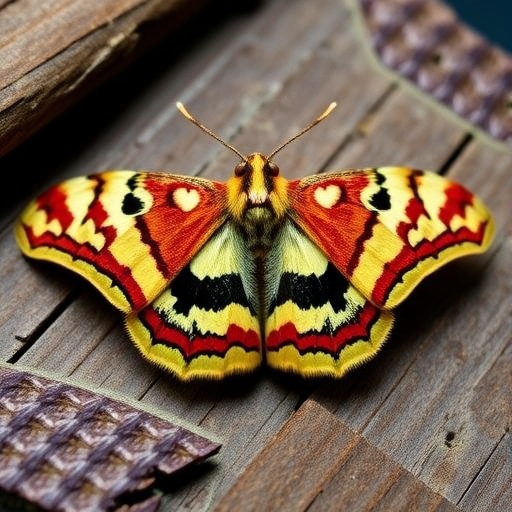
In a remarkable breakthrough in the field of entomology and biodiversity, a comprehensive integrative morphological and molecular study has unveiled a hidden trove of biodiversity within a moth species complex long thought to be singular. Originally described in 1818 and previously classified as Eois russearia, this tiny moth, scarcely measuring two centimeters across its wingspan, has now been revealed to represent at least eight distinct species endemic to Brazil. This discovery not only challenges previous taxonomic classifications but also emphasizes the sophisticated and multidimensional approach necessary for modern species delimitation.
The research, conducted by a collaborative team from the State University of Campinas (UNICAMP) and the University of São Paulo (USP), combined genetic sequencing technologies with a detailed morphological analysis, including understudied female genital structures, and ecological data derived from host plant associations. This multi-tiered approach enabled the researchers to circumvent the substantial morphological similarities that have historically masked species diversity and precluded accurate identification by classical taxonomy alone. The findings were published in the highly regarded journal Scientific Reports.
This moth species complex was studied across geographically and ecologically diverse regions of Brazil, including the Amazon rainforest, Atlantic Forest, and Pantanal wetlands. The eight newly described species display a fascinating pattern of distribution: two species, Eois iemanja and Eois ibeji, inhabit the ecological transition zone where the Atlantic Forest biome blends into the Cerrado savanna in São Paulo state. Meanwhile, Eois nanan and Eois iogunede are confined to the Pantanal biome, with specimens collected near Aquidauana in Mato Grosso do Sul. Four additional species—Eois oxumare, Eois orumila, Eois iroco, and Eois stantonae—were described from the outskirts of Manaus in the northern Amazon, with the latter honoring the memory of a deceased co-author, reflecting the human element intertwined with scientific discovery.
What is profoundly innovative about this research is the elaboration of an anti-colonial and culturally informative nomenclatural practice. Most of the newly named species draw from Afro-Brazilian cultural heritage, specifically the Orixás—deities revered in Candomblé and Umbanda religions—providing a meaningful counter-narrative to the traditionally Eurocentric naming conventions that frequently dominate taxonomic literature. This highlights a growing recognition within the scientific community of the sociocultural responsibilities associated with biodiversity documentation.
A cornerstone of this study lies in its incorporation of ecological specificity, particularly the moth larvae’s relationship with host plants of the genus Piper. These plants, notably including black pepper, represent a complex biochemical environment rich in secondary metabolites. The differential feeding preferences and adaptations observed among the moth species not only serve as an ecological determinant in species delimitation but also hint at potential co-evolutionary processes. This specificity underscores the significance of integrating ecological characteristics alongside genetic and anatomical data in taxonomic studies.
Genetic differentiation was anchored on analyses of the mitochondrial COI gene, a widely used molecular barcode for species identification. Sequences deposited in public databases suggest that the diversity within this complex extends beyond the eight described species, with at least three additional cryptic species detected. However, morphological confirmations and host plant data for these putative taxa remain pending due to the inaccessibility of specimens, emphasizing the ongoing nature of biodiversity exploration.
Moreover, this study disrupts preconceived notions regarding the geographic and ecological distribution of species within the subfamily Larentiinae, to which genus Eois belongs. Traditionally considered more diverse in temperate regions, this research illuminates a substantial yet previously unrecognized species richness at low altitudes within tropical biomes, including the Amazon and Atlantic Forest. The novel pattern suggests that localized ecological pressures, such as specialized host plant interactions, may foster rapid diversification dynamics over small spatial scales.
One of the most striking methodological insights is the use of female genital morphology for species distinction. Historically underutilized due to the delicate nature of female reproductive anatomy, this approach proved indispensable in differentiating species within the complex, where male genital structures offer little variation. This highlights the need to revise conventional taxonomic biases and incorporate more holistic anatomical analyses in biodiversity assessments.
The significance of this taxonomic revision extends beyond academic circles; by elucidating the true scale of Lepidoptera diversity in Brazil, it enriches our understanding of ecosystem complexity and informs conservation strategies in highly threatened tropical habitats. Recognizing cryptic species diversity is crucial for accurate biodiversity inventories, ecological monitoring, and understanding evolutionary processes, especially under accelerating environmental change.
These discoveries build upon prior work by the same research group, which identified other cryptic species within the genus Eois previously subsumed under Eois pallidicosta. Collectively, these studies suggest that moth diversity in the Neotropics may have been drastically underestimated, with species richness potentially ranging up to 176% higher than earlier estimates. Such findings compel the scientific community to reevaluate global biodiversity metrics, taxa-specific conservation priorities, and the robustness of existing ecological models.
The integrative approach advocated in this research—combining molecular data, morphology, and ecological associations—epitomizes the future direction of systematics. It reinforces that reliance on a single method can be both insufficient and misleading when confronting cryptic diversity, particularly among morphologically conserved groups. Additionally, the study underscores the critical role of publicly accessible genetic repositories and interdisciplinary collaboration, encompassing taxonomy, molecular biology, botany, and ecology.
This exemplary investigation was generously supported by the São Paulo Research Foundation (FAPESP) through multiple research grants and scholarships, and it underscores the importance of sustained, well-funded initiatives enabling complex biodiversity research in megadiverse countries. As global biodiversity faces unprecedented threats, such comprehensive efforts are vital to reveal and preserve the rich tapestry of life that remains largely hidden, even in well-studied groups like moths.
In conclusion, this study not only expands the known biodiversity of Brazilian moths but also represents a paradigmatic advance in integrative taxonomy and biodiversity research. By exposing multiple cryptic species through the fusion of genetic, morphological, and ecological evidence, and by honoring Afro-Brazilian cultural heritage in the scientific narrative, it exemplifies how modern science can meld rigorous methodology with cultural sensitivity, illuminating nature’s intricacies in both biological and societal dimensions.
News Publication Date: March 7, 2026.
Web References:
- https://www.nature.com/articles/s41598-026-41222-x
- https://bv.fapesp.br/en/pesquisador/71575/simeao-de-souza-moraes
- https://bv.fapesp.br/en/auxilios/113354
- https://bv.fapesp.br/en/auxilios/88375
- https://www.biota.org.br/en
References:
- Published study in Scientific Reports, DOI: 10.1038/s41598-026-41222-x
- Prior related studies in PeerJ and Zoologica Scripta on Eois species diversity.
Cite Scienmag News
Drew Townsend. (June 3, 2026). New Moth Species Discovered and Named in Honor of the Orixás. Scienmag. https://scienmag.com/new-moth-species-discovered-and-named-in-honor-of-the-orixas/
Drew Townsend. "New Moth Species Discovered and Named in Honor of the Orixás." Scienmag, 3 June 2026, https://scienmag.com/new-moth-species-discovered-and-named-in-honor-of-the-orixas/. Accessed 5 September 2026.
Drew Townsend. "New Moth Species Discovered and Named in Honor of the Orixás." Scienmag. June 3, 2026. https://scienmag.com/new-moth-species-discovered-and-named-in-honor-of-the-orixas/


