


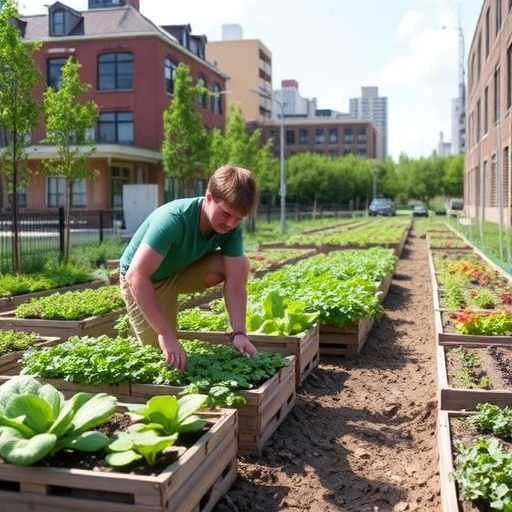
Urban agriculture is moving from the margins of city life toward the center of debates about food security, climate resilience and sustainable development. A new study by researchers including H. Zhao, C. B. Wardropper and H. Cao examines one of the most decisive factors in that transition: whether urban residents are willing to support the expansion of farming inside cities. Published in npj Urban Sustainability, the research explores how public attitudes could determine whether urban agriculture remains a collection of small community projects or becomes a meaningful component of future urban systems.
Urban agriculture includes a wide range of activities, from rooftop gardens and allotments to hydroponic facilities, community orchards, vertical farms and food production on vacant land. These systems can shorten supply chains by placing some food production close to consumers, while also creating opportunities for stormwater management, biodiversity protection and environmental education. Yet their benefits are not automatic. Urban farms compete for land, water, investment and public attention, and their expansion can generate concerns about cost, traffic, visual impact, food safety and unequal access.
The study’s central message is that technological progress alone will not be enough to scale urban agriculture. Advanced greenhouses, controlled-environment systems and data-driven irrigation can improve productivity, but they cannot resolve questions about who owns urban growing spaces, who benefits from them or how they fit into local planning. Public support acts as a form of social infrastructure. When residents trust projects and see them as legitimate, cities are more likely to provide land, funding, regulatory approval and long-term institutional backing.
That support is shaped by how people understand the purpose of urban agriculture. Residents may value locally grown food, fresh produce and greener neighborhoods, but they may also judge projects according to broader social and economic outcomes. A farm that produces vegetables while providing jobs, educational programs or affordable food may attract stronger support than a project perceived as serving only a private market. The researchers’ focus therefore places urban agriculture within a larger framework of public policy, community participation and environmental justice.
The technical case for urban agriculture is complex. Soil-based farms can improve local ecological function, but they may face contamination risks in former industrial areas and require careful testing or raised-bed systems. Hydroponic and aeroponic farms can produce crops with precise control over nutrients, temperature and water use, yet they depend on infrastructure, electricity and specialized management. Rooftop production can make use of underused space, although structural capacity, wind exposure and access to water can limit what is feasible. Public acceptance is likely to depend partly on whether these technical trade-offs are made visible and understandable.
The study also highlights the importance of scale. A single community garden may strengthen neighborhood connections, but a citywide food strategy requires coordination among planners, public-health agencies, schools, businesses, nonprofit organizations and residents. Scaling does not simply mean building more farms. It can involve integrating food production into zoning rules, preserving agricultural land within urban boundaries, offering long-term leases, establishing safety standards and creating funding models that allow projects to survive beyond short pilot programs.
Communication could become one of the most powerful tools in this process. Public support is rarely based on data alone; it is also influenced by trust, lived experience and perceptions of fairness. Residents may respond positively when they are involved in selecting sites, defining goals and evaluating results. Transparent information about water use, energy demand, crop yields, operating costs and distribution of produce can help counter exaggerated promises and prevent disappointment. In this sense, participation is not merely a public-relations exercise but a mechanism for improving the design of urban agricultural systems.
The researchers’ contribution arrives as cities confront simultaneous pressures from climate change, food-price volatility and rapid population growth. Extreme heat, flooding and supply-chain disruptions are exposing vulnerabilities in conventional food systems, while urban development is increasing competition for land. Urban agriculture cannot replace regional or global farming, and it is unlikely to supply every crop consumed by a city. Its potential lies instead in complementing larger food networks, increasing resilience at local scales and connecting food production with climate adaptation, public health and community development.
The findings are likely to resonate far beyond farming policy because they address a broader question: how can cities turn sustainability projects into shared civic priorities? Public support can determine whether an innovation is treated as a temporary experiment or becomes part of the built environment. By identifying the social conditions that make urban agriculture acceptable, useful and equitable, the study points toward a model of sustainability in which residents are not passive recipients of technological solutions but active participants in shaping them.
As urban agriculture captures growing attention online and in city halls, its most important harvest may be public trust. The future of rooftop farms, community growing spaces and high-tech food facilities will depend not only on crop science, engineering or investment, but also on whether urban residents believe these systems improve their neighborhoods. The research by Zhao, Wardropper, Cao and colleagues presents public support as a critical gateway to scale—and suggests that the cities most capable of growing food sustainably may be those willing to cultivate participation first.
Cite Scienmag News
Alan Morgan. (August 5, 2026). Building public support can scale urban agriculture and advance sustainable cities. Scienmag. https://scienmag.com/building-public-support-can-scale-urban-agriculture-and-advance-sustainable-cities/
Alan Morgan. "Building public support can scale urban agriculture and advance sustainable cities." Scienmag, 5 August 2026, https://scienmag.com/building-public-support-can-scale-urban-agriculture-and-advance-sustainable-cities/. Accessed 3 September 2026.
Alan Morgan. "Building public support can scale urban agriculture and advance sustainable cities." Scienmag. August 5, 2026. https://scienmag.com/building-public-support-can-scale-urban-agriculture-and-advance-sustainable-cities/


