


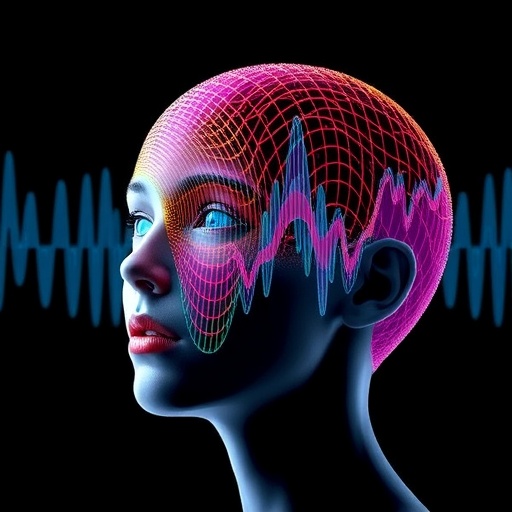
In the rapidly evolving field of affective computing, the precise and dynamic recognition of human emotions through electroencephalography (EEG) signals represents the frontier of both neuroscience and artificial intelligence research. A groundbreaking study published in Scientific Reports in 2026 by R.S. Soundariya and P. Thangaraj introduces a novel methodology that leverages advanced multi-scale wavelet transform techniques combined with a sophisticated Spatio-Temporal neural network to achieve unprecedented accuracy in EEG-based emotion recognition. This innovative approach not only addresses the inherent complexity of EEG data but also significantly enhances the temporal and spatial resolution necessary for decoding the subtle and fluctuating patterns of human emotions.
Understanding the nuances of emotion recognition via EEG signals has traditionally been impeded by the non-stationary and highly variable nature of brainwave data. Emotions manifest dynamically and are often encoded in transient electrophysiological patterns that require analysis methods capable of capturing these rapid fluctuations across multiple time scales. Soundariya and Thangaraj’s research capitalizes on the multi-scale wavelet transform’s ability to decompose EEG signals into components reflecting diverse frequency bands and temporal resolutions. This decomposition facilitates the extraction of refined features that are crucial in differentiating among complex emotional states, thereby circumventing the limitations posed by conventional fixed-window frequency-domain analyses.
The integration of the multi-scale wavelet transform with a Spatio-Temporal neural network forms the cornerstone of the study’s innovation. Unlike traditional models that often treat EEG data as static or purely temporal sequences, this framework acknowledges the intricate spatial interdependencies among the numerous EEG sensor channels alongside their temporal dynamics. The Spatio-Temporal neural network is meticulously designed to exploit these correlations, enabling the model to learn richer representations of emotional states as they evolve in real time. This dual-focused architecture bridges the gap between spatial patterns of brain activation and their temporal progression, yielding a more holistic and context-sensitive understanding of emotional processing.
The research pipeline commences with the rigorous preprocessing of raw EEG data, ensuring the removal of artifacts and noise that could obscure the subtle neural signatures of emotion. Following this, the multi-scale wavelet transform is applied to dissect the EEG signals across multiple frequency bands such as delta, theta, alpha, beta, and gamma. Each band is intimately linked to different cognitive and affective processes, making their isolated analysis critical for multitiered emotional classification. The extracted coefficients from the wavelet analysis form a robust feature set that encapsulates both transient and enduring neural oscillations linked to emotion expression.
Advancing beyond feature extraction, the Spatio-Temporal neural network architecture employed in the study incorporates convolutional layers adept at capturing spatially localized EEG patterns across the scalp. Coupling these with recurrent layers, typically Long Short-Term Memory (LSTM) or Gated Recurrent Unit (GRU) networks, the model effectively models the temporal dependencies inherent in the EEG sequences. This synthesis of convolutional and recurrent neural network components affords the model unprecedented ability to parse complex brain signal dynamics over time, fundamentally enhancing emotion prediction fidelity.
One of the most striking elements of Soundariya and Thangaraj’s work is the dynamic recognition aspect. Unlike static classification approaches that only label emotions over fixed time windows, their method continuously tracks emotional fluctuations, reflecting the real-time nature of human affective experience. This dynamic recognition has profound implications for applications spanning from mental health monitoring to adaptive human-computer interfaces, where understanding the temporal trajectory of emotions can lead to more personalized and responsive systems.
The study’s experimental validation includes diverse emotional stimuli elicited in controlled environments, capturing a wide gamut of affective states including happiness, sadness, anger, fear, and neutral conditions. The EEG data were meticulously collected from multiple subjects, ensuring that the model was trained and validated on a rich and varied dataset. The researchers report superior performance metrics compared to baseline models, demonstrating robust generalization across subjects and emotional categories. This reliability and accuracy position their framework as a leading candidate for real-world EEG emotion recognition applications.
Crucially, the multi-scale wavelet approach enhances interpretability alongside performance. By isolating frequency components relevant to different emotions, researchers and clinicians can gain insights into how specific brain rhythms contribute to emotional experiences. This interpretability is vital for translational neuroscience, bridging the gap between complex machine learning models and practical clinical tools that demand explainable mechanisms.
Moreover, the application of this EEG-based emotion recognition system extends beyond academic interest into tangible societal benefits. In mental health, continuous monitoring of emotional states may facilitate early intervention in disorders characterized by affective dysregulation, such as depression, anxiety, and bipolar disorder. The ability to unobtrusively and objectively track emotional changes could revolutionize therapeutic practices and patient outcomes, reducing reliance on self-report and subjective assessments.
In the realm of human-computer interaction, the integration of real-time, dynamic emotional feedback into adaptive systems promises more intuitive and empathetic technologies. Devices and software that respond to a user’s emotional state can tailor interactions to optimize engagement, learning, and productivity. For instance, educational platforms could adjust content difficulty based on learner frustration or boredom detected via EEG signals, thereby enhancing learning efficacy.
The technological underpinnings of this research also suggest a convergence with emerging brain-computer interface (BCI) technologies. As BCIs grow increasingly sophisticated, embedding reliable emotional intelligence into these systems could transform the way humans communicate with machines. This could lead to more seamless assistive technologies for individuals with disabilities, enabling emotionally aware robotic companions or control systems that adapt to the user’s psychological state.
Given the complexity of neural signals and individual variability, one of the enduring challenges remains the personalization of emotion recognition models. While Soundariya and Thangaraj’s model exhibits promising cross-subject applicability, future work might explore adaptive frameworks that fine-tune to individual baseline patterns. This could address inter-subject variability and increase the precision of emotion decoding in personalized contexts.
Complementing the core technological innovations, the study’s use of the multi-scale wavelet transform represents a methodological advance in signal processing. Wavelet analysis provides a powerful lens to capture localized temporal and frequency information, surpassing traditional Fourier-based methods in dealing with non-stationary EEG signals. This analytical paradigm shift is accelerating progress across neural data sciences, encouraging exploration of multi-resolution frameworks in diverse neuroengineering applications.
Ethical considerations surrounding EEG-based emotion recognition are also paramount as such technologies move towards clinical and commercial deployment. Issues regarding data privacy, emotional autonomy, and potential misuse of affective data necessitate comprehensive regulation and transparent design principles. The study by Soundariya and Thangaraj implicitly prompts the neuroscience and technology communities to engage proactively with these dilemmas to ensure responsible innovation.
In summary, the 2026 Scientific Reports publication by Soundariya and Thangaraj delineates a transformative leap in EEG-based dynamic emotion recognition. Through their ingenious fusion of multi-scale wavelet transform and a tailored Spatio-Temporal neural network, they open new horizons in understanding and harnessing the neural substrates of emotion. Their work not only enriches fundamental affective neuroscience but also catalyzes the development of next-generation affect-aware technologies with the potential to profoundly enhance human wellbeing and machine intelligence.
As the boundaries between neural engineering, machine learning, and affective science continue to blur, studies such as this invigorate the quest to decode the human brain’s emotional language. The implications reverberate through psychiatric care, interactive technology, and beyond, heralding an era in which machines grasp human feelings with richness and subtlety once deemed unattainable.
Cite Scienmag News
Cassandra Pierce. (June 4, 2026). Dynamic Emotion Recognition via EEG and Wavelet Neural Network. Scienmag. https://scienmag.com/dynamic-emotion-recognition-via-eeg-and-wavelet-neural-network/
Cassandra Pierce. "Dynamic Emotion Recognition via EEG and Wavelet Neural Network." Scienmag, 4 June 2026, https://scienmag.com/dynamic-emotion-recognition-via-eeg-and-wavelet-neural-network/. Accessed 5 September 2026.
Cassandra Pierce. "Dynamic Emotion Recognition via EEG and Wavelet Neural Network." Scienmag. June 4, 2026. https://scienmag.com/dynamic-emotion-recognition-via-eeg-and-wavelet-neural-network/


