


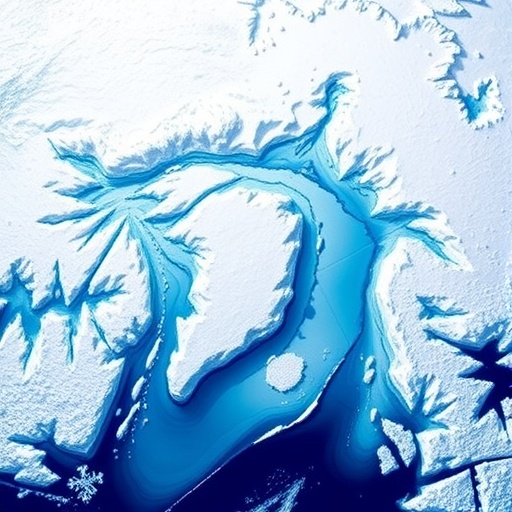
The Arctic’s rapidly changing climate has once again drawn global scientific attention, as a groundbreaking study uncovers an increase in Atlantic Water intrusion into the Arctic Eurasian Basin. This influx of warmer waters into one of the coldest and most vulnerable oceanic regions is fundamentally reshaping the Arctic’s marine environment, raising concerns about cascading effects on ice dynamics, ecosystem shifts, and broader climate feedback mechanisms. Published in Communications Earth & Environment, the study led by Chen, Wang, and Wang provides detailed observations and modeling data that reveal how intensifying Atlantic Water currents are injecting unprecedented thermal energy into this remote basin.
For decades, the Arctic Eurasian Basin has been characterized by its frigid temperatures, icy landscapes, and nutrient-poor waters. Traditionally isolated by colder Arctic waters and sea ice, the basin’s stability relied heavily on maintaining its low temperature regimes. However, recent decades have seen an alarming rise in Atlantic Water temperatures and volumes pushing northward through the Fram Strait and Barents Sea openings. Researchers have now documented not only higher temperatures but also deeper penetration of this warmer Atlantic Water into the basin, resulting in significant alterations of its stratification and energy distribution.
The intrusion of warmer waters brings with it a complex interplay of physical and chemical changes. Atlantic Water currents transport heat, salt, and dissolved oxygen, all of which can disrupt long-standing oceanographic patterns. Warmer, saltier Atlantic Water layers underlie colder surface layers, potentially destabilizing the water column and accelerating processes like vertical mixing and nutrient upwelling. These processes influence primary productivity and the cycling of organic matter, which in turn affect the entire marine food web, including the Arctic’s iconic species such as polar cod and marine mammals that depend on stable ice conditions.
One of the most striking implications of increased Atlantic Water intrusion is its impact on Arctic sea ice thickness and extent. Warmer ocean waters contribute to basal melting of ice shelves and sea ice from below, compounding melting driven by atmospheric warming. The study presents robust evidence that the thermal energy delivered by these currents has intensified melting rates in the Eurasian Basin more than previously reported. This mechanism may partially explain the accelerating decline in summer sea ice cover, contributing to a feedback loop where less ice allows more heat absorption by the ocean, amplifying warming further.
The new research integrates a multidisciplinary approach leveraging in situ measurements, satellite data, and numerical ocean models to trace the pathways and seasonal variability of Atlantic Water inflow. By mapping temperature and salinity profiles from multiple observational campaigns, the authors identified periodic pulses of warmer water that coincide with shifts in large-scale atmospheric circulation patterns. These linkages highlight the interconnectedness of ocean-atmosphere dynamics and suggest that climate oscillations in the North Atlantic can substantially modulate the Arctic’s thermal regime.
Crucially, the findings illuminate how Atlantic Water intrusion affects stratification and vertical mixing regimes. Increased stratification due to warmer lower layers suppresses the upward transport of nutrients from deep waters to the sunlit surface layers, potentially limiting phytoplankton blooms that form the base of Arctic food chains. Conversely, episodic mixing events triggered by transient currents and storms inject bursts of nutrients, creating spatially and temporally variable productivity patterns. These dynamics are critical for predicting future changes in Arctic marine ecosystems as they adjust to changing thermal and chemical environments.
Beyond biological implications, the alteration of Arctic Ocean circulation patterns has significant geophysical consequences. The reorganization of heat distribution affects regional ocean currents and may modulate large-scale climate phenomena, including the Arctic Oscillation and North Atlantic Oscillation. Given the Arctic’s role as a regulator of global climate through heat and moisture exchanges, these disruptions have potential reverberations that extend well beyond polar latitudes, influencing weather extremes and oceanic conditions in the Northern Hemisphere mid-latitudes.
The study’s model projections suggest that if Atlantic Water intrusion continues to intensify, the Arctic Eurasian Basin may see permanent changes in its hydrographic structure within the next few decades. Warmer thermal profiles could erode the cold halocline layer — a critical feature that isolates surface waters and maintains the subdued vertical mixing that historically preserved the basin’s ice and ecosystem stability. The loss or significant weakening of this halocline could transform thermal regimes, leading to more uniform temperature profiles and enhanced ocean-atmosphere heat fluxes in winter.
Observations from mooring arrays and autonomous underwater vehicles underscore the heightened variability in the timing and intensity of warm water pulses. This variability complicates efforts to forecast ecological impacts, as marine species face fluctuating conditions that challenge their adaptation capabilities. The heterogeneity in physical conditions mandates regional-scale assessments to identify hotspots of vulnerability and resilience within the Arctic marine environment, enabling more targeted conservation efforts.
Furthermore, the intrusion of Atlantic Water also influences biogeochemical cycles, particularly carbon fluxes. Warmer waters facilitate increased microbial respiration and organic matter decomposition, which can alter the Arctic Ocean’s role as a carbon sink. Shifts in alkalinity and nutrient balances affect carbonate chemistry, impacting organisms with calcium carbonate shells and skeletons. Altered ocean chemistry paired with warming trends could therefore reshape both physical and chemical oceanography, with knock-on effects for Arctic biodiversity and global carbon budgets.
This study expands on previous work by integrating high-resolution temporal and spatial data sets to capture transient phenomena influencing the Arctic Eurasian Basin’s evolving state. The authors emphasize that a combination of anthropogenic climate warming and natural variability drives the enhanced Atlantic Water influx, making the Arctic both a sentinel and amplifier of global climate change. Unraveling these complex drivers is essential not only for climate modeling but also for anticipating future scenarios that could affect international shipping routes, resource extraction, and indigenous communities dependent on stable Arctic ecosystems.
Looking ahead, the research community faces the challenge of improving predictions of Atlantic Water intrusion trends within Earth system models. Capturing the multi-scale interactions between ocean currents, atmosphere, sea ice dynamics, and biological processes requires enhanced data assimilation and coupled model frameworks. Such efforts will be crucial to delineate feedback mechanisms and to project the Arctic’s trajectory under different greenhouse gas emission scenarios, informing policy decisions related to climate mitigation and adaptation.
In conclusion, the discovery of warmer Atlantic Waters penetrating deeper and more energetically into the Arctic Eurasian Basin signals a pivotal shift in Arctic Oceanography. This phenomenon accelerates ice melt, changes nutrient distributions, alters marine ecosystems, and has the potential to influence global atmospheric and oceanic circulation patterns. As Earth’s polar frontier, the Arctic continues to offer invaluable insights into the interconnectedness of climate systems. Continued monitoring and research are vital to unraveling these complex dynamics and guiding responses to one of the most pressing environmental challenges of our time.
Cite Scienmag News
Violet Maxwell. (April 14, 2026). Atlantic Water Intrusion Energizes Arctic Eurasian Basin. Scienmag. https://scienmag.com/atlantic-water-intrusion-energizes-arctic-eurasian-basin/
Violet Maxwell. "Atlantic Water Intrusion Energizes Arctic Eurasian Basin." Scienmag, 14 April 2026, https://scienmag.com/atlantic-water-intrusion-energizes-arctic-eurasian-basin/. Accessed 3 September 2026.
Violet Maxwell. "Atlantic Water Intrusion Energizes Arctic Eurasian Basin." Scienmag. April 14, 2026. https://scienmag.com/atlantic-water-intrusion-energizes-arctic-eurasian-basin/


