

Tuesday, July 14, 2026
Science
No Result
View All Result
  • Login
  • HOME
  • SCIENCE NEWS
  • CONTACT US
  • HOME
  • SCIENCE NEWS
  • CONTACT US
No Result
View All Result
Scienmag
No Result
View All Result
Home Science News Earth Science

Arctic Surface Momentum Shifts Reveal Predictable and Persistent Dynamic States

July 8, 2026
in Earth Science
Reading Time: 2 mins read
0
Arctic Surface Momentum Shifts Reveal Predictable and Persistent Dynamic States

Arctic Surface Momentum Shifts Reveal Predictable and Persistent Dynamic States

65
SHARES
587
VIEWS
Share on FacebookShare on Twitter
ADVERTISEMENT

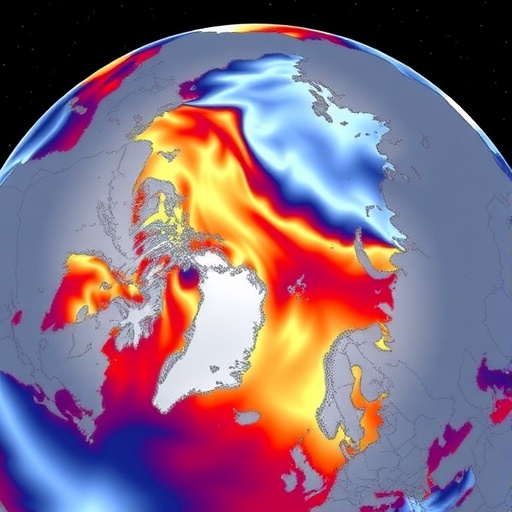
A groundbreaking study sheds new light on the dynamics of Arctic surface momentum, revealing that the region exhibits distinct regime transitions that are both persistent and predictable. This discovery, detailed in a recent publication by Liu and Liang, marks a significant advancement in our understanding of Arctic climate mechanisms and could enhance forecasting models for this sensitive and rapidly changing environment.

Arctic surface momentum balance plays a crucial role in determining the movement and behavior of the atmosphere and sea ice. Until now, the complex interactions governing momentum exchanges between the atmosphere and surface have been poorly understood, especially regarding their temporal variability and stability. Liu and Liang’s research provides compelling evidence that Arctic surface momentum states do not fluctuate randomly but instead transition between well-defined dynamical regimes.

Using high-resolution observational data combined with sophisticated dynamical systems analysis, the researchers identified persistent states characterized by unique momentum balance properties. These regimes influence wind patterns, sea ice drift, and atmospheric circulation, underlining their importance for regional climate variability. The stability of these states implies that such regimes can be anticipated before they give way to another, opening new pathways for predictive modeling.

The study outlines how shifts between these regimes impact Arctic weather and climate patterns, including alterations in momentum fluxes that drive sea ice deformation and atmospheric heat transport. Understanding these transitions is paramount for improving seasonal forecasts and climate models, which have struggled to capture rapid Arctic changes accurately.

Moreover, the predictability of these dynamical regimes suggests that certain Arctic weather phenomena may have longer lead times than previously thought. This insight holds promise for sectors reliant on Arctic forecasting, from shipping and resource extraction to indigenous communities and ecological management.

Technically, the authors applied nonlinear time series analysis techniques to dissect complex momentum data, teasing apart the underlying dynamics that govern regime stability and transitions. The interplay between atmospheric turbulence, surface roughness variability, and thermodynamic conditions emerged as critical factors sustaining these dynamical states.

This research arrives at a crucial juncture, as the Arctic faces unprecedented transformations due to anthropogenic warming. By illuminating the mechanisms behind these momentum regimes, Liu and Liang equip scientists and policymakers with a deeper understanding necessary to anticipate and adapt to emergent Arctic climate realities.

Ultimately, these findings suggest a more predictable Arctic environment than previously recognized, albeit one that still requires careful monitoring as climate change continues to accelerate. The potential to forecast regime shifts could revolutionize how climate impacts in polar regions are managed and mitigated—truly a scientific breakthrough with practical global significance.


Subject of Research: Arctic surface momentum balance and regime transitions

Article Title: Regime transitions in Arctic surface momentum balance reveal persistent and predictable dynamical states

Article References:
Liu, C., Liang, X. Regime transitions in Arctic surface momentum balance reveal persistent and predictable dynamical states. Nat Commun (2026). https://doi.org/10.1038/s41467-026-75328-7

Image Credits: AI Generated

Tags: Arctic sea ice movement and behaviorArctic surface momentum dynamicsatmospheric circulation patterns in Arcticdynamical systems analysis of Arctic climatehigh-resolution Arctic observational dataimpact of momentum regimes on Arctic weatherimplications for Arctic climate forecasting modelsinteractions between atmosphere and surface in Arcticpredictability of Arctic surface statesregime transitions in Arctic climateregional climate variability in the Arcticstability and persistence of Arctic climate regimes
Share26Tweet16
Previous Post

Immune Profiling Predicts Response to Radiation and Anti-PD-1 in Kidney Cancer

Next Post

Brain Network Changes Linked to Alexithymia Uncovered Through Mapping

Related Posts

Major Earthquakes Impact Sea-Level Predictions in Southeast Asia, NTU Study Finds
Earth Science

Major Earthquakes Impact Sea-Level Predictions in Southeast Asia, NTU Study Finds

July 14, 2026
UH Mānoa Study Finds Hawaiian Hotspot Temperature Rising
Earth Science

UH Mānoa Study Finds Hawaiian Hotspot Temperature Rising

July 13, 2026
Vertebrate Paleontologists Call to Protect Fossils Before T. rex Auction
Earth Science

Vertebrate Paleontologists Call to Protect Fossils Before T. rex Auction

July 13, 2026
New AI Model Aids Water Management Amid Worsening National Drought
Earth Science

New AI Model Aids Water Management Amid Worsening National Drought

July 13, 2026
Latitudinal Manganese Patterns Linked to Earth’s Major Ice Ages
Earth Science

Latitudinal Manganese Patterns Linked to Earth’s Major Ice Ages

July 13, 2026
Human Activities Intensify Hydrometeorological Drought Across North Africa Over Time
Earth Science

Human Activities Intensify Hydrometeorological Drought Across North Africa Over Time

July 13, 2026
Next Post
Brain Network Changes Linked to Alexithymia Uncovered Through Mapping

Brain Network Changes Linked to Alexithymia Uncovered Through Mapping

  • Mothers who receive childcare support from maternal grandparents show more

    Mothers who receive childcare support from maternal grandparents show more parental warmth, finds NTU Singapore study

    27656 shares
    Share 11059 Tweet 6912
  • University of Seville Breaks 120-Year-Old Mystery, Revises a Key Einstein Concept

    1061 shares
    Share 424 Tweet 265
  • Bee body mass, pathogens and local climate influence heat tolerance

    682 shares
    Share 273 Tweet 171
  • Researchers record first-ever images and data of a shark experiencing a boat strike

    546 shares
    Share 218 Tweet 137
  • Groundbreaking Clinical Trial Reveals Lubiprostone Enhances Kidney Function

    531 shares
    Share 212 Tweet 133
Science

Embark on a thrilling journey of discovery with Scienmag.com—your ultimate source for cutting-edge breakthroughs. Immerse yourself in a world where curiosity knows no limits and tomorrow’s possibilities become today’s reality!

RECENT NEWS

  • Deep Learning Detects REM Sleep Disorder and Parkinson’s Early via fMRI
  • Durable Silver Plating Developed for Extended Use
  • Engineered Bifidobacterium offers promise for oral cancer vaccine delivery
  • 3D-Printed Contact Lenses Made in Just 20 Minutes

Categories

  • Agriculture
  • Anthropology
  • Archaeology
  • Athmospheric
  • Biology
  • Biotechnology
  • Blog
  • Bussines
  • Cancer
  • Chemistry
  • Climate
  • Earth Science
  • Editorial Policy
  • Marine
  • Mathematics
  • Medicine
  • Pediatry
  • Policy
  • Psychology & Psychiatry
  • Science Education
  • Social Science
  • Space
  • Technology and Engineering

Subscribe to Blog via Email

Enter your email address to subscribe to this blog and receive notifications of new posts by email.

Join 5,146 other subscribers

© 2025 Scienmag - Science Magazine

Welcome Back!

Login to your account below

Forgotten Password?

Retrieve your password

Please enter your username or email address to reset your password.

Log In
No Result
View All Result
  • HOME
  • SCIENCE NEWS
  • CONTACT US

© 2025 Scienmag - Science Magazine

Discover more from Science

Subscribe now to keep reading and get access to the full archive.

Continue reading
