


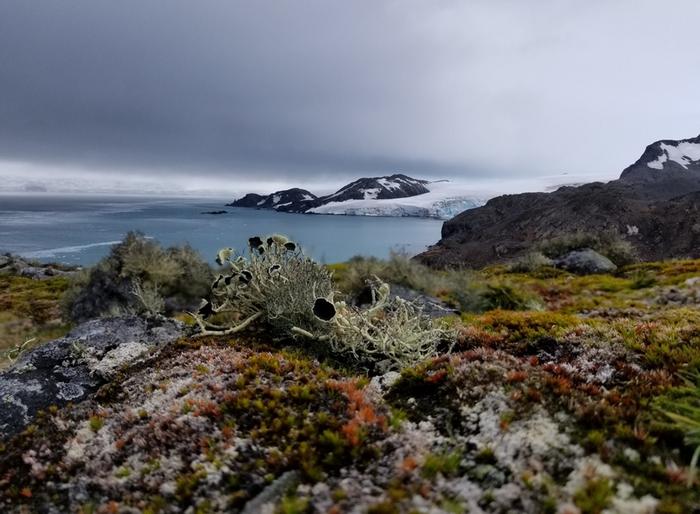
Antarctic-wide survey of plant life to aid conservation efforts

Credit: Felix Grewe
Antarctic-wide survey of plant life to aid conservation efforts
The first continent-wide mapping study of plant life across Antarctica reveals growth in previously uncharted areas and is set to inform conservation measures across the region.
The satellite survey of mosses, lichens and algae across the continent will form a baseline for monitoring how Antarctica’s vegetation responds to climate change.
Scientists used a European Space Agency satellite to sweep the continent, combined with field measurements taken over several summer seasons, and detected almost 45 square kilometers of vegetation – roughly three times the size of Lake Windermere in the Lake District, UK.
The international team, led by the University of Edinburgh with the Norwegian Institute for Nature Research, British Antarctic Survey and Scottish Association for Marine Science, found that over 80 per cent of the vegetation growth was contained within the Antarctic Peninsula and neighbouring islands.
The team estimates this growth makes up only 0.12 percent of Antarctica’s total ice-free area, highlighting the importance of monitoring key areas of vegetation abundance, which is inadequately protected under the existing Antarctic Specially Protected Area (ASPA) system, experts say.
Antarctic vegetation, dominated by mosses and lichens, has adapted to survive the harsh polar conditions and each type plays an important role in carbon and nutrient recycling on a local level, experts say. Until now, their spatial coverage and abundance across the continent remained unknown.
Previous research has shown that the environmental sensitivity of Antarctica’s vegetative species makes them excellent barometers of regional climate change. Monitoring their presence in Antarctica, a minimally disturbed landscape, could provide clues as to how similar vegetation types may respond to climate in other fragile ecosystems across the globe, such as parts of the Arctic.
Charlotte Walshaw, PhD researcher from the School of GeoSciences, University of Edinburgh, who led the study, said: “Our continent-scale map provides key information on vegetation presence in areas that are rarely visited by people. This will have profound implications for our understanding of where vegetation is located across the continent, and what factors influence this distribution.”
Dr Claudia Colesie, researcher at the University of Edinburgh’s School of GeoSciences, who took part in the study, said: “Lichens and mosses in Antarctica encounter the harshest living conditions on the planet on a daily basis. Only the most resilient organisms can thrive there. Now that we know where to look for them, we can provide more targeted conservation measures to safeguard their future.”
Dr Andrew Gray, researcher at the Norwegian Institute for Nature Research, who jointly led the study, said: “Remote sensing approaches such as this are low impact methods to study Antarctica’s fragile ecosystem as well as monitor change to its vegetation in the future.”
The research, published in Nature Geoscience, was funded by the Natural Environment Research Council (NERC) and UK Space Agency. Field campaigns were supported by the British Antarctic Survey, Instituto Antarctic Chileno and Antarctica New Zealand.
For further information, please contact: Rhona Crawford, Press and PR Office, 07876 391498, rhona.crawford@ed.ac.uk
Journal
Nature Geoscience
Method of Research
Survey
Subject of Research
Not applicable
Article Title
A satellite-derived baseline of photosynthetic life across Antarctica
Article Publication Date
6-Aug-2024
Cite Scienmag News
Margaret Porter. (August 6, 2024). Antarctic-wide survey of plant life to aid conservation efforts. Scienmag. https://scienmag.com/antarctic-wide-survey-of-plant-life-to-aid-conservation-efforts/
Margaret Porter. "Antarctic-wide survey of plant life to aid conservation efforts." Scienmag, 6 August 2024, https://scienmag.com/antarctic-wide-survey-of-plant-life-to-aid-conservation-efforts/. Accessed 3 September 2026.
Margaret Porter. "Antarctic-wide survey of plant life to aid conservation efforts." Scienmag. August 6, 2024. https://scienmag.com/antarctic-wide-survey-of-plant-life-to-aid-conservation-efforts/

