


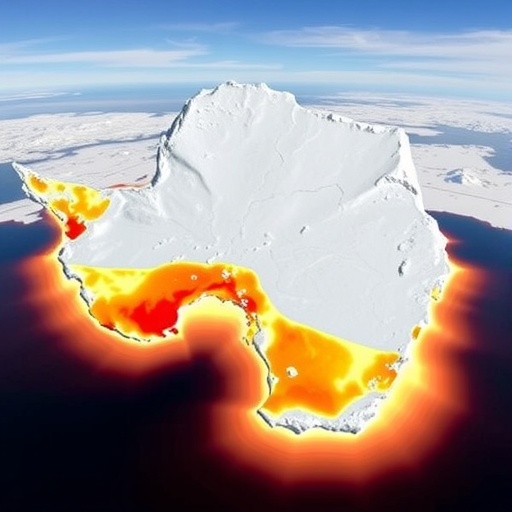
In a groundbreaking new study published in Nature Geoscience, researchers provide a transformative perspective on the role of Antarctic Bottom Water (AABW) in shaping ocean circulation and atmospheric carbon dioxide levels during the last deglaciation. By analyzing neodymium isotope data from the Weddell–Enderby Basin, the team offers unprecedented insights into the spatial and temporal dynamics of AABW in the Southern Ocean over the past 32,000 years. This monumental research challenges previously held views that favored North Atlantic processes as the dominant force in controlling deep South Atlantic water masses, instead highlighting the pivotal influence of Antarctic-sourced waters on the global carbon cycle.
For decades, scientists have recognized the Southern Ocean’s critical function as a vast reservoir for carbon storage, profoundly influencing the Earth’s climate system. The expansion and contraction of southern-sourced water masses have long been hypothesized to regulate atmospheric CO₂ fluctuations, yet the specifics of their origin, structure, and historical dispersal remained elusive. The current study demystifies these oceanic waters’ provenance and sheds light on their intricate past behavior, unveiling mechanisms that intricately link Antarctic climate variations with deep ocean circulation reorganization.
Central to this research is the comprehensive neodymium isotope (εNd) dataset collected from sediment cores in the Weddell–Enderby Basin, which serve as a reliable tracer for distinguishing water mass sources and mixing patterns. The neodymium isotope signature acts as a fingerprint for different deep water types, enabling the reconstruction of past oceanographic changes over millennial timescales. By meticulously charting εNd variations, the study elucidates how glacial Antarctic Bottom Water contracted dramatically during the last glacial maximum, ceding enormous deep ocean volumes to Circumpolar Deep Water (CDW) largely sourced from the Pacific Ocean.
This contraction of AABW, the study finds, played a crucial role in facilitating atmospheric carbon drawdown. Carbon-rich waters filled the deep Southern Ocean amidst glacial conditions, effectively sequestering CO₂ from the atmosphere. The dominance of CDW during this period suggests a stratified ocean state, isolating deep, carbon-laden waters and mitigating their exchange with atmospheric reservoirs. Such stratification hence constitutes a vital mechanism by which the ocean modulated greenhouse gas concentrations during intervals of global cooling.
Transitioning from glacial to interglacial periods, the study reveals a striking two-step expansion of Antarctic Bottom Water, closely coincident with phases of Antarctic warming during the last deglaciation. This expansion catalyzed significant destratification within the Southern Ocean, disrupting the deep-water layering that had previously sequestered carbon. The resulting enhanced vertical mixing likely facilitated the upward migration of carbon-enriched waters, thereby contributing to the deglacial rise in atmospheric CO₂.
Remarkably, the research challenges the dominant narrative emphasizing North Atlantic processes as primary drivers of deglacial deep South Atlantic water mass changes. The neodymium isotope evidence indicates that northern-sourced waters exerted only a limited influence during this transitional period. Instead, Antarctic Bottom Water dynamics emerge as central regulators of deep ocean circulation, highlighting the critical Southern Ocean role in modulating carbon exchange between the deep ocean and the atmosphere.
The implications of these findings extend far beyond regional oceanography: they illuminate fundamental Earth system interactions responsible for some of the most significant climate shifts in the planet’s recent history. Understanding how Antarctic Bottom Water behaved during glacial intervals reveals key processes underlying past atmospheric CO₂ variability, offering essential insights into feedbacks between ocean circulation and global climate forcing.
This innovative approach leveraging εNd tracers also underscores the value of isotopic geochemistry in paleoclimate reconstructions. By refining proxies to track deep ocean water mass provenance and transformations across abrupt climate transitions, scientists can achieve more nuanced reconstructions of ocean-atmosphere carbon dynamics. This enhances our predictive capabilities for how contemporary shifts in Southern Ocean circulation might influence future climate trajectories under anthropogenic forcing.
Moreover, these results resonate powerfully in the context of ongoing global warming. The modern Southern Ocean is warming and freshening at unprecedented rates, directly impacting AABW formation and circulation patterns. The observed historical sensitivity of AABW volumes to Antarctic warming invites careful consideration of potential feedbacks that could either amplify or mitigate ongoing carbon cycle perturbations.
The study further raises intriguing questions about the interplay of oceanic circulation patterns across hemispheres. If Antarctic Bottom Water was the dominant player in deep South Atlantic variability during the last deglaciation, how might changes in Northern Hemisphere deep water formation interact with Southern Ocean processes today? Understanding these teleconnections remains a pressing area for future research.
Crucially, the research exemplifies the power of integrative oceanographic studies employing multi-proxy methods combined with robust sediment core datasets. Such interdisciplinary approaches enable comprehensive disentangling of complex Earth system feedbacks, advancing our grasp of past and future climate dynamics. The spatial and temporal resolution achieved also catalyzes more confident reconstructions of heterogeneous Antarctic Bottom Water behavior across different sectors of the Southern Ocean.
In conclusion, this seminal study profoundly enhances our comprehension of the Southern Ocean’s profound role in regulating global carbon cycles through Antarctic Bottom Water dynamics. By demonstrating how AABW expansion and contraction modulated atmospheric CO₂ during the last deglaciation, the work refines our conceptual framework for deglacial climate change and fortifies the foundation for improved Earth system modeling. As humanity confronts the multifaceted challenges of accelerating climate change, such insights are indispensable for anticipating the ocean’s response and feedback potential in a warming world.
This revelation about Southern Ocean circulation patterns not only revises a fundamental understanding of past climate mechanisms but also shapes the trajectory of future climate research and policy considerations. The intimate linkages between Antarctic warming, ocean circulation restructuring, and atmospheric greenhouse gas concentrations revealed here stand as a critical guidepost for targeting climate mitigation efforts and forecasting ocean carbon cycle behavior in an era of rapid environmental transformation.
Cite Scienmag News
Violet Maxwell. (December 1, 2025). Antarctic Warming Fueled Bottom Water Expansion Deglaciation. Scienmag. https://scienmag.com/antarctic-warming-fueled-bottom-water-expansion-deglaciation/
Violet Maxwell. "Antarctic Warming Fueled Bottom Water Expansion Deglaciation." Scienmag, 1 December 2025, https://scienmag.com/antarctic-warming-fueled-bottom-water-expansion-deglaciation/. Accessed 3 September 2026.
Violet Maxwell. "Antarctic Warming Fueled Bottom Water Expansion Deglaciation." Scienmag. December 1, 2025. https://scienmag.com/antarctic-warming-fueled-bottom-water-expansion-deglaciation/


