


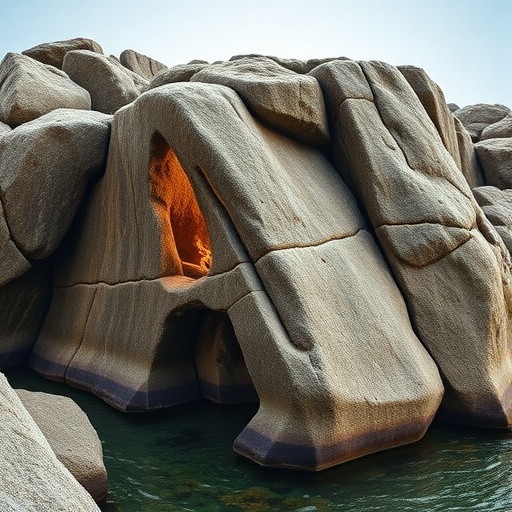
In a groundbreaking study set to reshape our understanding of Earth’s formative years, a group of geoscientists has unveiled new insights into the processes that led to the emergence of the earliest continental crust. Their research, focusing on the ancient geological heart of Scotland, provides compelling evidence that challenges traditional models of continental growth and offers a window into the dynamic and complex interactions shaping our planet over 3 billion years ago. This work not only illuminates the enigmatic past of Scotland’s oldest terrains but also holds significant implications for the broader narrative of Earth’s crustal evolution.
The team, led by Stefano Volante and colleagues, embarked on an exhaustive investigation into the Archean terranes nestled within the Scottish Highlands. These terrains represent some of the oldest exposed continental crust on Earth, serving as a natural archive of the processes that governed crustal formation during the Archean Eon. Through integrating advanced geochemical analyses and high-resolution geochronological techniques, the researchers have reconstructed a detailed timeline coupled with the petrogenetic evolution of these ancient rocks.
One of the pivotal aspects of this study is the application of cutting-edge isotopic tracing methods. By examining variations in neodymium (Nd), hafnium (Hf), and lead (Pb) isotopic compositions, the authors have deciphered the source characteristics and differentiation history of the magmatic events that built the early continental crust. These isotopes serve as robust chronometers and tracers, highlighting the interplay between juvenile mantle-derived material and reworked older crustal fragments. This nuanced approach has unveiled a more intricate picture of continental crust generation that emphasizes episodic magmatic pulses rather than continuous growth.
Moreover, the integration of zircon U-Pb geochronology has proven fundamental in constraining the timing of crustal accretion events. Zircons, often dubbed as nature’s time capsules, harbor a record of crystallization ages and elemental signatures that withstand geological alteration. Analysis of zircons retrieved from the studied regions indicates multiple discrete phases of crust formation stretching over tens of millions of years, suggesting that early continental crust development was a punctuated and dynamic process.
The researchers also explored the petrological characteristics of the rocks, highlighting the interplay between metamorphic overprints and magmatic protoliths. The Archean crust samples examined reveal evidence of high-grade metamorphism, indicating tectonothermal events that contributed to crustal thickening and stabilization. These processes are integral in the transformation of early, fragile crust into more resilient continental blocks capable of sustaining subsequent geological activity.
Further contributing to the richness of the study is the characterization of the mantle sources feeding the early magmatism. Analytical data suggests that the mantle beneath the early Scottish crust was chemically heterogeneous, with distinct domains reflecting variable degrees of partial melting and metasomatism. This heterogeneity facilitated the generation of diverse magma types contributing to the complexity observed in early crustal assemblages.
Volante and his team contextualize their findings within prevailing Earth system models, arguing for a re-evaluation of early plate tectonic dynamics. Their evidence aligns with growing consensus that early Earth tectonics operated on a distinct regime, combining features of modern-style plate tectonics with more localized crustal recycling mechanisms. This hybrid tectonic mode would explain the segmented crustal accretion patterns and the episodic nature of magmatic activity observed in the study.
The implications of this research extend beyond regional geology. By elucidating the mechanisms of early crust formation, the study informs models of Earth’s thermal evolution, mantle convection patterns, and the onset of surface environments conducive to life. Understanding how continents emerged and stabilized offers insights into the planetary habitability timeline and the conditions that may be mirrored on exoplanetary bodies.
Importantly, this work exemplifies the transformative power of combining multidisciplinary techniques—from isotope geochemistry and geochronology to structural geology and petrology—to unravel complex geological histories. The precision achieved in dating and characterizing rock samples underscores the revolution in analytical capacities available to modern Earth scientists.
The choice of Scotland’s ancient terrains as the focal region is strategic due to their exceptional preservation and accessibility, enabling the team to gather pristine samples representative of early Earth conditions. These terrains, part of the Lewisian complex, have long been recognized for their antiquity but lacked such integrative analytical scrutiny until now.
In conclusion, the insights provided by Volante and colleagues not only push forward the frontier of paleo-geological research but also pave the way for future explorations into other Archean cratons worldwide. Their methodology and findings serve as a benchmark for deciphering the formative chapters of continental crust and offer a roadmap for ongoing debates regarding Earth’s earliest tectonic and magmatic processes.
This seminal publication published in Nature Communications is poised to become a cornerstone reference for researchers delving into early crustal evolution. Its fusion of detailed empirical data and conceptual advances presents a compelling narrative that will stimulate scholarly discussion and inspire subsequent investigations into the geodynamic forces that have shaped our planet’s surface over billions of years.
The study’s success hinges on the collaborative effort of an international cohort of researchers, each contributing specialized expertise and innovative analytical techniques. This collaboration exemplifies the increasingly interdisciplinary and global approach required to tackle some of the most profound questions about Earth’s deep past.
As geoscience continues to evolve, studies such as this one underscore the dynamic nature of scientific understanding, reminding us that even well-studied regions harbor untapped secrets capable of rewriting assumptions and enriching our knowledge of Earth’s complex and fascinating history.
Cite Scienmag News
Violet Maxwell. (April 21, 2026). Ancient Scottish Rocks Reveal Early Continental Crust. Scienmag. https://scienmag.com/ancient-scottish-rocks-reveal-early-continental-crust/
Violet Maxwell. "Ancient Scottish Rocks Reveal Early Continental Crust." Scienmag, 21 April 2026, https://scienmag.com/ancient-scottish-rocks-reveal-early-continental-crust/. Accessed 3 September 2026.
Violet Maxwell. "Ancient Scottish Rocks Reveal Early Continental Crust." Scienmag. April 21, 2026. https://scienmag.com/ancient-scottish-rocks-reveal-early-continental-crust/


