


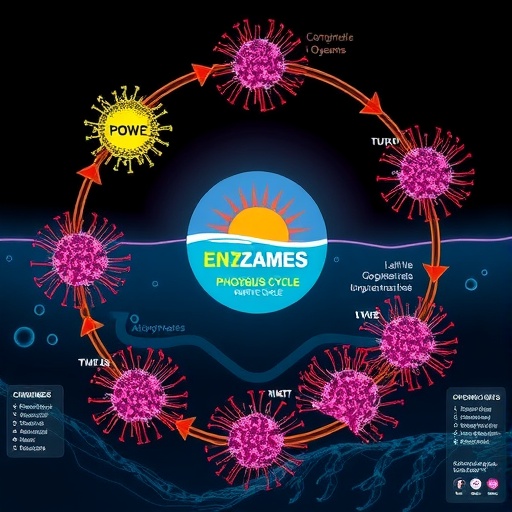
In a groundbreaking new study published in Nature Communications, researchers have unveiled the critical role played by a diverse set of alkaline phosphatase enzymes produced by Alteromonas—a genus of marine bacteria—in regulating the ocean’s phosphorus cycle. This discovery sheds significant light on the intricate biochemical processes underpinning nutrient cycling in marine ecosystems, with profound implications for understanding ocean productivity and global biogeochemical balances.
Phosphorus is a fundamental element driving biological productivity in marine environments, acting as a key limiting nutrient for the growth of phytoplankton and other microorganisms. Despite its importance, the mechanisms controlling the availability and cycling of phosphorus in the ocean have remained enigmatic. This new work spotlights the multifunctional enzymes known as alkaline phosphatases, revealing their diverse biochemical capabilities and pivotal role in phosphorus turnover.
Alteromonas, widely distributed marine bacteria, express a suite of alkaline phosphatases that exhibit functional diversity both in substrate specificity and environmental adaptability. The research team employed a combination of high-resolution metagenomics, proteomics, and enzymatic assays to map the distribution, biochemical properties, and ecological functions of these enzymes across various oceanic regions and depths.
One of the striking revelations from the study is the complex interplay between different forms of alkaline phosphatases produced by Alteromonas, each tailored to degrade specific organic phosphorus compounds. This multifunctionality enables these bacteria to efficiently scavenge phosphorus from a wide array of dissolved organic phosphate sources, which are otherwise inaccessible to many marine organisms. Consequently, Alteromonas act as central mediators in converting organically bound phosphorus into bioavailable inorganic forms.
Furthermore, the researchers observed that the expression and activity of these enzymes dynamically respond to phosphorus availability and environmental stressors, including changes in temperature, pH, and nutrient gradients. This adaptive enzymatic versatility highlights a sophisticated microbial strategy to persist and thrive in phosphorus-limited oceanic niches, thereby sustaining ecosystem productivity under fluctuating conditions.
The biochemical characterization of these alkaline phosphatases revealed mechanistic insights into their catalytic processes. Notably, some variants possess unusually broad substrate affinities and display remarkable catalytic efficiencies, which are facilitated by unique protein conformations and active site architectures. These structural adaptations enable Alteromonas enzymes to metabolize chemically diverse phosphorus compounds, contributing to their ecological success.
In addition to their classical phosphomonoesterase activity, certain alkaline phosphatases identified exhibit secondary functions, including the hydrolysis of phosphodiesters and phosphonates. Such multifunctionality underscores the evolutionary adaptations that broaden the phosphorus acquisition repertoire of Alteromonas, positioning them as highly versatile players in marine nutrient cycling.
Crucially, this enzymatic diversity extends beyond single bacterial strains, encompassing a broad genetic repertoire across Alteromonas populations worldwide. Metagenomic analyses reveal conserved but fractionally varied alkaline phosphatase gene clusters, indicative of both evolutionary constraints and local environmental pressures shaping functional diversity within the genus.
These findings suggest a direct link between microbial enzyme diversity and nutrient cycling efficiency in the ocean. By modulating phosphorus bioavailability, Alteromonas alkaline phosphatases influence primary productivity, carbon sequestration, and the functioning of marine food webs. This microbial control mechanism becomes especially pertinent under climate change scenarios where nutrient dynamics are increasingly altered.
The study’s authors emphasize that understanding such microbial enzymatic processes is vital for improving biogeochemical models that predict ocean responses to environmental change. Incorporating the role of multifunctional bacterial enzymes like those of Alteromonas can refine predictions related to nutrient fluxes, phytoplankton blooms, and carbon cycling, thereby informing conservation and management strategies.
Moreover, the research opens new avenues for biotechnological applications. The unique catalytic properties of Alteromonas alkaline phosphatases might be harnessed for environmentally friendly phosphorus recovery techniques, bioremediation of nutrient-polluted waters, and even agricultural enhancements through sustainable phosphorus recycling.
The discovery of the diverse enzymatic toolkit employed by Alteromonas also raises intriguing evolutionary questions about the origins and selection pressures driving microbial functional diversity in the marine environment. Future studies are poised to explore how gene exchange, mutation, and horizontal gene transfer contribute to the maintenance of such multifunctional systems.
Importantly, comprehensive ecological surveys complemented by laboratory experiments showcased how Alteromonas populations adjust enzyme expression profiles in response to seasonal changes, nutrient pulses, and oceanographic gradients. Such plasticity allows them to capitalize on transient phosphorus sources, ensuring persistent turnover and availability of this essential nutrient.
The study further details the methodologies enabling these insights, blending omics technologies with chemical kinetics and structural biology approaches. This integrative framework highlights the power of interdisciplinary science in unraveling complex environmental processes at a molecular level.
In conclusion, the multifunctionally diverse alkaline phosphatases of Alteromonas emerge as critical drivers of the ocean’s phosphorus cycle, facilitating nutrient transformation processes fundamental to marine ecosystem health and global biogeochemical stability. This research not only advances our molecular understanding of nutrient cycling but also underscores the indispensable role of microbial life in sustaining Earth’s oceanic productivity.
As ocean ecosystems face intensifying pressures from climate change, pollution, and overexploitation, insights into microbial nutrient dynamics become increasingly vital. The elucidation of Alteromonas alkaline phosphatase diversity and function provides a crucial piece of this puzzle, offering hope for informed interventions and a deeper appreciation of marine microbial ecology.
Cite Scienmag News
Violet Maxwell. (November 7, 2025). Alteromonas Enzymes Power Ocean’s Phosphorus Cycle. Scienmag. https://scienmag.com/alteromonas-enzymes-power-oceans-phosphorus-cycle/
Violet Maxwell. "Alteromonas Enzymes Power Ocean’s Phosphorus Cycle." Scienmag, 7 November 2025, https://scienmag.com/alteromonas-enzymes-power-oceans-phosphorus-cycle/. Accessed 3 September 2026.
Violet Maxwell. "Alteromonas Enzymes Power Ocean’s Phosphorus Cycle." Scienmag. November 7, 2025. https://scienmag.com/alteromonas-enzymes-power-oceans-phosphorus-cycle/


