


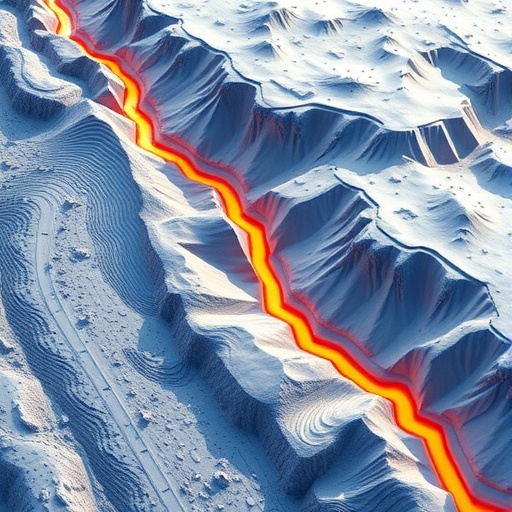
Faults are typically associated with earthquakes—sudden, violent shaking caused by the abrupt release of stress in Earth’s crust. However, a growing body of research reveals that faults can also move silently, releasing accumulated stress through slow slip events (SSEs) that unfold over hours or days without generating noticeable ground shaking. Until recently, these subtle fault motions have remained elusive, complicating efforts to understand fault behavior and earthquake cycles fully.
A pioneering study spearheaded by Dr. Zahra Zali of the GFZ Helmholtz Centre for Geosciences, in collaboration with experts from EarthScope and Stanford University, has applied cutting-edge artificial intelligence techniques to detect previously hidden short-duration slow slip events beneath the Parkfield segment of the San Andreas Fault. This fault section is one of the most intensively monitored on Earth, yet the detection of such transient aseismic slip episodes remained challenging due to their subtle nature and complexity within continuous geophysical signals.
The research team leveraged continuous borehole strainmeter data, renowned for its exceptional sensitivity to tiny crustal deformations. These strainmeters produce vast streams of data, embedding transient fault slip signals among long-term deformation trends, environmental noise, and instrument artifacts. To navigate this data complexity, the scientists developed a deep-learning workflow that utilized an autoencoder with skip connections—a neural network architecture adept at reducing high-dimensional input into a compact latent representation. This system then employed unsupervised clustering to isolate deformation patterns indicative of slow slip, rather than hunting for predefined signal templates.
This innovative methodology revealed dozens of short-duration slow slip events that had escaped traditional detection methods. These episodes typically spanned just a few hours and were corroborated by independent creepmeter observations, confirming their occurrence at shallow depths consistent with right-lateral slip along the San Andreas Fault.
A striking discovery emerged when the researchers analyzed the temporal relationship between these SSEs and low-frequency earthquakes (LFEs)—weak seismic signals known to be associated with fault slip. The team observed an increase in LFE activity following slow slip events, implying that aseismic fault movements can modulate local stress fields and potentially influence subsequent seismicity. This insight strengthens the concept that fault slip behaviors exist across a continuum, ranging from silent aseismic deformation to dynamic earthquake rupture.
Crucially, the study fills a notable gap in the observation of SSEs in transform fault systems like the San Andreas, as previous work predominantly focused on subduction zones where slow slip phenomena are more extensively documented. The scaling relationship identified between the size and duration of SSEs mirrors that of regular earthquakes, underscoring common underlying physical processes governing fault slip.
This research not only highlights the transformative power of artificial intelligence in unraveling complex Earth processes but also opens up new prospects for detecting transient fault behavior worldwide. Identifying these silent fault motions enhances our comprehension of stress transfer mechanisms and fault mechanics, crucial for refining seismic hazard assessments.
As Dr. Zali emphasizes, “By detecting these hidden signals, we can obtain a more complete picture of how faults behave between earthquakes, which is vital for understanding the evolution of stress in the Earth’s crust.” Future work leveraging dense geodetic networks and advanced machine learning may unveil similarly elusive slow slip activity on other faults, deepening our understanding of earthquake physics.
Cite Scienmag News
Violet Maxwell. (July 9, 2026). AI uncovers concealed movements along the San Andreas Fault. Scienmag. https://scienmag.com/ai-uncovers-concealed-movements-along-the-san-andreas-fault/
Violet Maxwell. "AI uncovers concealed movements along the San Andreas Fault." Scienmag, 9 July 2026, https://scienmag.com/ai-uncovers-concealed-movements-along-the-san-andreas-fault/. Accessed 3 September 2026.
Violet Maxwell. "AI uncovers concealed movements along the San Andreas Fault." Scienmag. July 9, 2026. https://scienmag.com/ai-uncovers-concealed-movements-along-the-san-andreas-fault/


