


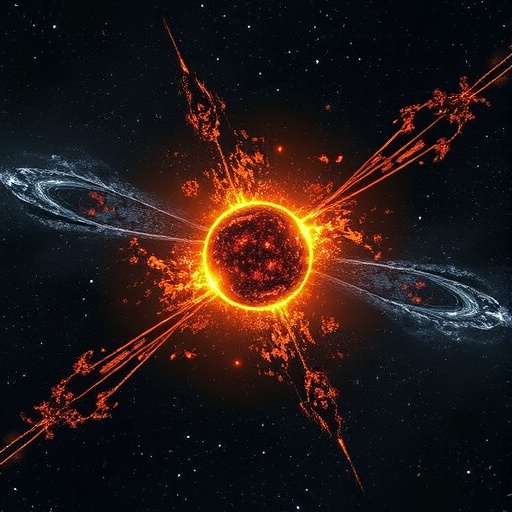
Hamilton, New York — A faint, persistent murmur in the gravitational-wave universe may be carrying an astonishingly ancient message. Detected through the painstaking monitoring of pulsars across the Milky Way, this nanohertz gravitational-wave background could preserve information about how the first supermassive black holes formed more than 13 billion years ago. A new study by Sohan Ghodla and Cosmin Ilie of Colgate University suggests that some of the black holes born at cosmic dawn may have left descendants massive enough to dominate the signal now being measured by Pulsar Timing Arrays, or PTAs. The proposed connection links two of modern astronomy’s most urgent mysteries: how enormous black holes appeared when the Universe was still young, and what produces the low-frequency gravitational waves washing across space today.
PTAs do not detect gravitational waves in the same way as observatories such as LIGO, Virgo, or KAGRA. Instead of using kilometer-scale laser interferometers to sense waves with frequencies of hundreds of hertz, PTAs turn the Galaxy into a vast detector. They observe millisecond pulsars—rapidly rotating neutron stars whose radio pulses arrive with extraordinary regularity. A passing gravitational wave slightly stretches and compresses spacetime, changing the apparent arrival times of those pulses by tiny amounts. When dozens of pulsars are monitored over many years, correlated timing variations can reveal a stochastic background: not one isolated cosmic collision, but the combined signal of countless unresolved sources. International PTA collaborations have reported compelling evidence for such a background at nanohertz frequencies, where the leading explanation is a population of orbiting supermassive black-hole binaries.
These binaries are expected to form when galaxies merge and bring their central black holes together. As the two black holes orbit, they emit gravitational radiation and gradually lose energy, causing their separation to shrink. The most powerful sources in the nanohertz band are expected to contain black holes with total masses of roughly a billion times that of the Sun or more. Yet this explanation immediately raises a difficult question. If the Universe’s largest black holes grew from smaller ancestors, how could those initial seeds become so massive so quickly? Observations by the James Webb Space Telescope and the Chandra X-ray Observatory have identified unexpectedly massive black-hole candidates at very high redshifts, intensifying the debate over whether ordinary stellar remnants could have assembled the earliest giants rapidly enough.
In their Physical Review D study, Ghodla and Ilie examine whether the origin of those seeds could influence the gravitational-wave background billions of years later. Their analysis follows the subsequent evolution of black holes formed through two proposed early-Universe channels. The first is direct collapse, in which enormous clouds of primordial gas avoid fragmenting into ordinary stars and collapse almost directly into black holes. The second involves supermassive Dark Stars, hypothetical primordial objects powered not mainly by nuclear fusion but by energy released through interactions involving dark matter. In the WIMP dark-matter scenario explored by the researchers, dark-matter heating could support a large, relatively cool and extended star while it continues to draw in gas. Such an object might grow to a mass of a million Suns or more before ultimately collapsing into a massive black-hole seed.
The importance of these two channels lies not only in the size of their seeds, but also in their expected abundance. A larger initial black hole can reduce the amount of subsequent growth required to reach the masses observed in the modern Universe. However, a sufficiently numerous population of massive seeds could also produce too many later mergers, creating a gravitational-wave background stronger than the one measured by PTAs. The researchers therefore model the halos hosting the early seeds, track the cosmic growth and merger histories of their black-hole descendants, and calculate the gravitational-wave spectrum expected from the resulting binary population. Their calculations indicate that supermassive Dark-Star remnants with a number density of approximately 10^-3 per cubic megaparsec could make a substantial, potentially dominant contribution to the observed nanohertz signal.
The direct-collapse scenario examined in the study produces a markedly weaker background. The reason is primarily demographic: the direct-collapse black holes considered by the researchers are expected to be far rarer, with characteristic number densities near 10^-6 per cubic megaparsec. Even if individual seeds are massive, too few of them would eventually find partners, form binaries, and merge in sufficient numbers to generate a strong stochastic signal. By contrast, a more abundant population of Dark-Star remnants would provide many more opportunities for descendant black holes to enter galactic nuclei, pair up after galaxy mergers, and radiate gravitational waves. The difference illustrates how a gravitational-wave background can depend not only on the mass of the sources, but also on the population statistics and environments in which those sources formed.
The study also turns PTA measurements into a possible census of objects that existed when the Universe was less than a few hundred million years old. For the models considered, seed densities in the approximate range of 10^-2 to 10^-1 per cubic megaparsec would begin to overproduce the measured gravitational-wave background. The exact limit depends strongly on the dark-matter halo masses associated with the seeds, because the halo environment affects black-hole growth, galaxy assembly, merger rates, and the eventual mass distribution of the binaries. In this sense, PTAs could constrain a population at redshifts greater than 10 even though the mergers responsible for most of the signal take place much later, after billions of years of cosmic evolution.
The calculations further support the conclusion that binaries with total black-hole masses above about 10^9 solar masses dominate the predicted PTA signal. Lower-mass systems can be numerous, but their individual gravitational-wave emission is substantially weaker, and their combined contribution at nanohertz frequencies is comparatively limited. This mass dependence offers an important physical explanation for why early massive seeds are so relevant. If the first black holes were born with enough mass—or grew rapidly enough—to become members of extremely massive binary systems, their descendants could leave a measurable imprint on today’s pulsar timing data. If instead the early Universe produced mostly small seeds, later growth and mergers would have to build the largest black holes, potentially changing both the amplitude and the shape of the gravitational-wave background.
The implications extend beyond one proposed type of primordial star. A successful explanation of the PTA signal must be tested against observations of galaxy populations, black-hole masses, quasar activity, dark matter, and the timing data themselves. Future PTA observations should improve the measurement of the background’s amplitude and spectral shape, while larger pulsar samples and longer observing campaigns may help identify departures from the simplest population models. At the same time, JWST and other observatories will continue searching for black holes and luminous galaxies at cosmic dawn. If the gravitational-wave background is stronger or structured in a way that favors an abundant population of massive descendants, it could provide indirect evidence that supermassive Dark Stars once existed—even if the original stars are too distant and faint to observe directly.
The proposed scenario is therefore a striking example of how the Universe can preserve ancient history in unexpected forms. A dark-matter-powered object that vanished at the beginning of cosmic time might be impossible to see today, yet its collapsed remnant could grow inside a galaxy, merge with another supermassive black hole, and contribute to spacetime vibrations detected by pulsars in the present-day Milky Way. “Pulsar timing arrays are usually thought of as probes of supermassive-black-hole binaries in the relatively recent Universe,” Cosmin Ilie said. “What our work shows is that the signal may also contain information about how the ancestors of those black holes formed at cosmic dawn.” If future measurements confirm the connection, the nanohertz sky could become a new archaeological record of the first black-hole seeds—and a powerful test of the exotic physics that may have shaped the earliest luminous objects in existence.
News Publication Date: 19-Aug-2026
Web References: https://doi.org/10.1103/hvfd-8fkr
References: Ghodla, S. and Ilie, C., “Reconstructing PTA measurements via early seeding of supermassive black holes,” Physical Review D, published 17 August 2026.
Keywords
Supermassive black holes, Dark Stars, direct-collapse black holes, gravitational waves, Pulsar Timing Arrays, nanohertz astronomy, cosmic dawn, dark matter, black-hole seeds, galaxy mergers, James Webb Space Telescope, astrophysics
Cite Scienmag News
Grant Pearson. (August 19, 2026). Dark stars may have imprinted gravitational-wave echoes across the Universe. Scienmag. https://scienmag.com/dark-stars-may-have-imprinted-gravitational-wave-echoes-across-the-universe/
Grant Pearson. "Dark stars may have imprinted gravitational-wave echoes across the Universe." Scienmag, 19 August 2026, https://scienmag.com/dark-stars-may-have-imprinted-gravitational-wave-echoes-across-the-universe/. Accessed 3 September 2026.
Grant Pearson. "Dark stars may have imprinted gravitational-wave echoes across the Universe." Scienmag. August 19, 2026. https://scienmag.com/dark-stars-may-have-imprinted-gravitational-wave-echoes-across-the-universe/


