


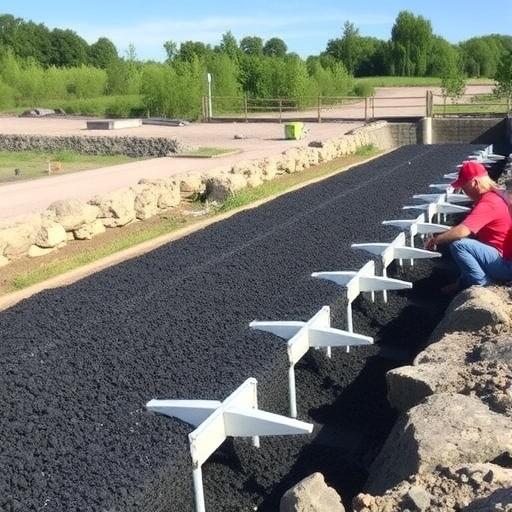
A material made from waste biomass could help transform one of wastewater treatment’s most promising technologies, according to a new review published in Biochar. Researchers report that biochar can function as an “electron bridge” inside anaerobic ammonium oxidation, or anammox, reactors, helping microorganisms exchange electrons more efficiently and potentially making nitrogen removal less energy-intensive, less expensive, and more sustainable.
The review, led by scientists at Suzhou University of Science and Technology in China, examines how biochar influences the biochemical and electrochemical processes that control anammox performance. Anammox bacteria remove nitrogen by converting ammonium and nitrite directly into nitrogen gas under oxygen-free conditions. Unlike conventional nitrification–denitrification systems, the process requires little or no added organic carbon and substantially reduces the need for aeration, which is often one of the largest energy demands in a wastewater treatment plant. In optimized systems, anammox can reduce aeration requirements by approximately 50 to 60 percent and lower operating costs by as much as 90 percent.
Despite these advantages, anammox has been difficult to deploy widely. The bacteria responsible for the process grow extraordinarily slowly, with doubling times of roughly 10 to 12 days, and their activity can be disrupted by sudden changes in temperature, chemical composition, loading rates, or toxic compounds. These organisms also depend on tightly coordinated electron-transfer reactions to convert nitrogen compounds. The new review suggests that biochar may help stabilize this fragile microbial network by providing both a physical surface for colonization and an electrically active pathway between microorganisms.
Biochar is produced by heating organic materials such as agricultural residues, manure, wood, or other biomass under oxygen-limited conditions. Its chemical and physical properties vary according to the original feedstock and the pyrolysis temperature. The resulting carbon-rich material can contain pores, mineral components, oxygen-bearing functional groups, conductive carbon structures, and redox-active compounds. In anammox reactors, these features allow biochar to operate in more than one way: it can support dense biofilms, conduct electrons across microbial communities, and temporarily accept and release electrons during metabolism.
The researchers identify three principal mechanisms behind this activity. The first involves extracellular polymeric substances, or EPS, which form the sticky matrix surrounding microbial cells in a biofilm. Biochar can stimulate microorganisms to produce more EPS, creating a structured environment that brings cells and electron-transfer proteins into closer contact. The matrix contains C-type cytochromes and other redox proteins capable of moving electrons across cell membranes and between neighboring organisms. According to the studies examined in the review, biochar increased EPS production by approximately 30 to 40 percent and raised the electron-transfer capacity of the biofilm by nearly 74 percent.
The second mechanism is direct interspecies electron transfer, commonly known as DIET. In many microbial communities, electrons must move through soluble chemical intermediates, a process that can be relatively slow and energetically demanding. Electrically conductive biochar can provide an alternative route. When bacteria attach to the carbon surface, electrons may pass through direct cell-to-cell contact or travel across conductive particles connecting different species. Biochar produced at temperatures above about 500 degrees Celsius often develops more graphitic carbon domains, which can form microscopic conductive networks resembling power lines within the reactor. These networks may improve metabolic cooperation among organisms involved in nitrogen conversion.
The third mechanism is mediated interspecies electron transfer, or MIET, in which electrons are transported by chemical carriers rather than solely through physical contact. Biochar surfaces commonly contain quinone, phenolic, and other redox-active groups that can reversibly accept and donate electrons. This gives the material the behavior of a reusable electron shuttle: it receives electrons from one microbial partner, undergoes a temporary change in oxidation state, and then transfers those electrons to another partner. Biochar made at lower temperatures, typically between 300 and 400 degrees Celsius, may contain greater quantities of electron-donating functional groups, while higher-temperature biochars generally offer stronger electrical conductivity. The review emphasizes that the ideal material may depend on the specific reactor and microbial community.
The performance gains reported in the reviewed studies are substantial. In one example, anammox reactors containing biochar showed 5.6-fold higher levels of hydrazine synthase genes, 8.7-fold higher levels of hydrazine dehydrogenase genes, and 9.4-fold higher levels of nitrite reductase genes than biochar-free controls. These genes encode enzymes associated with key steps in anammox metabolism. In another experiment, a fixed-bed column reactor combining biochar with anammox sludge achieved a maximum total nitrogen removal efficiency of 90.5 percent. Such findings suggest that biochar may do more than simply provide a surface for microbial attachment; it may actively reshape the metabolic activity and electron-flow architecture of the entire community.
The review also shows that biochar is not a single standardized material. Cattle-manure biochar, for example, can exhibit greater electron-exchange capacity than sawdust-derived biochar because it contains more oxygen-containing functional groups and redox-active metals. Biochars modified with iron or zinc have produced even stronger enhancement effects in some experiments, although the long-term environmental consequences and economic costs of these modifications require careful assessment. The authors argue that future reactor design should treat biochar as an engineered electrochemical material rather than an interchangeable additive. Machine-learning models could eventually help predict how feedstock, pyrolysis temperature, pore structure, mineral content, conductivity, surface chemistry, and aging will influence treatment performance.
Important uncertainties remain before the approach can be considered ready for widespread commercial use. The relative importance of EPS-mediated transfer, DIET, and MIET may change as biochar ages, becomes coated with microbial material, or interacts with dissolved chemicals in real wastewater. Reactor configuration, microbial composition, temperature, pH, and contaminant levels may also determine whether a particular biochar improves or inhibits anammox activity. The review calls for direct measurements of electron flux, isotope-tracing experiments, inhibitor tests, and spatially resolved electrochemical analyses to confirm exactly how electrons move through these systems. Researchers must also account for the energy required to produce biochar, since pyrolysis commonly occurs between 300 and 700 degrees Celsius. Technologies such as microwave-assisted pyrolysis and hydrothermal carbonization could help reduce that burden. If production impacts can be balanced against savings from lower aeration and reduced chemical use, biochar may provide an inexpensive and tunable route to make anammox wastewater treatment more resilient—and bring a low-energy nitrogen-removal technology closer to global adoption.
News Publication Date: 19-Aug-2026
Web References: https://doi.org/10.1007/s42773-026-00650-8; Biochar journal
References: Zhao, W., Li, W., Zhu, Y. et al. “Biochar as an electron bridge: mechanistic insights into enhanced anammox performance in wastewater treatment.” Biochar 8, 131 (2026). DOI: 10.1007/s42773-026-00650-8.
Keywords
Biochar, anammox, wastewater treatment, nitrogen removal, electron transfer, direct interspecies electron transfer, mediated interspecies electron transfer, microbial electrochemistry, biofilms, sustainable water treatment
Cite Scienmag News
Denise Maddox. (August 19, 2026). Biochar Electron Bridges Unlock Hidden Energy Savings in Wastewater Treatment. Scienmag. https://scienmag.com/biochar-electron-bridges-unlock-hidden-energy-savings-in-wastewater-treatment/
Denise Maddox. "Biochar Electron Bridges Unlock Hidden Energy Savings in Wastewater Treatment." Scienmag, 19 August 2026, https://scienmag.com/biochar-electron-bridges-unlock-hidden-energy-savings-in-wastewater-treatment/. Accessed 3 September 2026.
Denise Maddox. "Biochar Electron Bridges Unlock Hidden Energy Savings in Wastewater Treatment." Scienmag. August 19, 2026. https://scienmag.com/biochar-electron-bridges-unlock-hidden-energy-savings-in-wastewater-treatment/


