


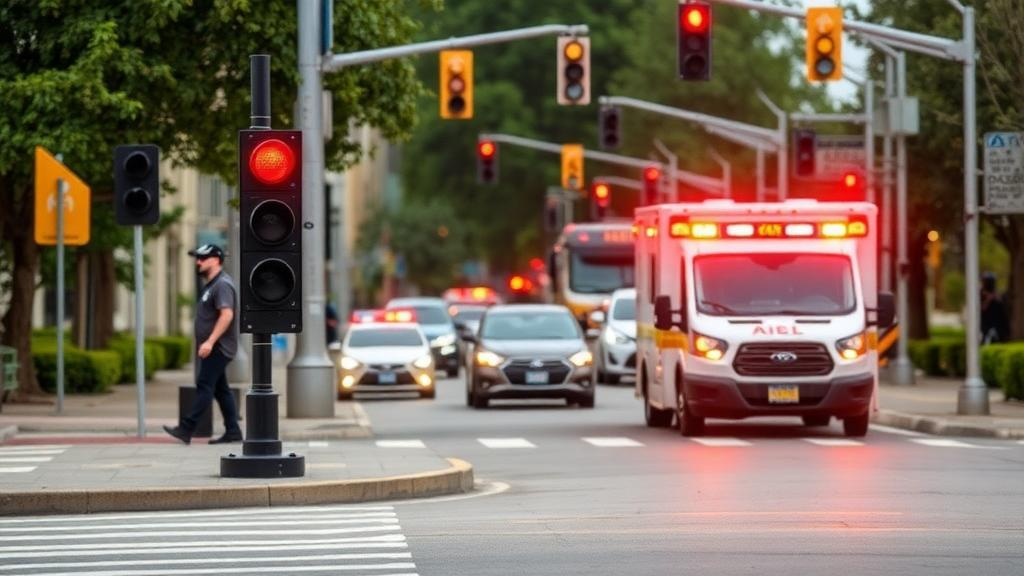
City intersections are among the most stubborn bottlenecks in modern transportation, and as autonomous vehicles begin to share the road with conventional cars, buses and emergency vehicles, the case for rethinking how traffic signals decide who goes first has become impossible to ignore. A new study published in Multimedia Tools and Applications presents an adaptive, artificial-intelligence-driven traffic control system designed to let signal junctions, autonomous vehicles and emergency services communicate in real time. The research team, led by Appalabathula Venkatesh of the Anil Neerukonda Institute of Technology and Sciences in Visakhapatnam, India, together with colleagues at the Lendi Institute of Engineering and Technology, reports that the prototype reduced vehicle waiting times at junctions by between 30 and 60 percent, improved congestion control by up to 25 percent, and detected emergency vehicles with accuracy in the region of 90 percent.
The core idea behind the system is deceptively simple: a traffic signal should not run on a fixed timer, but should instead respond to what is actually on the road. To achieve that, the researchers combined multiple sensing modalities at the junction level. Infrared sensors, sound sensors and cameras work together to build a live picture of traffic conditions. Camera feeds are processed by machine-learning models that perform object recognition, classifying vehicles dynamically as they approach. The fusion of several sensor types matters because no single sensor is reliable in every condition: cameras struggle in poor lighting, sound sensors can be masked by ambient noise, and infrared detection alone cannot distinguish vehicle types. By combining them, the system gains redundancy and robustness across the varied conditions a real intersection faces day and night.
At the heart of the vehicle-recognition pipeline is a lightweight neural architecture known as FOMO, built on MobileNetV2 and MobileNetV3 backbones. FOMO, short for Faster Objects, More Objects, is a compact object-detection approach designed for constrained hardware, which makes it well suited to deployment on edge devices at intersections where computing power and energy budgets are limited. MobileNetV3, the more advanced of the two backbones tested, uses efficient convolutional building blocks to deliver strong detection performance at low computational cost. In this study, the MobileNetV3-based configuration was used to evaluate the system across a range of scenarios, and it proved capable of distinguishing several vehicle categories, including ambulances, fire trucks, trucks and autonomous vehicles. That classification ability is what allows the control logic to treat an approaching fire engine differently from a delivery van.
Emergency-vehicle priority is one of the most compelling applications of the system. In conventional traffic management, ambulances and fire trucks depend on sirens and the goodwill of surrounding drivers to clear a path, a process that is slow, stressful and frequently dangerous. The AI-driven controller instead identifies the emergency vehicle through its sensor suite and recognition model, then adjusts signal phases to grant it priority, coordinating across junctions so that a green corridor can be established ahead of the vehicle. The reported emergency detection performance of roughly 90 percent suggests the recognition models are reliable enough for this task under the tested conditions, although the researchers also specifically evaluated false-detection scenarios to probe how the system behaves when it is wrong.
The evaluation protocol covered four distinct conditions: normal traffic flow, coordination with autonomous vehicles, emergency clearance, and false detection. Testing under normal traffic measured how well the adaptive signal timing reduced delays for everyday road users, with the headline result being the 30 to 60 percent reduction in waiting times at vehicle stations. The autonomous-vehicle coordination scenario tested the vehicle-to-infrastructure communication dimension, in which connected AVs exchange information with the junction controller, allowing signal decisions to account for vehicles that can respond predictably and precisely to timing instructions. The congestion-control gains of up to 25 percent reflect the system’s ability to adapt signal phases to actual demand rather than pre-programmed schedules, smoothing flow when traffic patterns shift.
What distinguishes this work from many smart-city concepts is its grounding in practical, low-cost hardware. The team built and tested physical prototypes, generating a small internal dataset during testing to evaluate the AI model’s performance; the study did not rely on external datasets. The researchers’ earlier work, presented at an IEEE conference in 2025, described a density-based signal light management system implemented on an STM32-Nucleo microcontroller for sustainable smart cities, and the new study extends that line of research toward full AI-driven, multi-sensor junction control with vehicle classification. The choice of edge-friendly architectures such as FOMO and MobileNet reflects a deliberate design philosophy: intelligence should live at the intersection itself, not depend entirely on distant cloud servers that introduce latency and connectivity risks.
The timing of this research is significant because the vehicle population is changing. Autonomous vehicles bring predictable behavior and rich connectivity, but they also introduce new coordination problems: a mixed fleet of AVs and human-driven vehicles creates flow patterns that fixed-time signals, designed decades ago for simpler traffic, handle poorly. Reviews of connected and autonomous vehicle impacts on urban transportation have repeatedly highlighted that the benefits of AV technology depend heavily on the surrounding infrastructure being able to communicate and adapt. Systems like the one described in this study address that gap directly, treating the signal junction not as a passive timer but as an active agent in a multi-agent traffic network, negotiating priorities among AVs, conventional vehicles and emergency services.
The broader context is equally important. Traffic congestion imposes enormous economic and environmental costs, and road traffic crashes remain a leading cause of death worldwide, with pedestrians bearing a disproportionate share of the harm in many regions. Artificial intelligence has been proposed as a lever for progress on the United Nations Sustainable Development Goals, particularly those concerning sustainable cities and sustainable infrastructure, and intelligent transportation is one of the most concrete applications of that vision. Prior research has shown that machine-learning models can predict road traffic as effectively as complex microscopic simulators, and that deep reinforcement learning can optimize signal control in ways that reduce both delays and emissions. The present study contributes a hardware-realized, sensor-fused implementation that moves these ideas closer to deployment on real streets.
There are, of course, caveats that temper the enthusiasm. The reported figures come from prototype testing under controlled conditions rather than from a city-wide deployment, and the internal dataset used for evaluation was small and generated by the researchers themselves. Real intersections present edge cases that are difficult to reproduce: extreme weather, occluded sightlines, unusual vehicle types, adversarial or degraded sensor inputs, and the sheer unpredictability of human road users. The false-detection testing in the study acknowledges this challenge, but scaling from a prototype junction to a network of thousands of intersections raises questions about maintenance, calibration, cybersecurity and interoperability with existing signal infrastructure that the study does not resolve. Explainability of AI decisions is another active concern in the intelligent-vehicle literature, since traffic authorities will want to understand why a signal granted priority in any given moment.
Even with those limitations, the study offers a concrete demonstration that adaptive, AI-driven traffic control can deliver measurable improvements in the metrics that matter most to city dwellers: shorter waits, smoother flow and faster emergency response. The combination of affordable sensors, efficient on-device neural networks and vehicle-to-infrastructure communication points toward a future in which the humble traffic light becomes an intelligent node in a coordinated urban mobility network. As autonomous vehicles multiply and cities grapple with congestion, systems of this kind, validated step by step from prototype to pilot to deployment, may well define the next generation of traffic management, making streets safer and more efficient for every vehicle on the road, whether it is driven by an algorithm or by a person.
Subject of Research: AI-driven adaptive traffic signal control and emergency vehicle priority for autonomous vehicle navigation
Article Title: Adaptive AI-driven traffic control system and management for autonomous vehicle navigation
Article References: Adaptive AI-driven traffic control system and management for autonomous vehicle navigation. (n.d.). https://doi.org/10.1007/s11042-026-21955-7
Image Credits: AI Generated
DOI: 10.1007/s11042-026-21955-7
Keywords: autonomous vehicles, AI traffic control, FOMO, MobileNetV3, object detection, vehicle-to-infrastructure communication, emergency vehicle priority, smart cities, traffic congestion, machine learning, sensor fusion, intelligent transportation systems
Cite Scienmag News
Denise Maddox. (October 10, 2026). AI Traffic Signals That Cut Waiting Times by Up to 60 Percent Put Ambulances First. Scienmag. https://scienmag.com/ai-traffic-signals-that-cut-waiting-times-by-up-to-60-percent-put-ambulances-first/
Denise Maddox. "AI Traffic Signals That Cut Waiting Times by Up to 60 Percent Put Ambulances First." Scienmag, 10 October 2026, https://scienmag.com/ai-traffic-signals-that-cut-waiting-times-by-up-to-60-percent-put-ambulances-first/. Accessed 10 October 2026.
Denise Maddox. "AI Traffic Signals That Cut Waiting Times by Up to 60 Percent Put Ambulances First." Scienmag. October 10, 2026. https://scienmag.com/ai-traffic-signals-that-cut-waiting-times-by-up-to-60-percent-put-ambulances-first/


