


Supercapacitors promise the best of both worlds in energy storage: the lightning-fast charge and discharge of a capacitor and the respectable energy reserves of a battery. Yet the materials at their heart have long been caught in a frustrating trade-off. Metal oxides can store enormous amounts of charge through fast surface reactions, but they conduct electricity poorly, clump together into inactive lumps, and slow down the very charge-transfer reactions they are supposed to accelerate. A new study published in the journal Ionics by K. Govindan and colleagues reports a carefully engineered composite of cerium oxide and graphitic carbon nitride that confronts these weaknesses head-on, delivering a specific capacitance of 675 farads per gram, near-perfect cycling stability, and an unusually clear picture of why the combination works.
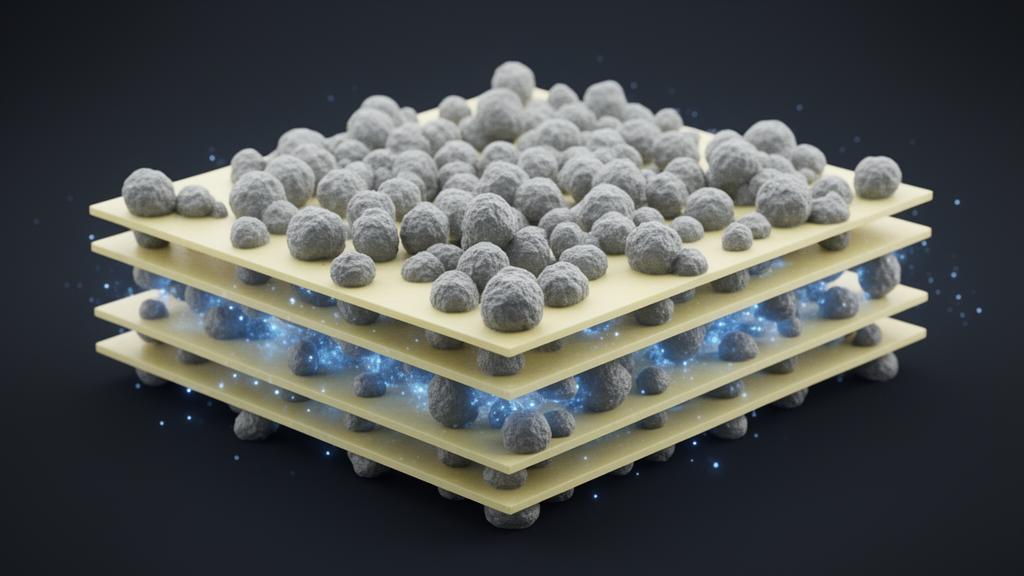
The research team synthesized their CeO2/g-C3N4 heterostructure using a hydrothermal approach, a technique that crystallizes materials from aqueous precursors inside a sealed, pressurized vessel. The strategy is conceptually elegant: cerium dioxide, a rare-earth oxide prized for its redox flexibility, is welded onto graphitic carbon nitride, a metal-free polymer-like semiconductor made of stacked carbon-nitrogen sheets. By fusing the two into a single heterointerface, the researchers created a conductive bridge designed to speed electron transport across the junction while preserving the abundant electrochemically active sites that each component contributes. Earlier studies had explored this pairing, but the role of the interface itself in governing charge-storage kinetics and surface-controlled pseudocapacitance remained poorly understood, which is precisely the gap the new work set out to fill.
Characterization confirmed that the composite was more than a simple physical mixture. Raman spectroscopy and X-ray photoelectron spectroscopy revealed signatures consistent with enhanced charge-transport characteristics at the junction between the two phases. Nitrogen adsorption measurements using the Brunauer-Emmett-Teller method showed a mesoporous architecture with a specific surface area of 179.43 square meters per gram and an average pore diameter of 14 nanometers. That combination matters enormously for a supercapacitor electrode: a large accessible surface area multiplies the number of sites where electrolyte ions can dock and exchange charge, while mesopores of roughly 14 nanometers are large enough to let ions move freely through the material rather than stalling in dead-end micropores.
The electrochemical results are where the design pays off. Tested in a standard three-electrode configuration in a 1 molar potassium hydroxide aqueous electrolyte, the CeO2/g-C3N4 electrode delivered a specific capacitance of 675 farads per gram at a current density of 1 ampere per gram. Just as important, the electrode showed excellent rate capability, meaning it retained a substantial fraction of that capacitance when pushed to faster charging rates, a property many high-capacitance materials lose dramatically. Electrochemical impedance spectroscopy told a similar story from a different angle: the composite exhibited a remarkably low charge-transfer resistance of just 0.42 ohms, indicating that electrons and ions encounter very little opposition as they move through the electrode and across the heterointerface.
Durability, often the Achilles heel of pseudocapacitive metal oxides that swell, crack, or dissolve over repeated cycling, proved equally impressive. After 5000 charge-discharge cycles, the electrode retained 99.7 percent of its original capacitance, a figure that approaches the theoretical limit for any electrode undergoing repeated electrochemical cycling. For a material whose charge storage depends on fast, reversible surface redox reactions rather than simple ion adsorption, that level of retention suggests the heterointerface does more than boost performance; it also mechanically and electrochemically stabilizes the active material against the degradation pathways that normally erode metal-oxide electrodes.
Perhaps the most scientifically valuable contribution of the study is its kinetic analysis, which dissects where the stored charge actually comes from. Using current-sweeping measurements, the researchers separated the total stored charge into surface-controlled capacitive contributions and diffusion-controlled contributions from bulk faradaic reactions. The verdict: 88.70 percent of the charge storage was surface-controlled. In practical terms, nearly nine-tenths of the energy is stored in reactions happening right at the electrode surface, where electrons can move in and out almost instantaneously, rather than in sluggish diffusion-limited processes deeper in the material. This dominance of fast surface pseudocapacitance explains both the high capacitance and the strong rate performance, and it confirms that the engineered heterointerface is doing exactly what it was designed to do: enabling quick electron transfer and efficient electrolyte-ion diffusion.
When the researchers assembled the material into a full device-level assessment, the composite delivered a maximum energy density of 23.4 watt-hours per kilogram at a power density of 721 watts per kilogram. Those numbers sit in a meaningful region of the energy-power landscape. Conventional carbon supercapacitors typically offer high power but modest energy density, often below 10 watt-hours per kilogram, while batteries deliver high energy but cannot match capacitor-level power delivery or cycle life. An electrode that combines hundreds of farads per gram with capacitor-grade power and battery-adjacent energy density points toward hybrid supercapacitor devices that could buffer renewable energy, capture regenerative braking energy, or smooth power fluctuations on the grid.
The choice of cerium oxide as the redox-active component deserves attention in its own right. Cerium dioxide is unusual among metal oxides because of the facile Ce4+/Ce3+ redox couple and its capacity to form and heal oxygen vacancies, both of which provide abundant fast charge-storage sites. But pristine CeO2 suffers from the classic rare-earth oxide problems: poor electrical conductivity, particle agglomeration that buries active sites, and slow charge-transfer kinetics. Pairing it with graphitic carbon nitride addresses each weakness. The carbon nitride framework acts as a conductive, nitrogen-rich scaffold that disperses the oxide particles, suppresses agglomeration, and supplies a continuous electronic pathway, while the heterointerface itself creates an internal electric field that accelerates interfacial charge transfer.
The broader significance of the work lies less in any single performance metric than in the design principle it validates. By quantifying the capacitive contribution and tying it to the engineered interface, the study offers mechanistic perspectives for the rational design of rare-earth oxide/carbon nitride electrodes generally, rather than a one-off material recipe. The authors, affiliated with institutions in Tamil Nadu, India, report no competing interests and note that no datasets were generated or analyzed beyond the study itself. As demand grows for storage technologies that can charge in seconds, survive hundreds of thousands of cycles, and avoid scarce or toxic elements, interface-engineered composites like this CeO2/g-C3N4 heterostructure demonstrate that the path forward may lie not in discovering exotic new compounds, but in learning to weld familiar ones together at the nanoscale so that electrons, ions, and active sites all move at the speed the grid of the future will demand.
Subject of Research: CeO2/graphitic carbon nitride heterostructure electrodes for high-performance supercapacitors
Article Title: Enhanced electrochemical performance of CeO2/g-C3N4 composite electrodes for advanced energy storage applications
Article References: Govindan, K., Ramabalan, S., Mahalakshmi, S., & Seenivasan, S. (2026). Enhanced electrochemical performance of CeO2/g-C3N4 composite electrodes for advanced energy storage applications. Ionics. https://doi.org/10.1007/s11581-026-07484-1
Image Credits: AI Generated
DOI: 10.1007/s11581-026-07484-1
Keywords: supercapacitors, CeO2, graphitic carbon nitride, heterostructure, pseudocapacitance, energy storage, hydrothermal synthesis, charge transfer resistance, rare-earth oxide, mesoporous materials, cycling stability, energy density
Cite Scienmag News
Denise Maddox. (October 10, 2026). Cerium Oxide Meets Carbon Nitride in a Supercapacitor Electrode That Barely Wears Out. Scienmag. https://scienmag.com/cerium-oxide-meets-carbon-nitride-in-a-supercapacitor-electrode-that-barely-wears-out/
Denise Maddox. "Cerium Oxide Meets Carbon Nitride in a Supercapacitor Electrode That Barely Wears Out." Scienmag, 10 October 2026, https://scienmag.com/cerium-oxide-meets-carbon-nitride-in-a-supercapacitor-electrode-that-barely-wears-out/. Accessed 10 October 2026.
Denise Maddox. "Cerium Oxide Meets Carbon Nitride in a Supercapacitor Electrode That Barely Wears Out." Scienmag. October 10, 2026. https://scienmag.com/cerium-oxide-meets-carbon-nitride-in-a-supercapacitor-electrode-that-barely-wears-out/


