One of the world’s most influential simple climate models has just been given a major upgrade, and it could change how scientists count the cost of a warming planet. MAGICC, the Model for the Assessment of Greenhouse-gas-Induced Climate Change, has long been used to translate emissions scenarios into global temperature projections, including for the Intergovernmental Panel on Climate Change (IPCC). But until now, it carried a hidden simplification: after the historical period, methane emissions from natural sources such as wetlands were held constant, no matter how hot the planet became. A team led by Trevor Sloughter of Imperial College London and the University of Exeter has now built a new version, MAGICC v7.6, that lets wetlands respond dynamically to rising temperatures. Writing in the journal Geoscientific Model Development, the researchers show that this seemingly small change nudges every warming scenario upward and, perhaps more importantly, widens the uncertainty range around future temperature projections.
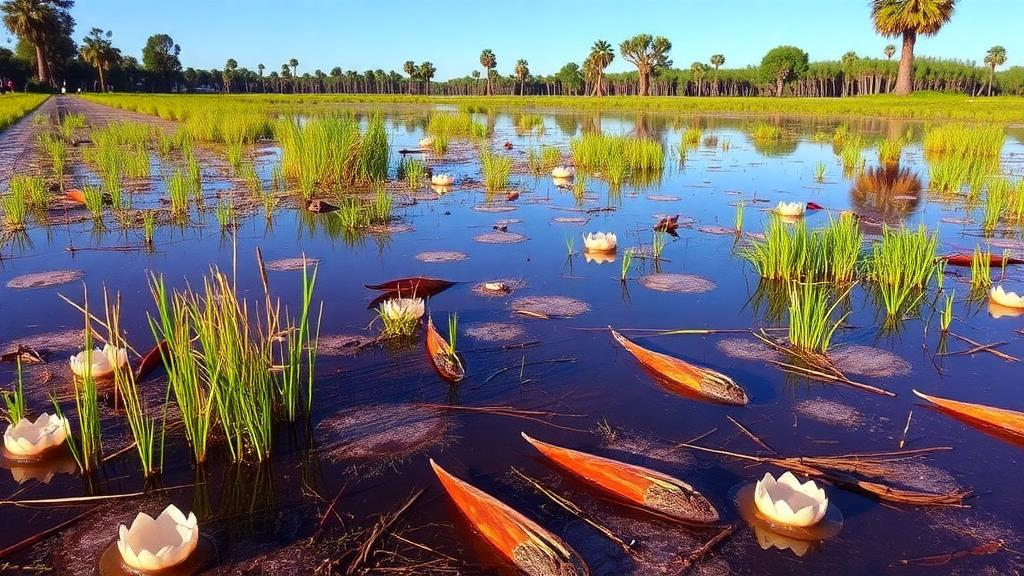
The stakes are larger than they might first appear. Wetlands cover roughly 12 million square kilometres of the Earth’s land surface, nearly 8 percent of the total, and their methane emissions account for somewhere between 20 and 30 percent of all global methane emissions, both natural and human-caused. That makes wetlands the single largest methane source in the coupled human-Earth system. Methane is a potent greenhouse gas, far more effective than carbon dioxide at trapping heat over decadal timescales, so any systematic change in wetland output ripples through the entire climate budget. Yet despite their importance, very few of the high-resolution Earth System Models (ESMs) that underpin modern climate projections explicitly model wetlands as a methane source, leaving simple climate models like MAGICC with little evidence to constrain their present and future contributions.
The new work draws on two rare modelling studies that did project wetland methane emissions deep into the twenty-first century. The first, by Thomas Kleinen of the Max Planck Institute for Meteorology and colleagues, added a wetlands component to the Max Planck Institute Earth System Model (MPI-ESM) and ran it under five Shared Socioeconomic Pathways, from the ambitious SSP1-1.9 to the high-emissions SSP5-8.5, extending the simulations all the way to the year 3000. The second, by Zhen Zhang of the Institute of Tibetan Plateau Research and colleagues, used a wetlands model coupled to an earlier version of MAGICC under the older Representative Concentration Pathways. Strikingly, both studies found a strong linear relationship between wetland methane emissions and global average temperature, although they disagreed on how sensitive emissions are to each degree of warming.
That disagreement is at the heart of the new parameterisation. When the team fit a linear equation, expressing emissions as a slope times temperature anomaly plus an intercept, to the Kleinen data, the calibrated temperature sensitivity varied depending on how far into the future the fit extended: 37.5 megatonnes of methane per degree Celsius using data up to 3000, 45.8 megatonnes up to 2500, and 52.6 megatonnes up to 2300. The Zhang calibration produced a value of 35.5 megatonnes per degree. Because the linear relationship breaks down after about 2300, when stabilising temperatures cause wetland emissions in the MPI-ESM to decline, and because uncertainty grows with every additional century, the team chose to treat the higher estimates as bounding the upper end of plausible sensitivity. A recent study by Ulas Im and colleagues, published while the paper was being written, found little to no temperature sensitivity at all, suggesting the true range may span from near zero to the high end of the Kleinen fit.
To capture this deep uncertainty, MAGICC v7.6 draws its temperature-sensitivity parameter from a normal distribution with a median of 30 megatonnes of methane per degree and a standard deviation of 13 megatonnes. This places the Zhang estimate near the centre of the distribution while allowing a substantial fraction of model runs to reach or exceed the Kleinen values. The distribution is also consistent with an ensemble analysis of 16 process-based wetland models published by Zhang and colleagues in 2025. In practice, the model runs concentration-driven until 2015, so that historical methane remains anchored to observations, and then switches to emissions-driven mode, at which point the new wetland feedback kicks in. Each scenario simulation uses 600 probabilistic draws of parameter combinations, allowing MAGICC to propagate the spread of disagreement among Earth System Models into its own output.
The results are revealing. Even in comparatively cool scenarios such as SSP1-2.6, natural methane emissions in the new model climb above 200 megatonnes per year by mid-century, an increase of more than 20 megatonnes over the roughly 182 megatonnes per year that the old version held constant throughout the twenty-first century. In the warmer C3 category of mitigation scenarios, median peak natural emissions rise above 216 megatonnes, and in the 95th percentile they reach as high as 265.8 megatonnes per year. These extra emissions translate into higher atmospheric methane concentrations, which in turn feed back into the carbon cycle: methane oxidation adds carbon dioxide to the atmosphere, and warmer temperatures increase carbon dioxide respiration, producing a small but measurable rise in atmospheric carbon dioxide of a few parts per million.
The temperature consequences are modest but consequential. Peak and end-of-century warming increase across all scenarios by a few hundredths of a degree Celsius, and the warmer the scenario, the larger the increase. More striking is the effect on uncertainty: the spread between the 5th and 95th percentile temperature estimates widens by roughly ten percent in the new version, meaning the wetland feedback makes the hottest plausible futures even hotter relative to the coolest. This has direct implications for how scenarios are classified. Under the IPCC’s Sixth Assessment Report framework, C1 scenarios are those that limit warming to 1.5 degrees Celsius by 2100 with at least a 50 percent probability, C2 allows higher overshoot of 1.5 degrees, and C3 limits peak warming to 2 degrees with 67 percent probability. Running the new model, nine of 97 C1 scenarios no longer meet their end-of-century criterion, 33 of 133 C2 scenarios fail to stay below 1.5 degrees at 2100, and 82 of 311 C3 scenarios no longer keep peak warming below 2 degrees with the required probability.
The feedback also stretches the duration and depth of temperature overshoot, the period during which ambitious mitigation pathways temporarily exceed 1.5 degrees before drawing warming back down. In the old model, C1 scenarios overshot 1.5 degrees for an average of 28.7 years and C2 scenarios for 53.3 years. In MAGICC v7.6, those averages stretch to 38.9 and 59.9 years respectively, and the integrated overshoot, measured in degree-years, grows from 1.5 to 2.7 for C1 scenarios and from 7.0 to 9.3 for C2 scenarios. For ecosystems and communities exposed to peak temperatures, those extra years above the threshold matter, even if the annual temperature increment attributable to wetlands is only on the order of hundredths of a degree.
The authors are candid about the limitations of their approach. Temperature is used here as a proxy for a tangle of processes that actually drive wetland emissions, including changing precipitation patterns and the expansion of inundated tropical wetland area, and the linear relationship is known to break down over multi-century timescales, particularly under high warming where reversibility comes into question. Seasonal studies have also documented hysteresis, meaning emissions do not simply retrace their path when temperatures fall. Still, the timing of the upgrade is significant: MAGICC is being used to prepare concentration inputs for the CMIP7 generation of Earth System Model experiments, and the new version ensures that the low bias introduced by assuming constant natural methane in CMIP6 will not be repeated. As more Earth System Models publish twenty-first-century wetland methane projections, the calibration can be refined, or the simple linear relationship replaced with something more sophisticated, bringing the hidden methane feedback one step closer to being fully accounted for.
Subject of Research: Representation of temperature-dependent natural wetland methane emissions in the MAGICC simple climate model
Article Title: Natural methane emissions feedbacks in MAGICC v. 7.6
Article References: Natural methane emissions feedbacks in MAGICC v. 7.6. (n.d.). https://doi.org/10.5194/gmd-19-9063-2026
Image Credits: AI Generated
Keywords: MAGICC, wetlands, methane, climate model, climate feedback, simple climate model, Earth System Models, IPCC, emissions scenarios, temperature overshoot, Geoscientific Model Development, CMIP7
Cite Scienmag News
Denise Maddox. (October 10, 2026). Wetlands Turn Up the Heat: New Climate Model Adds Natural Methane Feedback. Scienmag. https://scienmag.com/wetlands-turn-up-the-heat-new-climate-model-adds-natural-methane-feedback/
Denise Maddox. "Wetlands Turn Up the Heat: New Climate Model Adds Natural Methane Feedback." Scienmag, 10 October 2026, https://scienmag.com/wetlands-turn-up-the-heat-new-climate-model-adds-natural-methane-feedback/. Accessed 10 October 2026.
Denise Maddox. "Wetlands Turn Up the Heat: New Climate Model Adds Natural Methane Feedback." Scienmag. October 10, 2026. https://scienmag.com/wetlands-turn-up-the-heat-new-climate-model-adds-natural-methane-feedback/